5 Healthy Cheeses and How to Choose the Best for You
Do you like cheese, but don't know if it is good for your health? Learn about the nutritional content of the different types of cheese.
- Published
- Updated
- 7 min read
- 7 min read
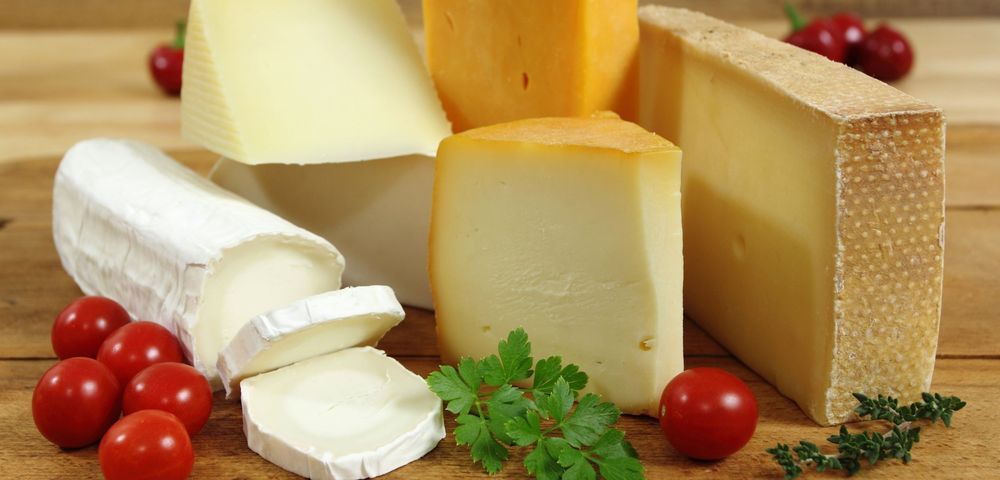
If you've made your way here, chances are you love cheese just as much as we do. But have you ever wondered if the cheese you're eating is the best choice for your health?
Today we'll dive into the nutritional characteristics of different types of cheese to help you make an informed decision wich one suits you best. Plus, we'll leave you with a list of the healthiets options that are also easy to find.
💡 Also, keep in mind that whit the Fitia app, you can access comprehensive nutritional information of thousands of foods, including their attributes (for example, you can see if theyre high in sodium, sugars, fiber, etc.). Download it for free here.
Cheese and its different varieties
"Cheese" refers to any product made by coagulating milk (or a derivative of it, such as skim milk, for example) and separating the whey(1).
Given that this definition is quite broad, it covers a wide array of products. Therefore, minor variations in processing can result in numerous types of cheese. Based on their characteristics, these can be classified as follows (2):
- Soft, semi-hard, hard or extra hard.
- Ripe or not (fresh, soft, semi-cured, cured, old and aged).
- With or without rind
- Brine-salted or directly salted
For instance, cheddar cheese is a hard, ripe cheese that can be found with or without rind; whereas cottage cheese is soft, unripe and without rind(2).
Moreover, the type of bacteria used incheese production also impact characteristics such as flavor, aroma and the presence or absence of holes.
Different cheese, different nutrient composition
The variations in cheeses mean that their nutritional makeup will also differ.
Generally speaking, all cheeses are sources of fats and proteins, though these nutrients can vary in proportions. Additionally, cheeses can differ in the content of certain key nutrients like sodium and lactose.
Typically, fresh and soft cheeses tend to be lower in calories and fats, while ripe and hard cheeses often have a higher concentration of nutrients (including fats, proteins and micronutrients).
How to choose the best cheese?
1. Go for cheeses lower in fats
We're aware that a diet high in saturated fats is linked to a greater risk of cardiovascular events, so it's advisable to cut down on this type of fat (3,4).
Most of the fats in cheese are saturated fats. Therefore, it's best to choose cheeses with lower fat content.
Cheeses with less fat (amounts per 100g of product):
- Cottage cheese: 4 grams of fat
- Ricotta cheese: 10 grams of fat
- Queso Fresco Light: 6 grams of fat
- Feta Cheese: 10 -21 gramms of fat
- Low-fat mozzarella Cheese: between 10 - 20 grams of fat
Avoid cheeses that are high in fats (amounts per 100g of product):
- Mascarpone: 47 grams of fat
- Cream cheese: 34 grams of fat
- Cheddar: 34 grams of fat
- Manchego: 34 grams of fat
- Gruyere: 32 grams of fat
- American cheese: 31.1 g fat
- Swiss cheese: 31 g fat
2. Make sure it has a good protein content.
Choosing cheeses high in protein can help you reach your daily requirements.
Cheeses with high total protein content (amounts in 100g of product):
- Romano: 32 grams of protein
- Gruyere: 30 grams of protein
- Parmesan: 28 grams of protein
- Swiss: 27 g protein
- Manchego: 26 g protein
- Provolone: 26 g protein
- Mantecoso: 25.2 g protein
However, you should keep in mind that cheeses with the highest net amount (total grams) of protein will also tend to be higher in fats and calories (you'll notice some repeats from the list of high-fat cheeses). You might consider consuming these types of cheese as an extra protein source, but in moderate quantities.
To avoid an excess fats, we recommend choosing cheeses that offer the highest protein content relative to their total calorie count (that is, those with a higher percentage of calories coming from protein). Here, you'll find repeats from the list of low-fat cheeses.
Cheeses with a high relative protein content:
- Cottage: (45% of its calories come from protein).
- Pear (34%)
- Reggianito ( 33%)
- Romano (33%)
- Mozzarella (30%)
- Pategras (30%)
3. Limit your sodium (salt) intake.
Sodium (the primary component of table salt) is an essential mineral for our body's function. However, consuming more than necessary can lead to serious health issues, such as the development of high blood pressure (5,6).
Globally, there is a tendency to consume excessive amounts of sodium (ultra-processed products contain quite high levels), so it is advised to measure its intake.
Cheese contributes to daily sodium consumption, so we recommend choosing those with lower sodium content per serving.
Cheeses with less sodium per serving (amounts per 30 g serving of cheese):
- Ricotta cheese: 33 mg of sodium (1.6% RDV*).
- Swiss: 56 mg of sodium (2.8% VDR*)
- Cottage: 95 of mg sodium (4.7% VDR*)
Cheeses with higher sodium content (amounts per 30 g serving of cheese):
- Roquefort: 543 mg of sodium (27.1% VDR*)
- Parmesan: 541 mg of sodium (27.1% VDR*)
- Romano: 430 mg of sodium (21.5% VDR*)
- American: 383.7 mg of sodium (25.1% VDR*)
- Processed cheese: 384 mg of sodium (19.2% RDA*)
*Daily Value (DV) based on the recommended limit by the World Health Organization: 2000 mg (7).
4. If you're aiming to manage your calorie intake, go for fresh cheeses.
The lower the fat content in cheese, the lower its calorie content will be. In this sense, if you're looking to control your calorie intake, we suggest opting for the low-fat fresh cheeses we mentioned earlier (such as cottage cheese, ricotta, low-fat mozzarella, low-fat fresh cheese).
Moreover, these cheeses also tend to have a higher water content, which means they'll provide fewer calories in a larger serving. This can lead to a greater feeling of fullness and help manage how much you eat.
💡 Remember that with the Fitia app you can get a personalized meal plan for weight loss according to your characteristics and food preferences. Download it for free here.
5. If you are lactose intolerant, choose lactose-free cheeses.
If you have difficulty digesting lactose, you've likely steered clear of dairy products (or only consume lactose-free versions). Luckily, there are types of cheese that have low or no lactose content.
Generally, aged cheeses contain lower amounts of lactose than fresh cheeses, as the lactose is consumed by the cheese's bacteria during the aging process. Additionally, some types of cheese undergo an extra washing step in their processing that further reduces the total lactose content (8,9).
However, remember that ripened cheeses tend to have more fat, so we recommend moderating their consumption.
Cheeses with lower lactose content (amounts per 100g of product):
5 Healthy Cheeses
After considering each recommendation, here's a list of 5 easily available cheeses that meet the criteria for a healthier cheese option.
Cottage cheese
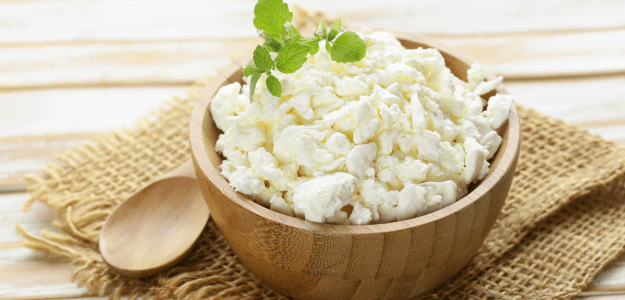
In 100 grams of cottage cheese you find:
- Calories: 98 kcal
- Proteins: 11.1 g
- Fat: 4 g
- Saturated fats: 1.7 g
- Carbohydrates: 3.4 g
- Lactose: 2.67 g
- Sodium: 315 mg (16% of Recommended Daily Value)
- Calcium: 83 mg (8.5% of the Recommended Daily Value)
2. Ricotta cheese
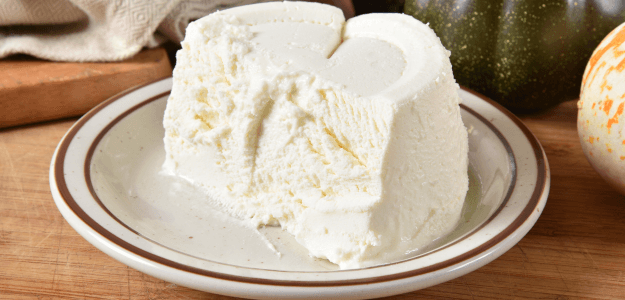
In 100 grams of ricotta cheese or cottage cheese you find:
- Calories: 150 kcal
- Protein: 8 g
- Fat: 10 g
- Saturated fats: 7 g
- Carbohydrates: 7.3 g
- Sodium: 110 mg (5% of the Recommended Daily Value)
- Calcium: 224 mg (22.4% of the Recommended Daily Value)
3. Queso Fresco Light:
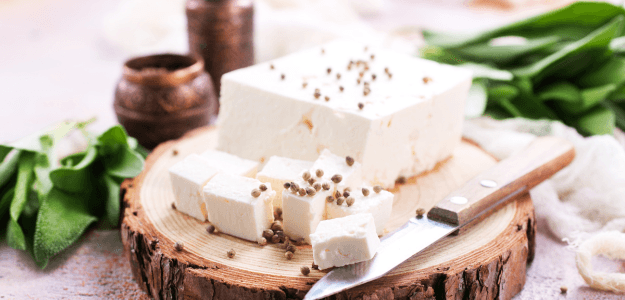
In 100 grams of fresh or white cheese you find:
- Calories: 154 kcal
- Protein: 19 g
- Fat: 6 g
- Saturated fat: 3 g
- Carbohydrates: 4 g
- Lactose: 3 g
- Sodium: 297 mg (35% of Recommended Daily Value)
4. Mozzarella Cheese
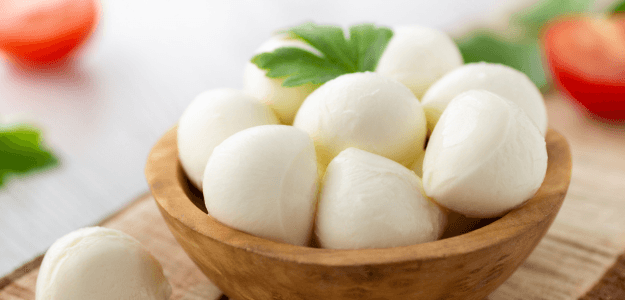
In 100 grams of mozzarella cheese you find:
- Calories: 299 kcal
- Protein: 22.2 g
- Fat: 22.1 g
- Saturated fat: 13.9 g
- Carbohydrates: 2.4 g
- Lactose: 0 g
- Sodium: 486 mg (24% of the Recommended Daily Value)
- Calcium: 505 mg (50.5% of the Recommended Daily Value)
5. Feta Cheese
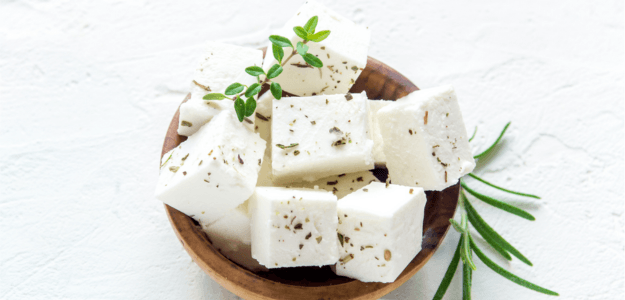
In 100 grams of feta cheese you find:
- Calories: 265 kcal
- Protein: 14.2 g
- Fat: 21.5 g
- Saturated fat: 13.3 g
- Carbohydrates: 3.9 g
- Sodium: 1139 mg (57% of the Recommended Daily Value)
- Calcium: 493 mg (49.3% of Recommended Daily Value)
References
- FAO. GENERAL STANDARD FOR CHEESE CXS 283-1978. Codex Alimentarius. 2021.
- Nutrition Division. Codex Alimentarius - Leche y Productos Lácteos Segunda edición. FAO/WHO. 2011. ISBN: 978-92-5-305837-2.
- Fats and fatty acids in human nutrition: report of an expert consultation. FAO Food and Nutrition Paper 91. Rome: Food and Agriculture Organization of the United Nations; 2010.
- Guidelines: Saturated fatty acid and trans-fatty acid intake for adults and children. Geneva: World Health Organization; 2018 (Draft issued for public consultation in May 2018).
- Mente A, O'Donnell MJ, Rangarajan S, McQueen MJ, Poirier P, Wielgosz A, Morrison H, Li W, Wang X, Di C, Mony P, Devanath A, Rosengren A, Oguz A, Zatonska K, Yusufali AH, Lopez-Jaramillo P, Avezum A, Ismail N, Lanas F, Puoane T, Diaz R, Kelishadi R, Iqbal R, Yusuf R, Chifamba J, Khatib R, Teo K, Yusuf S; PURE Investigators. Association of urinary sodium and potassium excretion with blood pressure. N Engl J Med. 2014 Aug 14;371(7):601-11. doi: 10.1056/NEJMoa1311989. PMID: 25119606.
- Filippou CD, Tsioufis CP, Thomopoulos CG, Mihas CC, Dimitriadis KS, Sotiropoulou LI, Chrysochoou CA, Nihoyannopoulos PI, Tousoulis DM. Dietary Approaches to Stop Hypertension (DASH) Diet and Blood Pressure Reduction in Adults with and without Hypertension: A Systematic Review and Meta-Analysis of Randomized Controlled Trials. Adv Nutr. 2020 Sep 1;11(5):1150-1160. doi: 10.1093/advances/nmaa041. PMID: 32330233; PMCID: PMC7490167.
- WHO. Guideline: Sodium intake for adults and children. Geneva, World Health Organization (WHO), 2012.
- Dekker PJT, Koenders D, Bruins MJ. Lactose-Free Dairy Products: Market Developments, Production, Nutrition and Health Benefits. Nutrients. 2019 Mar 5;11(3):551. doi: 10.3390/nu11030551. PMID: 30841534; PMCID: PMC6471712.
- Hou J, McSweeney PL, Beresford TP, Guinee TP. Effect of curd washing on the properties of reduced-calcium and standard-calcium Cheddar cheese. J Dairy Sci. 2014 Oct;97(10):5983-99. doi: 10.3168/jds.2014-8051. Epub 2014 Aug 14. PMID: 25129501.
Related articles
 Foods
FoodsTop 5 Low Calorie Cheeses Your Nutrition Tracker Will Approve
Discover the best low-calorie cheeses for weight loss, complete with macros, tips, and easy recipes. Find every cheese listed inside Fitia.
Read article Foods
Foods6 Tips for Breaking Your Fast in a Healthy Way
Discover 6 tips to break your fast the healthy way. Learn what to eat, what to avoid, and start your day with energy.
Read article Foods
FoodsHow to Weigh Food: Raw or Cooked?
Explore how to weigh raw and cooked foods for an accurate diet according to your fitness goals.
Read article