Best Calorie Counter App for Muscle Gain in the US (2026): 4 Apps Compared for Lifters
The 4 best calorie counter apps for US lifters in 2026, compared on macros, database, adaptation, and meal planning.
- Published
- 8 min read
- 8 min read

TL;DR: Most US calorie counter apps were built for weight loss, which means they handle muscle gain badly. The right pick for a US lifter or bodybuilder in 2026 nails four things: macro tracking that highlights protein, a verified US food database, adaptation as your bodyweight climbs, and surplus-friendly meal planning. This guide compares four US-available apps that actually deliver on all four, with the research behind each pick.
Table of contents
- What makes a calorie counter actually useful for muscle gain
- The 4 best calorie counter apps for muscle gain in the US (2026)
- Quick comparison table
- A coach's note: what actually moves the needle for US lifters
- FAQ
What makes a calorie counter actually useful for muscle gain
Most calorie counters in the US take a weight-loss-first approach that targets the majority user type in the region. By our own internal data, 79.7% of active users select "lose weight" as their goal. Muscle gain runs in the opposite direction: lifters and athletes are trying to hit a daily protein floor, sustain a calorie surplus most days, and stay there long enough for their hard work to translate into actual lean mass gains.
That changes what you need from a tracker. Specifically:
- Accurate macro tracking, especially protein. Although there's been a lot of debate lately around protein requirement floors for muscle gain, the truth is that a large body of research in resistance-trained populations shows meaningful gains in muscle strength continue up to about 1.5 grams of protein per kilogram of bodyweight per day (Tagawa et al., 2022). Depending on your size, that often translates into quantities most people won't reach by just eating normally throughout the day without tracking. Hitting that floor consistently requires more precision than photo-logging-only apps can usually deliver.
- A verified food database that handles common US foods. We're focusing on the US here. Lifters eat a lot of repeat staples (oats, rice, eggs, ground beef, chicken thighs, whey, peanut butter), which means they need an app whose database handles those with verified entries from most if not all common brands available across the nation, rather than crowdsourced approximations where the same food returns five different calorie counts.
- Adaptation as your bodyweight climbs. Your maintenance calories rise as you gain lean mass. An app that locks you into a static calorie target eventually stops producing a surplus and you stall without knowing why. Quality apps for muscle gain recalibrate as your weight changes.
- A surplus-friendly meal plan or template system. Eating in a surplus is harder than people think. A 3,000-calorie day takes deliberate planning. Apps that generate meal plans for surplus targets, or let you save high-calorie staples as templates, save a lot of time.
With that, here are the four US-available apps for 2026 that actually deliver on these.
The 4 best calorie counter apps for muscle gain in the US (2026)
1. Fitia (4.9 ⭐ App Store Rating)
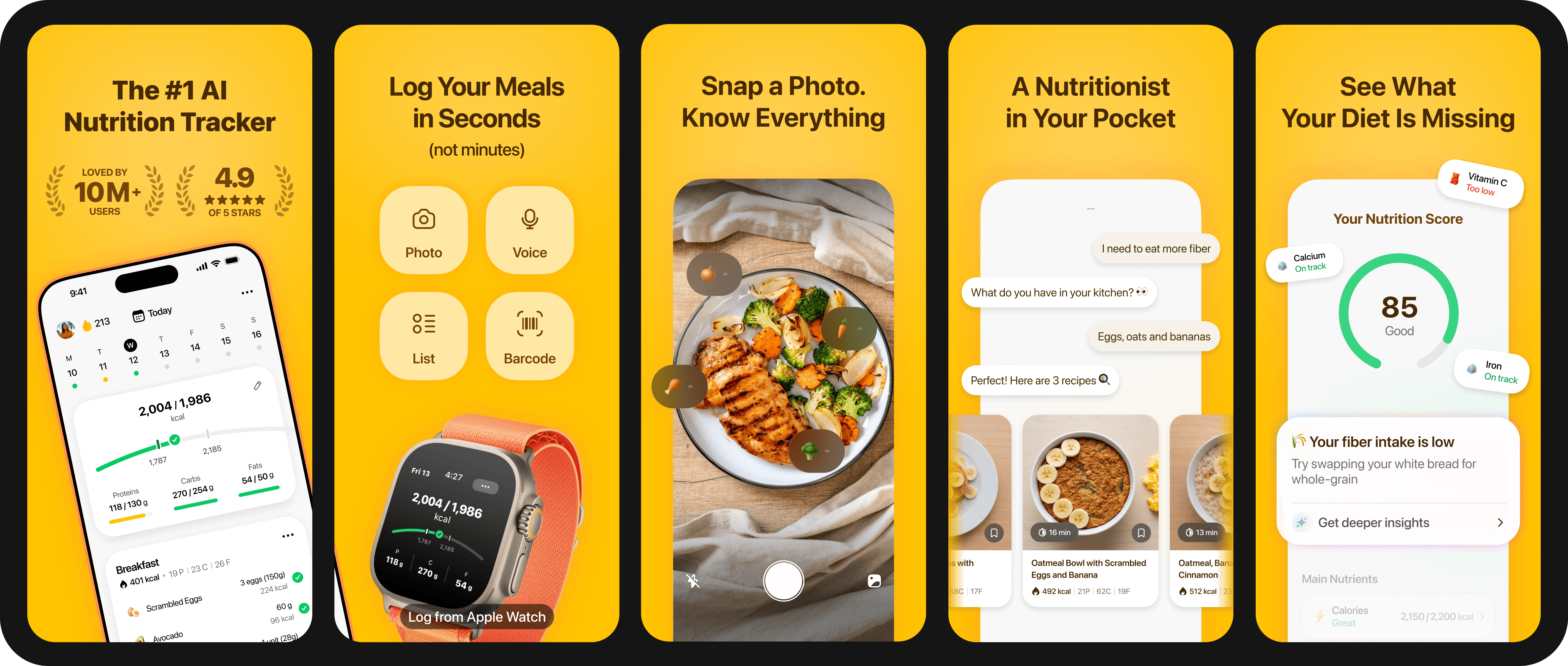
A well-established nutrition giant outside the US that has spent the last 2 years building the best version of its app solely focused on the US public. It combines an optimized AI calorie tracker with full meal planning, paired with a verified US food database. Fitia builds the right macros and meal plan for you based on your goal, pace, dietary pattern, food preferences, and activity level, and adapts it based on how you progress through the weeks.
- Best for: US lifters who want surplus tracking without the daily decision of figuring out what to eat. The meal plan handles the difficulties of eating in a surplus, the AI Coach answers all sorts of questions, and the plan recalibrates as your bodyweight climbs.
- Standout features for muscle gain: Surplus-friendly meal plans, verified US food database built in-house, macro recalibration on weight changes, 24/7 AI Coach for protein and macro questions, Instacart export for groceries, family-sync so you and your training partner can follow plans tied to each person's goals.
2. Carbon Diet Coach (4.8 ⭐ stars App Store Rating)
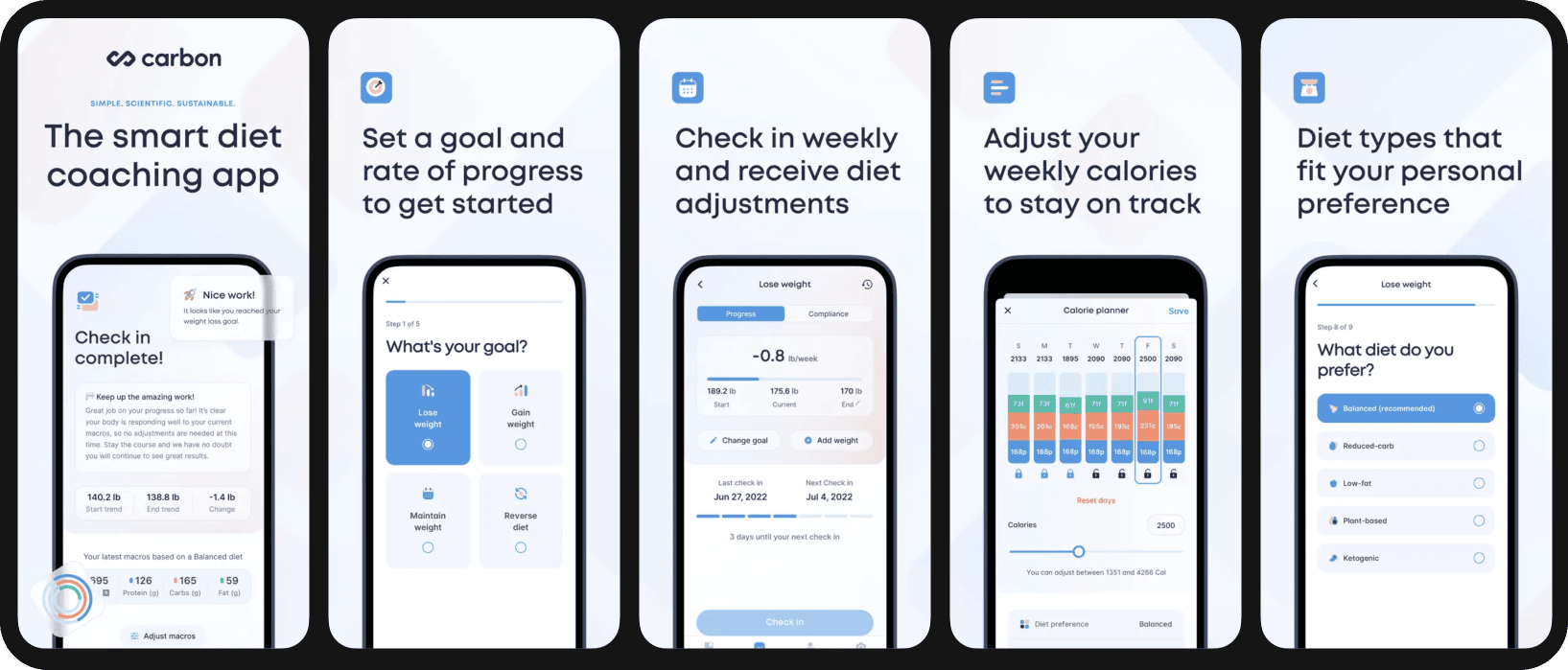
Built by Dr. Layne Norton (PhD, Nutritional Sciences), Carbon adjusts your daily calories and macros automatically each week based on how your bodyweight is responding, using its creator's evidence-based methodology. The app sticks to the formula that adaptive coaching apps in this category lean on.
- Best for: US lifters who like Dr. Layne Norton's methodology and aren't bothered by using a basic tracker (no AI logging included).
- Standout features for muscle gain: Adaptive weekly recalibration based on weight trend, calorie planning for higher and lower calorie days.
3. MacroFactor (4.8 ⭐ stars App Store Rating)
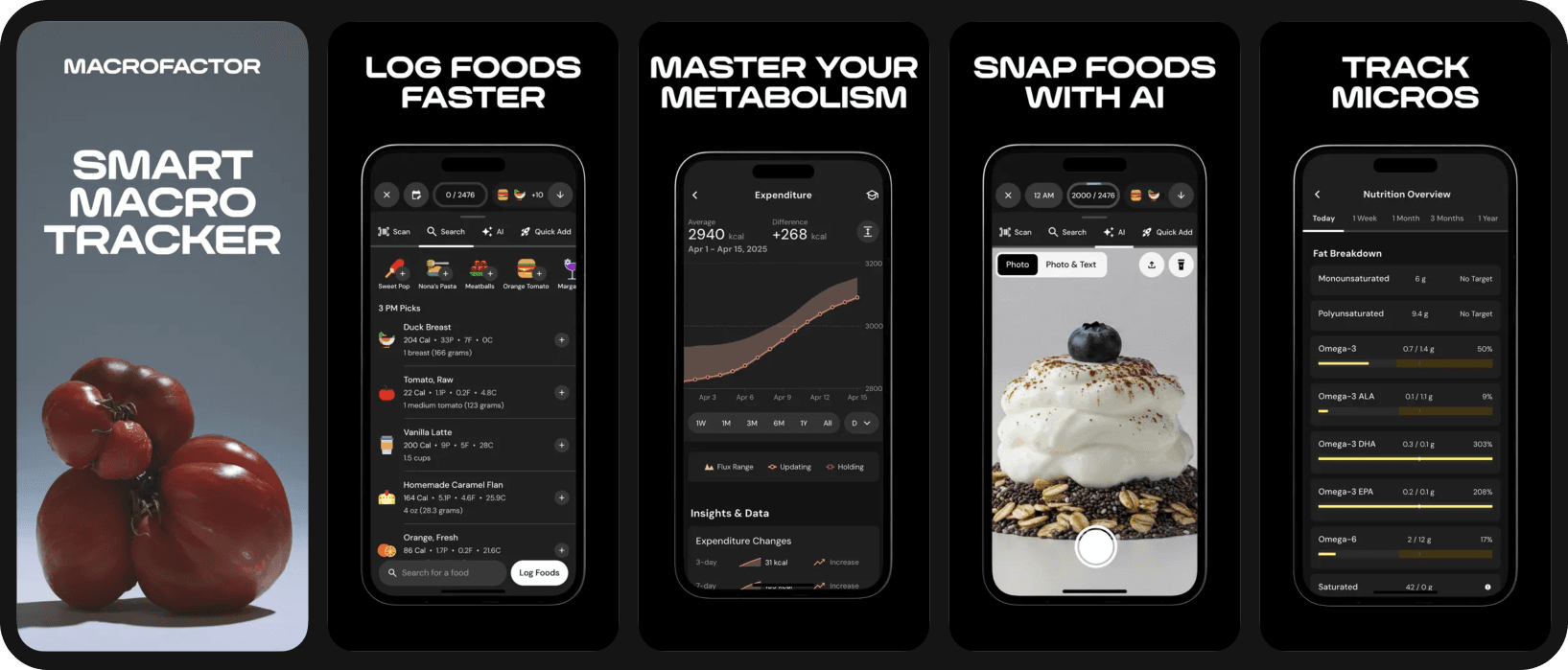
Unlike Carbon Diet Coach, instead of following a specific person's methodology, MacroFactor's macro adjustment is algorithmic in nature, implying that the user will have to log their data consistently so the algorithm can make the best adjustments possible.
- Best for: US lifters who want adaptive macros based on an algorithmically calculated TDEE.
- Standout features for muscle gain: Adaptive weekly macro recalibration based on weight trend, verified database, no manual TDEE estimation required.
4. RP Diet Coach and Planner (Renaissance Periodization) (4.4 ⭐ App Store Rating)
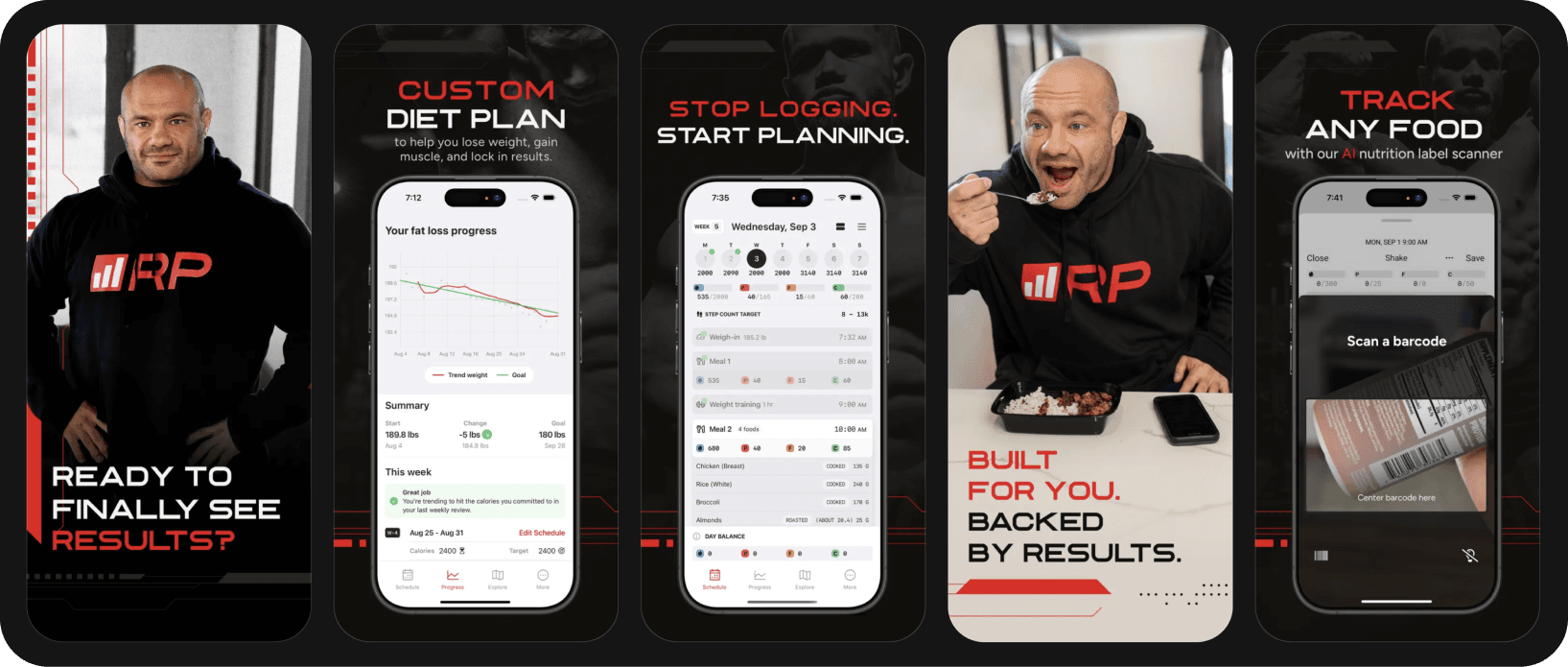
Built by the Renaissance Periodization team (Dr. Mike Israetel and the RP coaches), RP Diet Coach is the nutrition arm of the RP ecosystem, with an emphasis on periodized meal planning across phases (mass gain, maintenance, cut).
- Best for: US lifters who like Dr. Mike Israetel's methodology and want a diet built around a structured, meal-by-meal plan.
- Standout features for muscle gain: Personalized calories and macros based on your body and fitness goals, meal timing guidance, flexible scheduling.
Quick comparison table
| App | Best for | Macro adaptation | Database | Meal planning | Price |
|---|---|---|---|---|---|
| Fitia (4.9 ⭐) | US lifters wanting surplus meal plans and adaptive macros built in | Yes, recalibrates on weight changes | Verified US (in-house) | Yes, surplus-friendly | Free tier + Premium |
| Carbon Diet Coach (4.8 ⭐) | Fans of Dr. Layne Norton's methodology | Yes, adaptive weekly | Verified (FatSecret) | No | Paid subscription |
| MacroFactor (4.8 ⭐) | Algorithm-driven adaptive macros | Yes, algorithmic weekly | Verified | No | Paid subscription |
| RP Diet Coach (4.4 ⭐) | Fans of Dr. Mike Israetel's methodology, structured meal-by-meal plans | Phase-based (mass gain, maintenance, cut) | Undefined | Yes, phase-based | Paid subscription |
Bulking in 2026? Start Fitia's free trial and you'll get the AI Coach, a verified US food database, surplus-friendly meal planning, and macros that recalibrate as you grow.
A coach's note: what actually moves the needle for US lifters
The patterns that separate a successful muscle gain phase from a frustrating one usually come down to two things most people get wrong.
The first is rate of gain. The common bulking error is eating in a 600 to 800 calorie surplus and gaining 1.5 to 2 pounds a week, which for most natural US lifters past the beginner phase produces too much fat gain for the muscle gained.
A modest 200 to 400 calorie surplus producing about 0.25% to 0.4% of body weight gain a week is the sweet spot for minimizing fat gain while still adding lean mass. Pick an app that helps you stay in that range, and trust the slower rate even when it feels too slow to matter.
The second is consistency. Tracking 5 to 7 days a week, every week, over months will outperform tracking perfectly for two weeks and then disappearing for three. If you can only commit to logging four days a week, log those four days every week. The lifters who get to a meaningful bulk at the end of six months are the ones who showed up consistently, both to the gym and when opening their calorie tracker.
FAQ
How much protein do I need for muscle gain?
Research in lifters doing resistance training supports a daily protein intake of about 1.5 to 1.6 grams per kilogram of bodyweight per day, or roughly 0.7 grams per pound (Tagawa et al., 2022; Bagheri et al., 2023). For a 180-pound US lifter, that's about 122 to 130 grams a day. Going higher (e.g., 2 g/kg) doesn't appear to add meaningful gains in strength based on the dose-response meta-analyses, but it's not harmful for healthy adults either.
Does it matter which app I use as long as I'm tracking?
Less than people think. A 2022 systematic review of 34 randomized app-based interventions found that the number and type of app features was not associated with weight outcomes (Antoun et al., 2022). What mattered was the combination of consistent tracking and a behavioral support layer. The best app for muscle gain is the one you'll actually open every day for a long bulk, ideally paired with some form of accountability.
Can I gain muscle without tracking calories?
Possible, but harder. A modest calorie surplus is required for muscle gain in most adults past the beginner phase. Without tracking, most US lifters either undereat (and stall their gains) or overeat (and gain more fat than muscle). Tracking gives you the data to course-correct. Even abbreviated tracking strategies produce meaningful results compared to no tracking, based on weight management research (Raber et al., 2021).
How fast should I gain weight on a bulk?
For most natural US lifters past the beginner phase, about 0.25% to 0.4% of body weight per week. That typically means a 200 to 400 calorie daily surplus above maintenance. Gaining faster than that produces a higher fat-to-muscle ratio in what you add. Apps with adaptive recalibration (like Fitia) can help hold you in this range automatically.
About the Author
 | Fabrizio Baca Olcese is a nutritionist from Universidad Peruana de Ciencias Aplicadas (UPC) and a NASM-certified personal trainer, with five years of experience in nutrition, product development, and user growth at the intersection of health and technology. As Fitia's first hire and part of the founding team, he has helped scale the company to over 10 million monthly active users across 17 countries. At Fitia, he works as Senior Business Development, leading user acquisition and B2B partnerships while combining his nutrition background with his drive to make healthy living more accessible. |
References
- Tagawa, R., Watanabe, D., Ito, K., et al. (2022). Synergistic Effect of Increased Total Protein Intake and Strength Training on Muscle Strength: A Dose-Response Meta-analysis of Randomized Controlled Trials. Sports Medicine - Open, 8(1), 110. https://doi.org/10.1186/s40798-022-00508-w
- Bagheri, R., Shakibaee, A., Camera, D. M., et al. (2023). Effects of 8 weeks of resistance training in combination with a high protein diet on body composition, muscular performance, and markers of liver and kidney function in untrained older ex-military men. Frontiers in Nutrition, 10, 1205310. https://doi.org/10.3389/fnut.2023.1205310
- Antoun, J., Itani, H., AlArab, N., & Elsehmawy, A. (2022). The Effectiveness of Combining Nonmobile Interventions With the Use of Smartphone Apps With Various Features for Weight Loss: Systematic Review and Meta-analysis. JMIR mHealth and uHealth, 10(4), e35479. https://doi.org/10.2196/35479
- Payne, J. E., Turk, M. T., & Kalarchian, M. A. (2021). Adherence to mobile-app-based dietary self-monitoring: Impact on weight loss in adults. Obesity Science & Practice, 8(3), 279–288. https://doi.org/10.1002/osp4.566
- Raber, M., Liao, Y., Rara, A., et al. (2021). A systematic review of the use of dietary self-monitoring in behavioural weight loss interventions: delivery, intensity and effectiveness. Public Health Nutrition, 24(17), 5885–5913. https://doi.org/10.1017/S136898002100358X
Related articles
 Fat Loss
Weight Loss Calorie Chart (2026): How Many Calories to Eat by Body Weight, Sex, and Activity
See how many calories to eat to lose weight, with simple charts by body weight and activity, plus why your target changes as you go.
Read article
Best Online Nutrition Coach in the US (2026): What to Look For Before You Pay
Online nutrition coaching in the US 2026: three tiers, what the research says, and the red flags to spot before you pay for an app or coach.
Read article
The Lazy Person's Guide to Food Tracking in the US (2026)
Four levels of low-effort food tracking for busy US adults, from photo logging to automated meal plans. Pick the one you can actually keep doing daily.
Read article