
May 16, 2026
The best MacroFactor alternatives in 2026
TL;DR: MacroFactor's adaptive algorithm is great. What it never does is tell you what to actually cook. This guide compares five alternatives, Fitia, MyFitnessPal, Lifesum, Yazio and Eat This Much, ranked by how much daily friction they remove. Fitia leads because it's the rare app that keeps the adaptive layer MacroFactor is loved for and adds meal planning on top.
Table of Contents
- Why look for an alternative to MacroFactor in 2026
- The 5 best MacroFactor alternatives in 2026
- Fitia
- MyFitnessPal
- Lifesum
- Yazio
- Eat This Much
- Summary table
- Why Fitia is the most complete MacroFactor alternative in 2026
- FAQs
Why look for an alternative to MacroFactor in 2026
MacroFactor's pitch is well known by now: log your food, log your weight, and let the algorithm quietly recalculate your calorie target every week.
What it deliberately doesn't do is tell you how to get to those targets. There's no meal plan, no recipe library that scales to your macros, no "you have 38g of protein left, here are five dinners that hit it." For disciplined trackers who already know what to cook, that's fine. For everyone else, the gap shows up around the third "what should I actually eat tonight?" stare into the fridge.
That gap is the real reason to look at alternatives in 2026. MacroFactor is arguably one of the best in the world at the nutrition math, but the math is only half the job. The other half is turning that number into dinner, and that half is where most people actually struggle.
So the useful question isn't "which app has a better algorithm than MacroFactor?" Very few do, and that's not where the friction is. The question is "which app takes a calorie target and turns it into a meal you actually want to eat, on a Wednesday, with the groceries you already have?" Offloading those daily food decisions is what frees up the mental bandwidth that goes back into training or work.
Below are the five alternatives I'd point a friend toward, starting with the one I'd recommend first to anyone walking out of MacroFactor asking "okay, now what?"
The 5 best MacroFactor alternatives in 2026
1. Fitia
Quick Overview
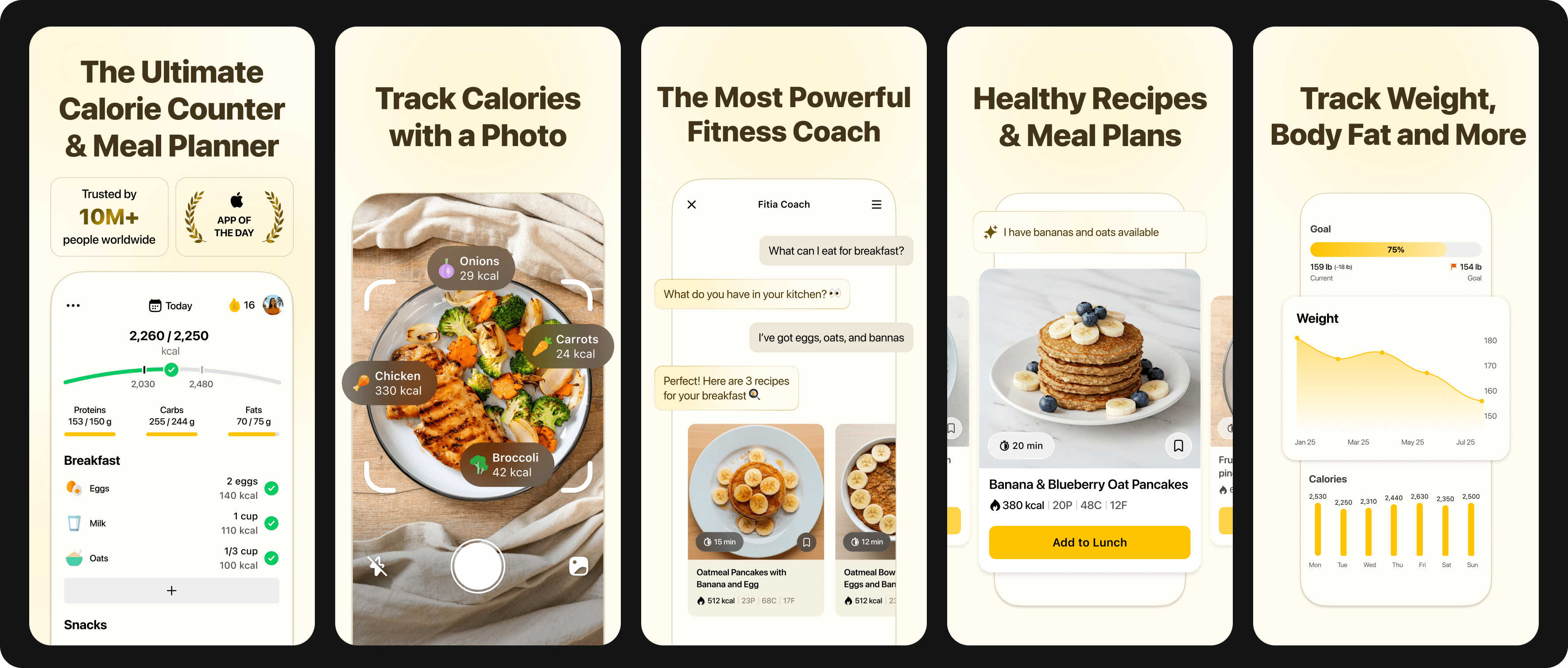
Fitia is the rare app that pairs adaptive macro targets with fully personalized meal plans, AI-powered logging, and a nutrition-professional-verified food database. Where MacroFactor stops at "here's your target," Fitia hands you a weekly plan that hits the target, a grocery list to buy it, and a 24/7 AI coach to answer the inevitable "is this enough protein?" question at 9 p.m. on a Tuesday. With more than 10 million users and an average 4.9/5 rating across the App Store and Google Play, it's currently the fastest-growing nutrition app in the world.
Best For
Fitness enthusiasts who want a good balance of nutrition guidance and tracking depth. Especially strong for home cooks, anyone who eats culturally diverse food (the database has exceptional Latin American, Spanish, Caribbean, and Mediterranean coverage), and families who want shared accounts. It works across goals like cuts, lean bulks, and recomp.
Pros
- Adaptive algorithm built on 150+ scientific studies. Calories and macros auto-adjust based on real weight progress.
- Genuinely personalized meal plans. The plan respects your calorie target, macro split, dietary restrictions, and food preferences.
- AI logging that works on real food. Photo, voice, and natural-language text, all trained on the verified database.
- Verified food database, reviewed by nutrition professionals. Every entry is checked before publication, which solves the "same banana, five different calorie counts" problem crowdsourced apps still have.
- Cultural and regional accuracy. Country-specific products and authentic coverage of cuisines a US-centric database fumbles.
- Automatic shopping list. The weekly plan becomes a smart grocery list.
- Built-in extras. Intermittent fasting tracker, body composition tracking, progress photos, 20+ nutrient tracking, Apple Health and Health Connect sync, and a Fitia Social accountability layer.
Cons
- Premium required for meal planning. The free tier handles basic logging well, but adaptive coaching, AI logging, and meal planning sit behind Premium.
- Available in English and Spanish only.
Pricing
Free version available. Premium: $19.99/month or $59.99/year. The Family Plan is available for $89.99 annually, offering shared access and 75 % savings compared to individual plans (2-6 members).
2. MyFitnessPal
Quick Overview
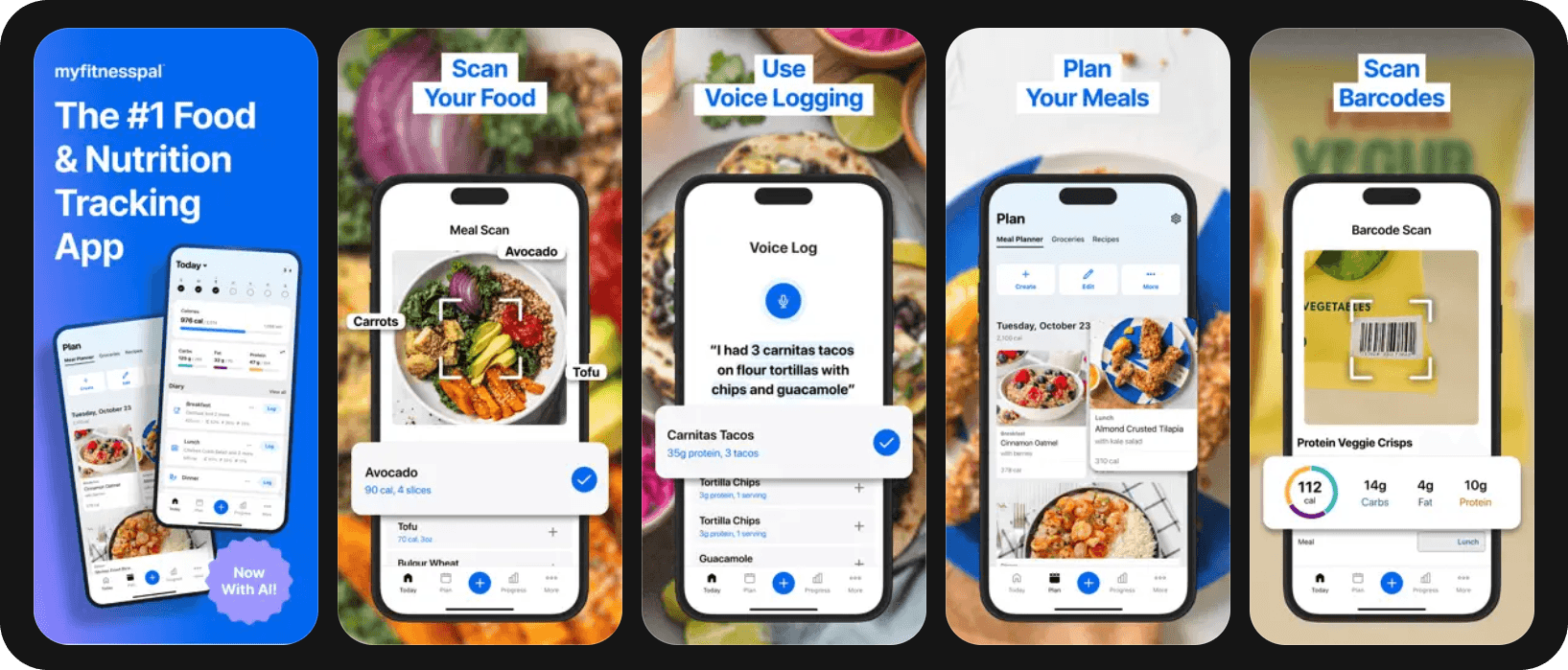
MyFitnessPal's food database is one of the largest in the market, and recent updates added AI meal scanning, voice logging, and smarter recipe import.
Best For
US-based users who eat heavily branded or restaurant food, value a massive crowd-sourced database, and use multiple connected fitness devices.
Pros
- Large database.
- Deep integration ecosystem. Apple Health, Garmin, Fitbit, Oura, and dozens of fitness apps.
- Has a meal planner (on the top tier). The Premium+ Meal Planner builds menus from 1,500+ recipes and auto-generates grocery lists, so MyFitnessPal does cover the "what do I cook" layer, just not at the standard price.
- 2026 AI features. Photo logging, voice input, and personalized meal suggestions closed some of the gap with newer apps.
Cons
- Crowdsourced accuracy issues. Duplicate entries are common; unverified entries float around without the verified check.
- Meal planning is locked to the priciest tier. The Meal Planner (1,500+ recipes, auto grocery lists) requires Premium+, not standard Premium, and is only available in select regions (US, UK, Canada, Ireland, New Zealand, Australia).
Pricing
Free with ads. Premium: $19.99/month or $79.99/year. Premium+ (meal planner included): $24.99/month or $99.99/year.
3. Lifesum
Quick Overview
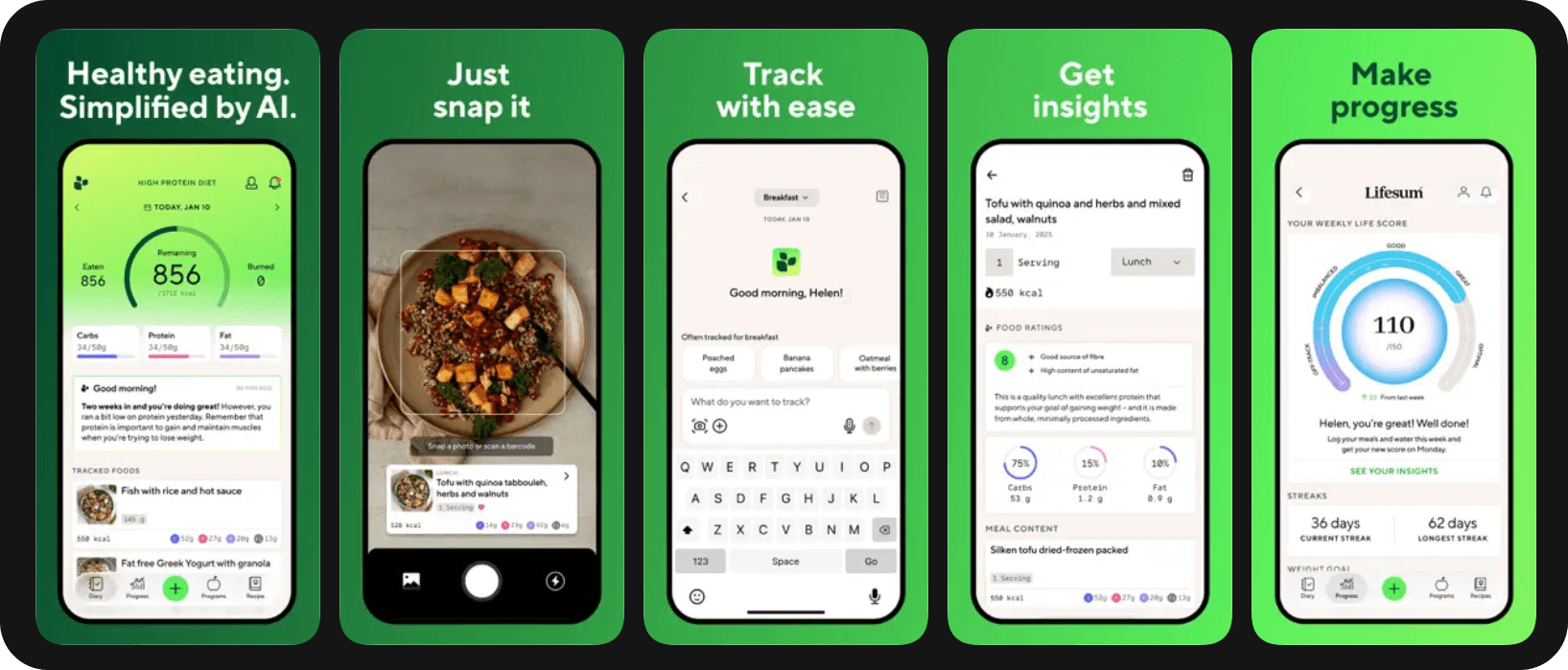
Lifesum's angle is dietary patterns. Instead of dialing in custom macro grams, you pick a diet style — Mediterranean, keto, high-protein, Scandinavian, plant-based — and the app structures tracking and meal suggestions around that pattern.
Best For
Beginners and pattern-followers who respond better to "eat this style of food" than to "hit these specific numbers."
Pros
- Built-in plans aligned to named diets. Keto, Mediterranean, high-protein and more — removes a lot of decision fatigue for newer users.
- Solid habit tracking. The "Life Score" rates eating, hydration and activity, and gamifies consistency without feeling cheap.
Cons
- Plans are templates. They don't adapt weekly to your weigh-ins the way Fitia's or MacroFactor's targets do.
- Limited macro and nutrient precision. Tracks roughly 22 nutrients on an unverified database; restrictive if you want to dial in exact grams or monitor micronutrients.
Pricing
Free version available. Premium: $18.49/month or $99.99/year.
4. Yazio
Quick Overview
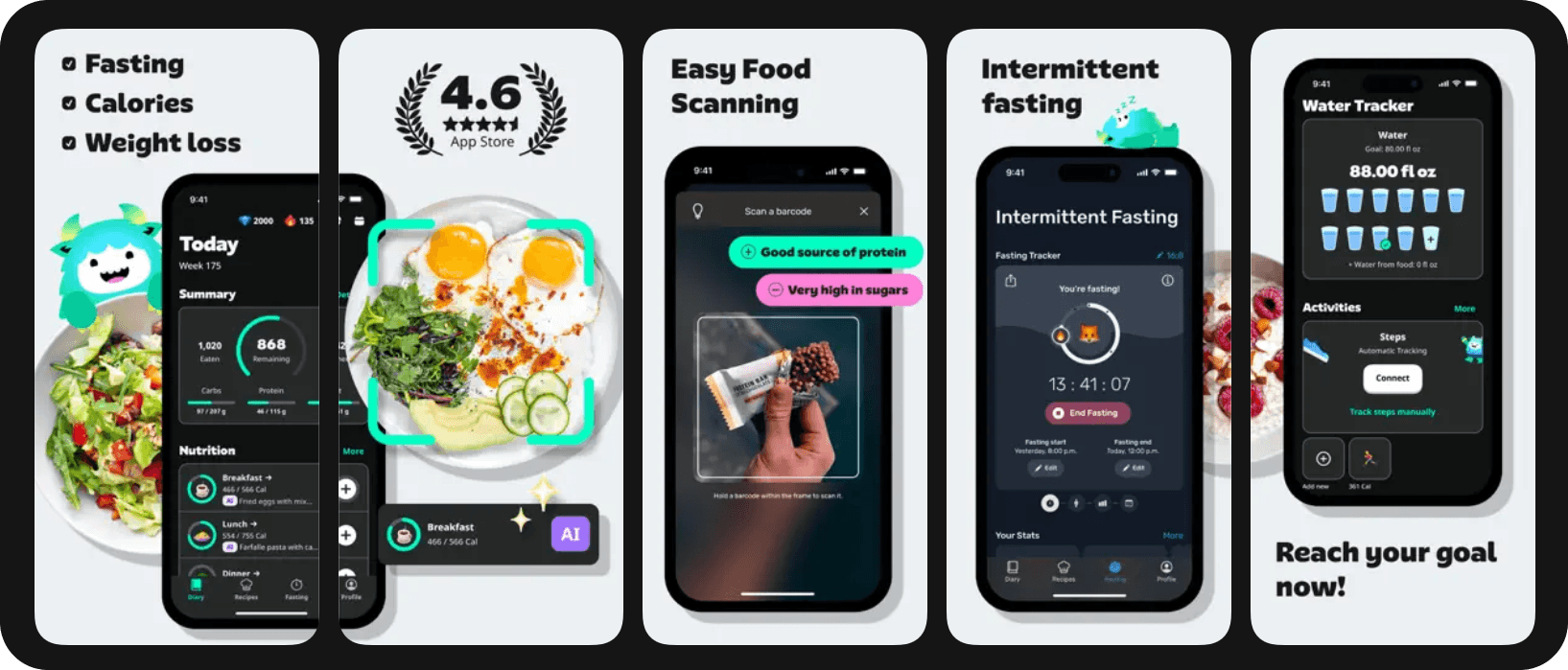
Yazio combines calorie and macro tracking with an intermittent fasting module and guided meal plans, and its database has noticeably better European packaged-food coverage than US-built competitors.
Best For
Users who combine macro tracking with intermittent fasting, anyone eating predominantly European foods, and people who want guided meal plans without enterprise pricing.
Pros
- Well-designed IF tracker. Presets for 16:8, 18:6, 20:4, 5:2, and OMAD with clear visualization alongside your eating window.
- Solid guided meal plans. Tied to common goals (low-carb, high-protein, vegetarian), with a 2,000+ recipe library created and tested by its nutrition team.
- Strong European database. German, French, and Italian packaged goods are accurately represented.
Cons
- Shallower nutrient depth than the specialists. Typically 12–15 fields rather than the 20+ in Fitia.
- The best features are paywalled. recipes, fasting tools, and AI logging all require PRO.
Pricing
Free version available (limited). PRO: ~$47.90/year.
5. Eat This Much
Quick Overview
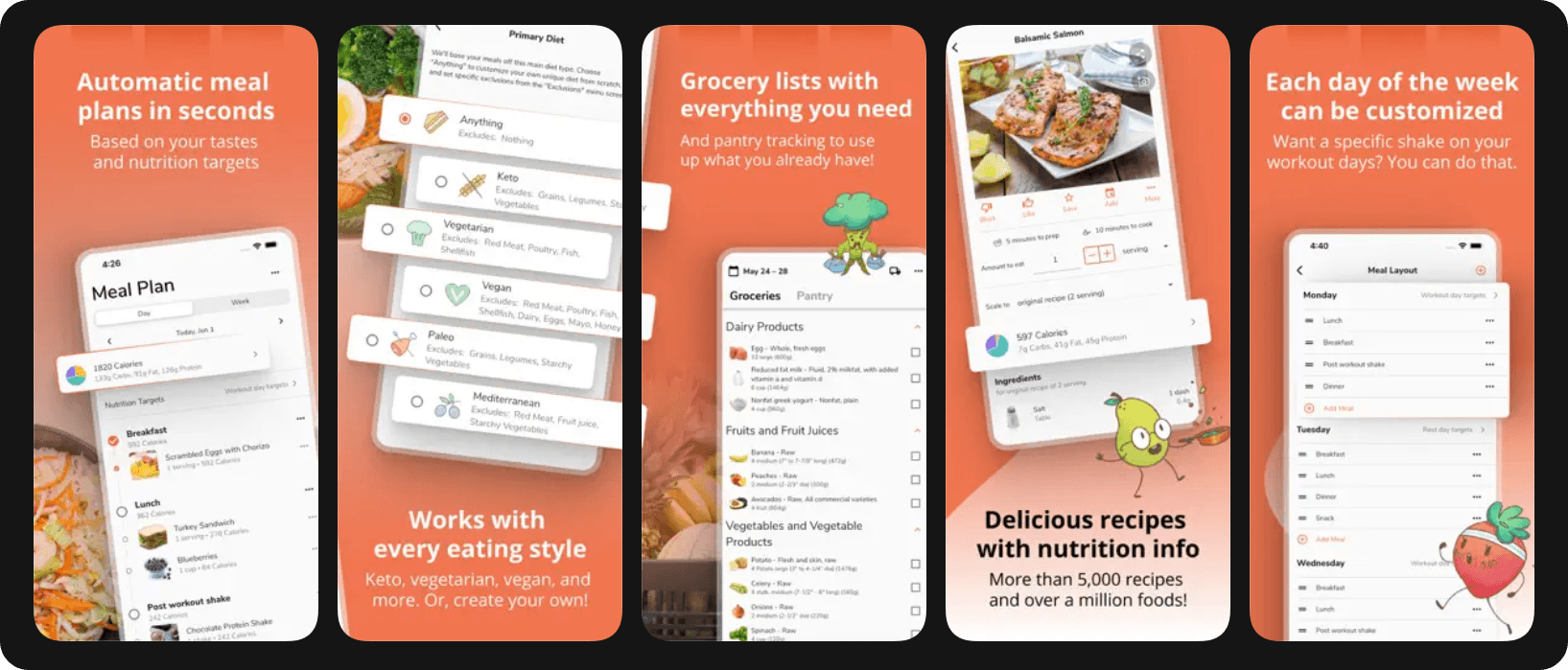
Eat This Much is the point solution for people who want meal planning first and tracking second. You set your calorie target, macro split, dietary preferences, and meals per day, and it generates a full plan you can regenerate, swap, or refine.
Best For
Home cooks and meal preppers who already know their macro targets and just need an automated planner to translate them into actual meals.
Pros
- Automated plan generation. Respects your macro split, calorie target, dietary restrictions, and dislikes.
- Grocery list automation and recipe scaling. Plus meal-frequency control (3 meals, 5 meals, snacks included).
Cons
- No adaptive algorithm. You bring the target; it builds the plan. Pair it with another app for auto-adjustment.
- Minimal tracking. A planner that happens to have a logger, not the other way around.
Pricing
Free version (basic plans). Premium: $14.99/month or $60/year.
Summary table
| App | Starting Price | Best For | Notable Features |
|---|---|---|---|
| Fitia | $19.99/mo | Adaptive macros + meal plans + cultural food coverage | Verified 10M+ database, AI photo/voice logging, adaptive meal plans, AI Coach, IF tracker |
| MyFitnessPal | $19.99/mo | US users with huge variety of branded foods | Large item database, broad integrations, 2026 AI features |
| Lifesum | $18.49/mo | Diet-pattern followers | Themed plans (keto, Mediterranean), Life Score, clean UI |
| Yazio | ~$47.90/yr | Intermittent fasting + European foods | IF tracker, guided meal plans, strong EU database |
| Eat This Much | $14.99/mo | Automated meal planning | Plan generation, recipe scaling, grocery list |
Why Fitia is the most complete MacroFactor alternative in 2026
Each app above can work — the real question is which one removes enough daily friction that you're still opening it at month six.
For years, the MacroFactor-alternatives conversation was dominated by a single question: "which app has the best adaptive algorithm?" That's still a great question. It's just no longer the only one. In 2026, the next layer of differentiation is whether the app can take that calorie target and turn it into a meal you actually want to eat.
That's the layer Fitia owns. It's the only app in its class that combines a fully dietitian-verified food database, AI-based logging, an adaptive algorithm built on 150+ studies, fully personalized meal plans with one-tap macro-matched swaps, an automatic shopping list, and a 24/7 AI coach — all without requiring multiple subscriptions, and at a price ($59.99/year) that undercuts most competitors.
MacroFactor remains a superb tool for one part of the problem. Fitia solves the whole problem in one app. If that trade fits how you want to track, give it a try. Download Fitia now.
About the Author
 | Fabrizio Baca Olcese is a nutritionist from Universidad Peruana de Ciencias Aplicadas (UPC) and a NASM-certified personal trainer, with five years of experience in nutrition, product development, and user growth at the intersection of health and technology. As Fitia's first hire and part of the founding team, he has helped scale the company to over 10 million monthly active users across 17 countries. At Fitia, he works as Senior Business Development, leading user acquisition and B2B partnerships while combining his nutrition background with his drive to make healthy living more accessible. |
Fitia: Meal Plans & Calorie Counter
We use cookies to enhance your browsing experience, analyze site traffic, and personalize content. By clicking 'Accept', you consent to the use of these technologies in accordance with our Privacy Policy.