
May 07, 2026
7 Best Noom Alternatives for Sustainable Weight Loss in 2026
TL;DR: Noom's behavioral curriculum is still useful for some, but 2026's best alternatives have closed the gap with faster logging, adaptive meal planning, and verified food data — often at a lower cost. The seven below are ranked by friction, not feature count, with Fitia leading as the most complete all-in-one system.
Table of Contents
- Why the best Noom alternatives in 2026 look different
- The 7 Best Noom Alternatives in 2026
- Fitia
- MyFitnessPal
- Lose It!
- Cronometer
- Lifesum
- MacroFactor
- WeightWatchers (WW)
- Summary Table
- Why Fitia is the most complete Noom alternative in 2026
- FAQs
Why the best Noom alternatives in 2026 look different
The legacy of Noom’s emphasis on the psychological nature of weight loss, as well as the importance of how we eat (not just how much) has not diminished over time. Millions of users were introduced to this concept through Noom’s behavioral curriculum, daily lesson format, and use of green/yellow/red colors.
The difference today is that the next generation of diet apps has taken the same ideas and added new features such as better logging tools, quicker meal planning capabilities, and a level of personalization that allows each user to see themselves and their eating habits in context rather than in a pre-determined framework. The overall direction of the market in 2026 has shifted from "We will teach you how to lose weight," to "We will make losing weight as easy as possible."
In short, the market has moved away from having you read about how to lose weight and towards making it easier to lose weight by giving you less work to do.
If you're reading this, you're probably not looking to abandon what works about Noom. You're looking for something that fits your week better. Therefore, you want options that provide fewer readings, faster food logging and also want pricing that does not resemble paying for a gym membership.
Fortunately for those who want these types of options; there are many alternatives to Noom that have closed all meaningful gaps and have even surpassed Noom in terms of speed and accuracy. Below are the seven I'd point a friend toward, starting with the one I'd recommend first if sustainable weight loss is your actual goal.
The 7 Best Noom Alternatives in 2026
1. Fitia
Quick Overview
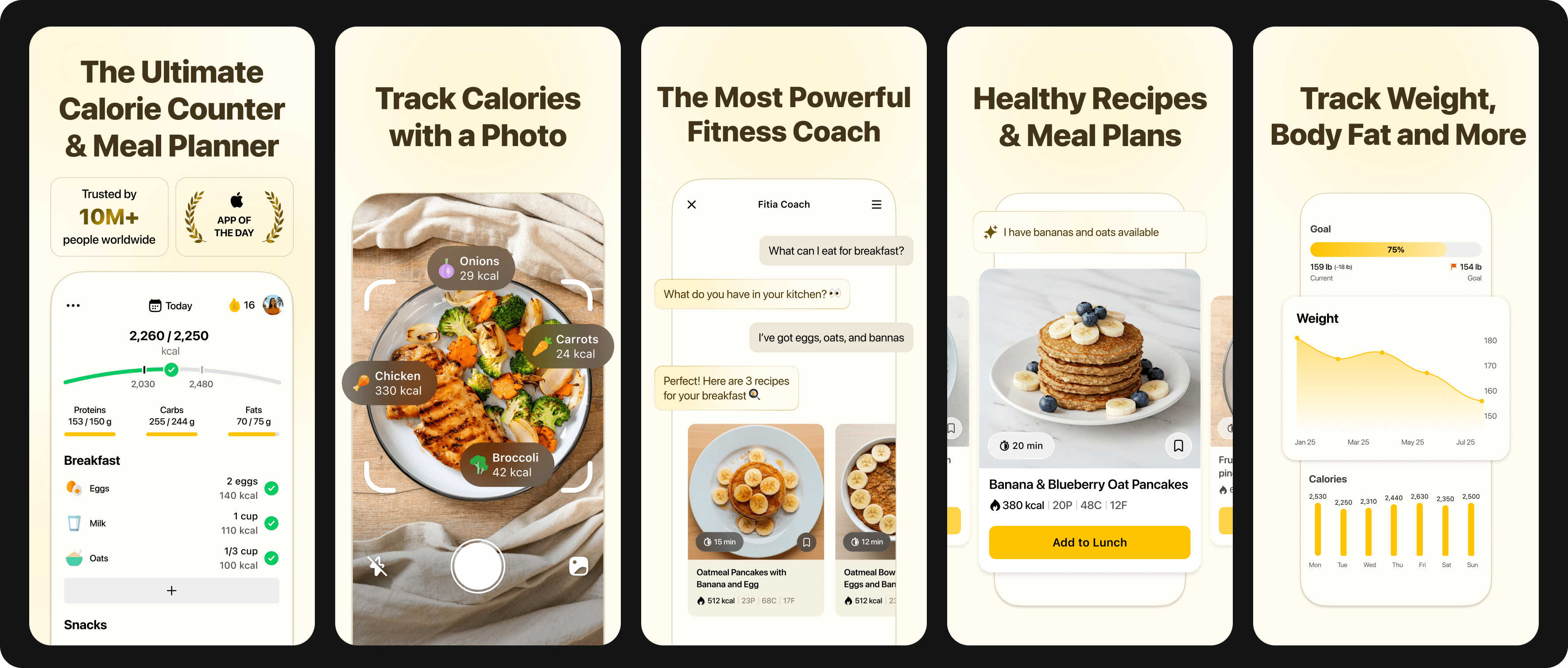
Fitia is the all-in-one nutrition platform that does what most people actually wanted from Noom: tells you what to eat, logs it without friction, and adjusts as you progress. It pairs an AI-powered logging engine — photo, voice, or text — with adaptive meal plans built on a dietitian-verified database of more than 10 million foods. With more than 10 million users and an average rating of 4.9/5 across the App Store and Google Play, it’s currently the fastest-growing nutrition app in the world. Its key differentiator is that the data behind the experience is genuinely accurate.
Best For
People who want a complete nutrition system, not just a calorie counter — especially anyone who's bounced off Noom because the lessons felt slow, off Cal AI because the database felt sloppy, or off MyFitnessPal because they were tired of fishing through duplicate user-submitted entries. Fitia is built for sustainable, real-life weight loss: families who cook together, flexible dieters who follow IIFYM principles, intermittent fasters, and anyone who's discovered that "what should I eat tonight?" is the question that breaks every diet.
Pros
- Verified food database, not crowdsourced. Fitia's team of nutritionists built the entire 10+ million-item database from scratch instead of accepting user submissions
- AI logging via photo, voice, or text. The AI is trained on the verified database, so accuracy stays intact even at speed. When you're following a Fitia meal plan, logging is often a one-tap confirmation.
- Adaptive meal plans built on 150+ studies. Fitia generates a complete weekly plan based on your calorie needs, macro split, food preferences, schedule, and budget. The algorithm calculates caloric needs using validated metabolic equations and adjusts them based on activity level, body composition, and goals. As your weight changes, the plan adjusts.
- Automatic shopping list. The weekly plan converts to a smart grocery list.
- Fitia AI Coach + Fitia Social. The AI Coach provides daily nutrition guidance without the cost of a human coach. Fitia Social creates a safe space to share anything fitness-related and adds a social accountability layer, including friends, coworkers, challenges, and leaderboards, for users motivated by community.
- Intermittent fasting integration. Custom timers for 16:8, 18:6, 20:4, or any window.
- 20+ nutrient tracking, including new vitamins and minerals. Beyond calories and macros, Fitia tracks fiber, sugar, saturated fat, sodium, and a full vitamin/mineral panel, with a Nutrition Score that summarizes your day at a glance.
- Wearable and Health app sync. Pairs with Apple Health, Health Connect, and downstream tools (Strava, Fitbit, Garmin, Oura) so activity data feeds into your calorie targets automatically.
Cons
- Premium subscription required for full meal planning. The free version handles tracking, calorie counting, and basic logging well, but the personalized meal plan generator, advanced reports, and grocery list automation live behind the Premium paywall.
- Available in English and Spanish only.
Pricing
Free version available. Premium: $19.99/month or $59.99/year. The Family Plan is available for $89.99 annually, offering shared access and 75 % savings compared to individual plans (2-6 members).
2. MyFitnessPal
Quick Overview
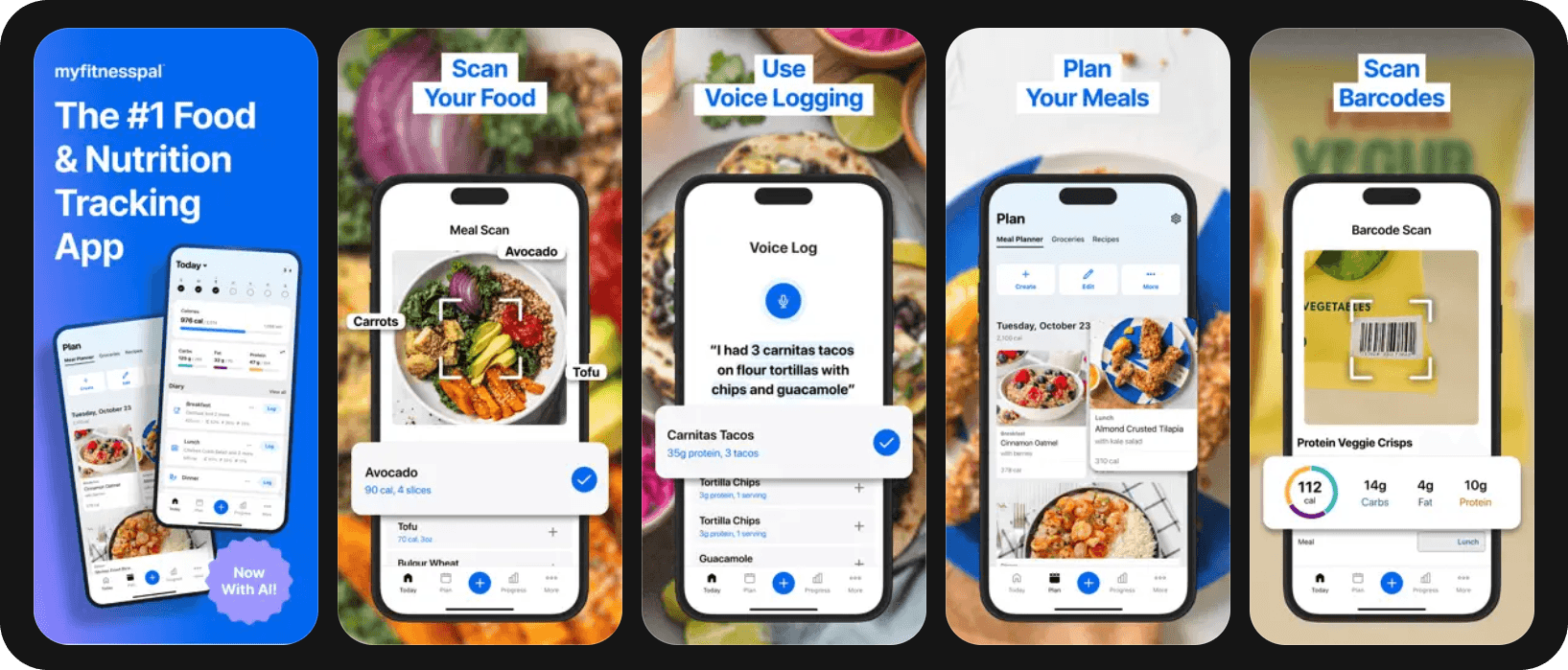
MyFitnessPal has been around since 2005 and has one of the largest food databases in the category, with over 14 million items. In 2026, it added AI photo logging, voice entry, and a Premium+ tier that bundles meal planning. It remains the default choice for users who want raw database breadth above all else, but it has recently faced backlash from current users due to its April 2026 UI changes, generating significant pushback on Reddit.
Best For
Self-motivated trackers who want maximum food coverage. Especially strong if you eat out a lot at chain restaurants or use obscure brands the verified-database apps haven't added yet.
Pros
- Large database. Over 14 million foods.
- Deep ecosystem of integrations. Syncs with most fitness trackers, smart scales, and third-party apps.
- Premium+ Meal Planner with 1,500+ recipes. With grocery delivery integration via Instacart.
Cons
- User-submitted entries cause accuracy variance. The same food can have different macros across multiple entries; without the green-check verified flag, you're guessing.
- Aggressive ads in the free tier. The free version has become noticeably more cluttered as the company introduced its ad network in 2026.
- The new UI has been very polarizing among users.
Pricing
Free with ads. Premium: $19.99/mo or $79.99/yr.
3. Lose It!
Quick Overview
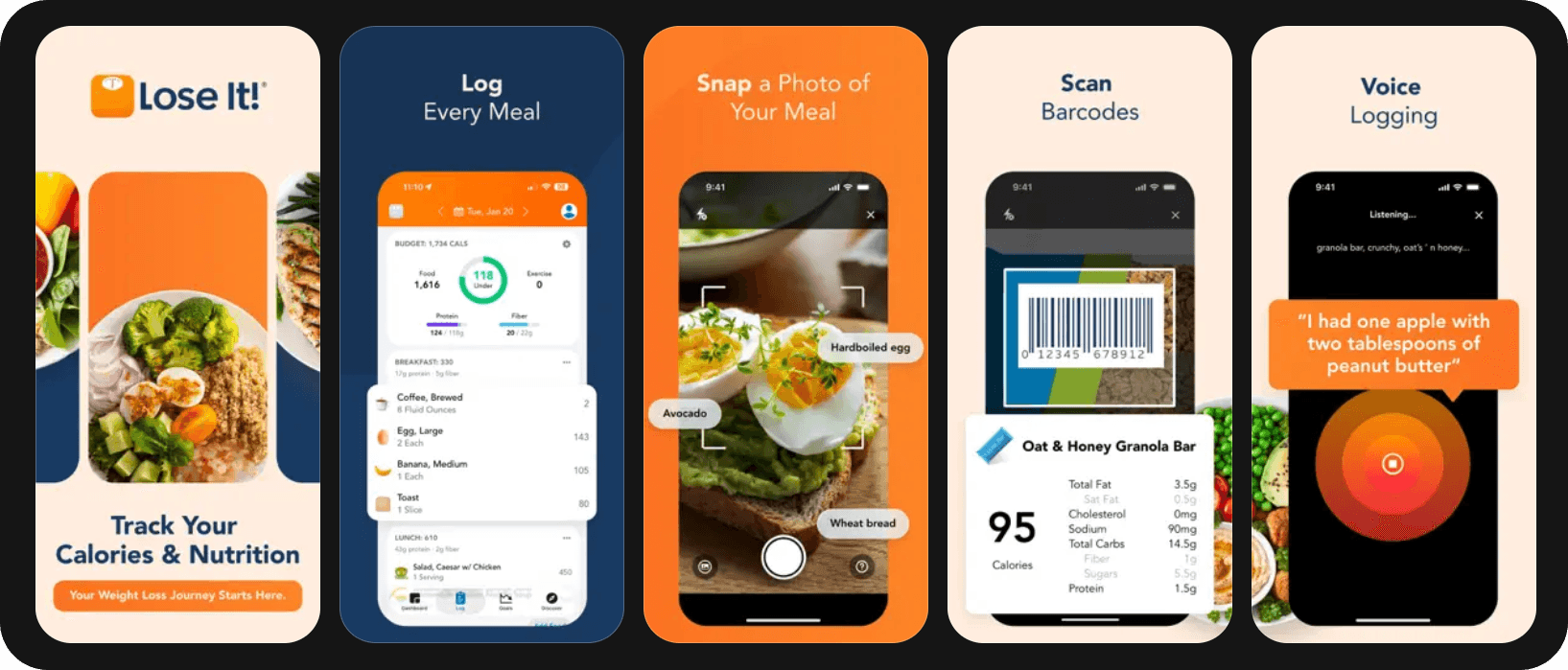
The 2026 version of Lose It! adds Snap It! photo recognition and voice logging, but the core appeal is unchanged — set a goal, log meals, watch a simple progress chart, repeat.
Best For
Self-directed dieters who want lightweight tracking without coaching, lessons, or meal plans getting in the way. Great value-per-dollar at the Premium tier.
Pros
- Snap It! photo logging. Reasonable accuracy for common foods, though it leans on the user-submitted database.
- Strong community challenges. Group challenges with friends or strangers add accountability without coaching costs.
- Aggressively priced Premium tier. At $39.99/year, it undercuts most competitors on this list.
Cons
- Database is also crowdsourced. Entries may vary in quality.
- Limited meal planning. Premium includes some meal-plan features, but the depth and personalization don't match Fitia or Lifesum.
Pricing
Free version available. Premium: $39.99/yr.
4. Cronometer
Quick Overview
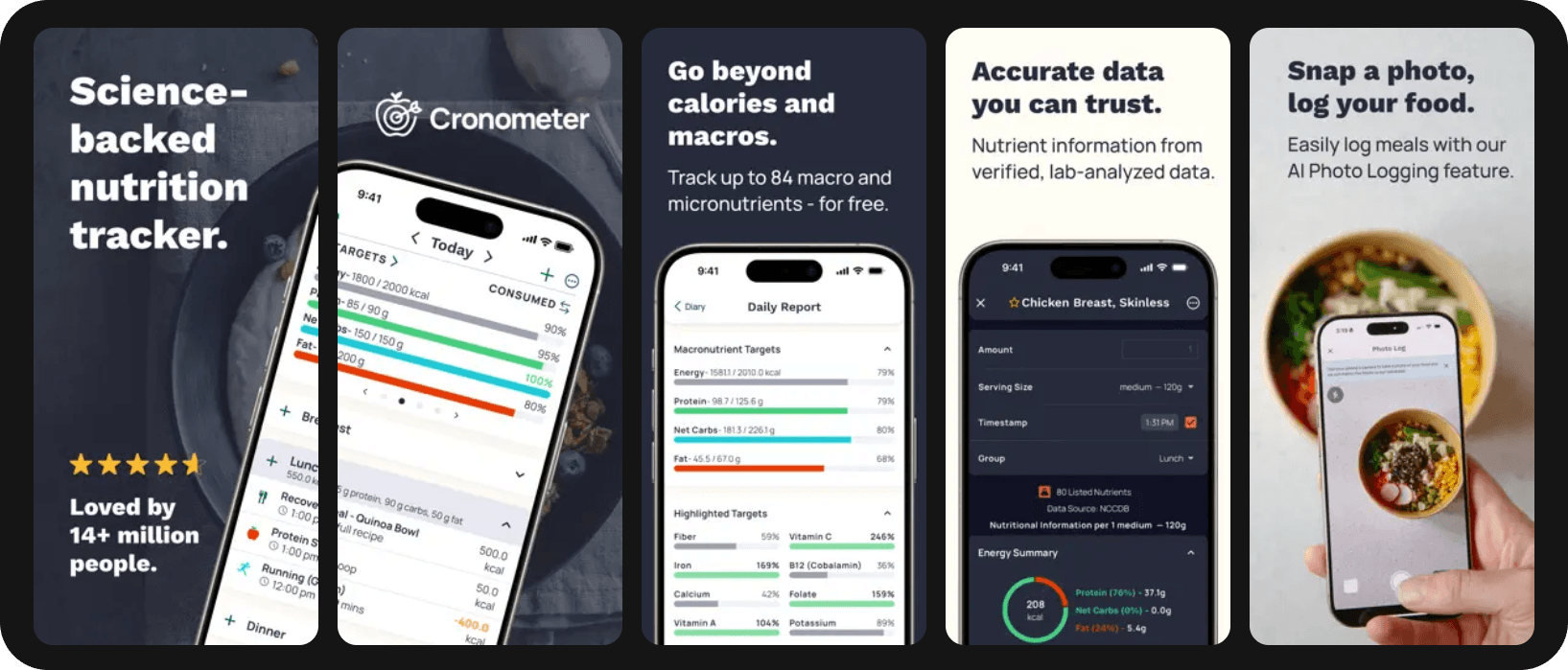
Cronometer is the data nerd's nutrition app. While most trackers stop at calories and macros, Cronometer tracks 80+ nutrients per food, drawing from professional databases like NCCDB and USDA.
Best For
Detail-oriented users: biohackers, athletes, people managing medical conditions, and anyone on a therapeutic diet. If your goal involves vitamin or mineral targets, Cronometer takes it seriously.
Pros
- Verified, lab-grade nutrition data. Entries are pulled from official sources rather than user submissions.
- 80+ nutrients tracked per food. Far beyond the standard calorie/macro panel.
- Generous free tier. Most core features (calorie tracking, macros, micros, basic charts) are free.
Cons
- Interface feels clinical, not consumer-friendly. There's a learning curve, especially for casual users coming from Noom.
- Smaller database (~500,000 foods). Less coverage of restaurant items and niche brands than MyFitnessPal or Fitia.
Pricing
Free version available. Cronometer Gold: $10.99/mo or $59.99/yr.
5. Lifesum
Quick Overview
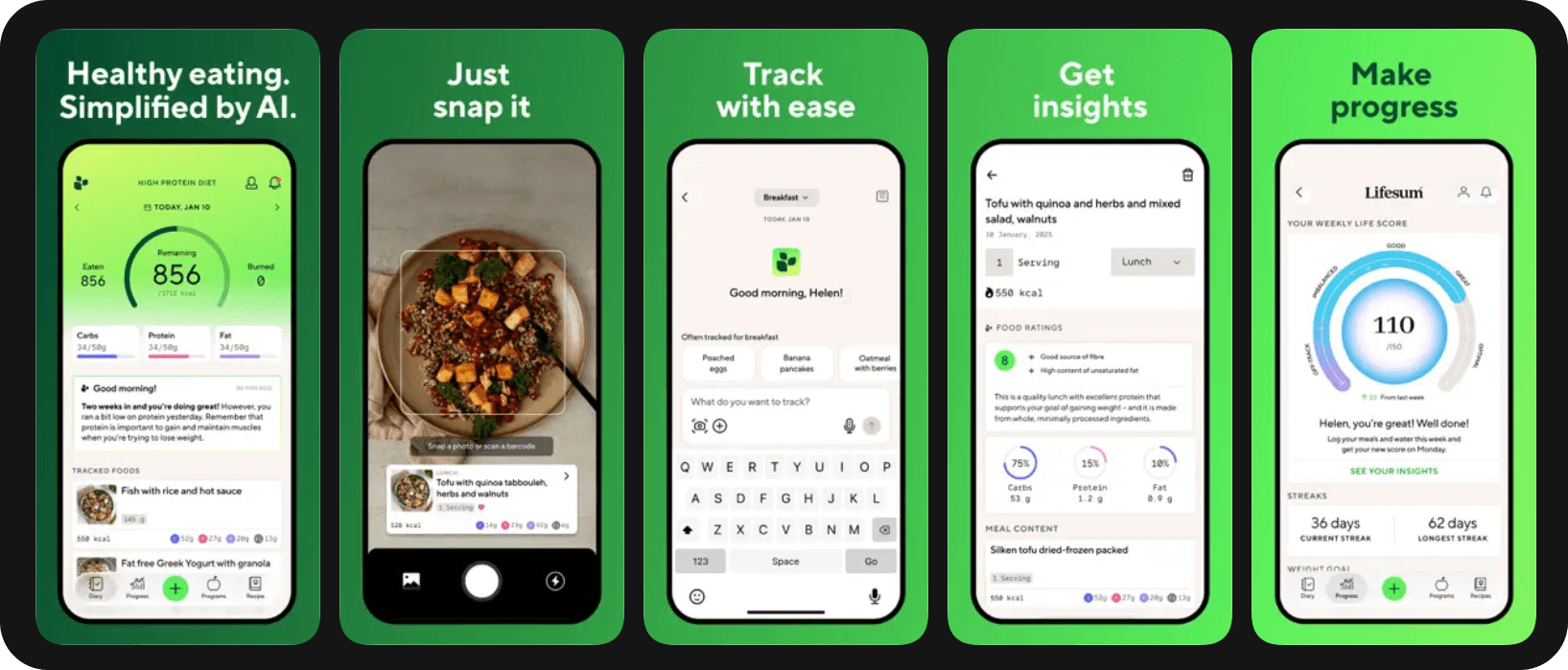
Lifesum pairs calorie tracking with structured meal plans (Keto, Mediterranean, 5:2, 16:8, High-Protein, Clean Eating) and a "Life Score" that summarizes overall eating quality, not just calorie balance.
Best For
Beginners who want structure without feeling overwhelmed, especially anyone following a specific diet protocol, such as keto, Mediterranean, or intermittent fasting, and looking for a guided plan instead of figuring out macros from scratch.
Pros
- 12+ structured diet plans. Keto, Mediterranean, vegetarian, paleo, fasting protocols, all with curated recipes.
- Life Score holistic feedback. Evaluates eating quality, hydration, and activity patterns alongside calories.
- AI photo logging added in 2025. Speeds up tracking.
Cons
- Pricing varies wildly by region and promotion. Annual costs range from ~$45 to ~$100 — confusing for first-time buyers.
- Smaller database than top competitors. Coverage gaps on regional and restaurant items.
Pricing
Free version available. Premium: $18.49/mo or $99.99/yr
6. MacroFactor
Quick Overview
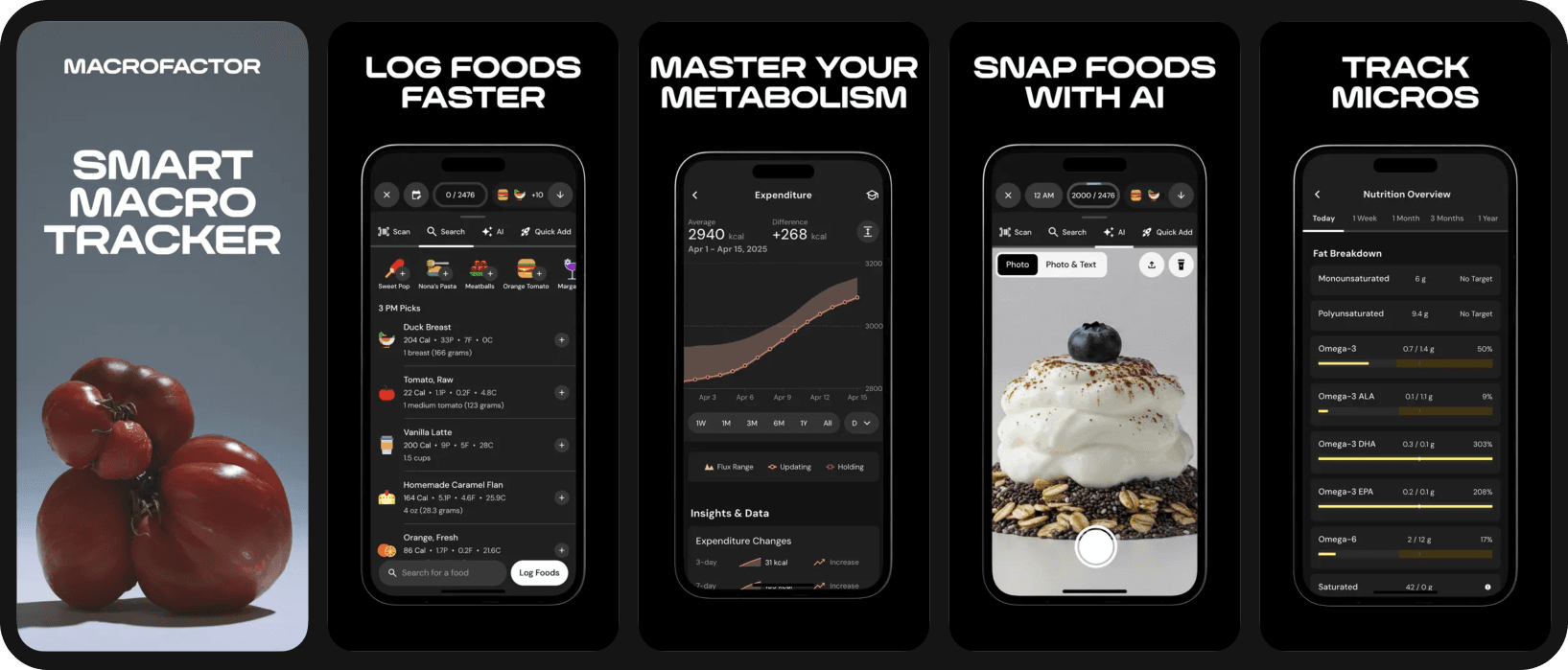
MacroFactor is an evidence-based tracker built primarily for athletes. Its core differentiator is an adaptive TDEE algorithm that recalculates your calorie and macro targets weekly based on actual weight trend data.
Best For
Strength athletes and intermediate-to-advanced trainees. Especially valuable if you've experienced metabolic adaptation (the dreaded "eating less and not losing").
Pros
- Adaptive TDEE algorithm. Adjusts targets based on your rate of progress.
- Verified database. Pulls from the NCC Food and Nutrient Database used in academic research.
- Adherence-neutral philosophy. No "red food" shaming; the app just adjusts when you miss targets.
Cons
- No free tier. Premium-only model is less accessible than freemium competitors.
- Minimal coaching or planning. This is a tracker for users who already know how to plan their own meals.
Pricing
$11.99/mo or $71.99/yr. No free tier.
7. WeightWatchers (WW)
Quick Overview
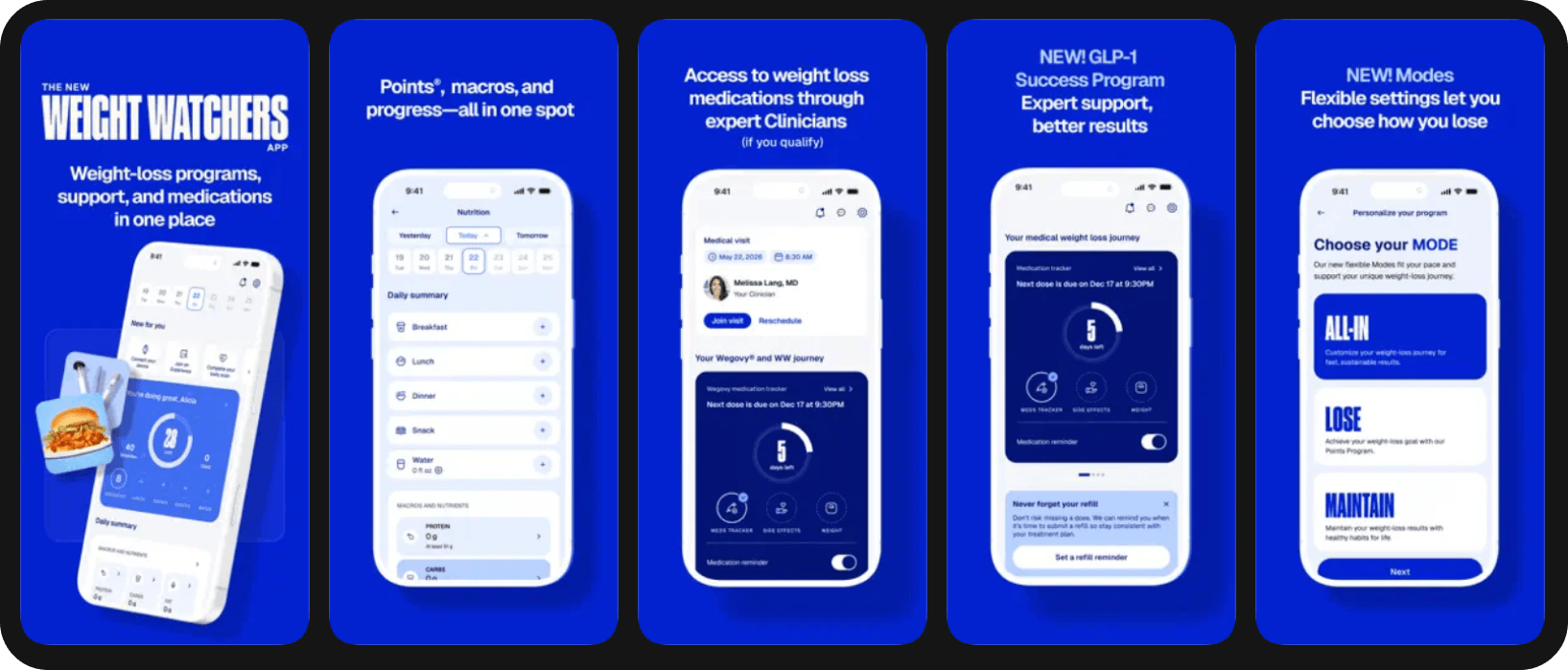
WeightWatchers is the legacy behavioral platform, now in its digital-first era. Its Points system reframes calorie counting as a simpler scoring game where nutrient density (protein, fiber) lowers the cost of a food and added sugar raises it. Real human coaches and group workshops are still core to the experience for users who pay for higher tiers.
Best For
Users who liked Noom's coaching ethos but want community and group accountability over self-paced lessons. Particularly strong for users who thrive in workshop settings or want long-term, stepped-down support.
Pros
- Decades of behavioral evidence. WW is the most-studied weight-loss program in clinical literature.
- Community and human coach access. Live workshops and group meetings drive accountability for social motivators.
- Points system simplifies eating decisions. Many users find it less mentally taxing than calorie counting.
- GLP-1 integration via Med+ plans. WW now offers prescription weight-loss medication coordination for users who qualify.
Cons
- Premium pricing structure. Base Core plan starts around $12/month, but Med+ plans and longer commitments push the cost higher.
- Points abstraction can mask macros. Users seeking precise protein or carb targets find Points limiting.
Pricing
Pricing ranges from $12 to $25 for the first month with a 12-month commitment. MED+ continues at $74/month after month one, and GLP-1 medication costs are not included.
Summary Table
| App | Starting Price | Best For | Notable Features |
|---|---|---|---|
| Fitia | $19.99/mo | Sustainable weight loss with full nutrition system | Verified 10M+ database, AI logging, adaptive meal plans, AI Coach, Teams, IF tracker |
| MyFitnessPal | $19.99/mo | Large database, self-directed tracking | 14M+ foods, Premium+ Meal Planner |
| Lose It! | $39.99/yr | Lightweight tracking with community challenges | Snap It! photo logging, group challenges, simple goals |
| Cronometer | $10.99/mo | Micronutrient depth and verified data | 80+ nutrients tracked, USDA/NCCDB sourced |
| Lifesum | $18.49/mo | Structured diet plans (keto, Med, fasting) | 12+ diet plans, Life Score, clean UI |
| MacroFactor | $11.99/mo | Adaptive macros for strength athletes | Weekly TDEE recalculation, research-grade data |
| WeightWatchers | ~$12/mo and up (year commitment) | Community coaching and group accountability | Points system, live workshops, Med+ GLP-1 plans |
Why Fitia is the most complete Noom alternative in 2026
Each of the above listed apps for weight loss has the potential to be successful, but the real issue becomes which app removes enough friction from each user’s daily routine to cause them to continue using the app.
One simple reason why Fitia is the most successful in removing friction for the greatest number of users is because it is the only app in its class that integrates a fully verified by registered dietitians food database, AI based logging, adaptive meal planning, an AI based coach, and accountability through community, all without requiring multiple subscriptions to achieve this.
Where Noom invests in psychology curriculum, Fitia invests in the data and personalization layer underneath. If that trade fits how you want to lose weight, give it a try. Download Fitia now.
FAQs
What is a Noom alternative?
Any weight-loss app that helps you build sustainable eating habits without locking you into Noom's psychology curriculum or pricing. The category ranges from full nutrition systems like Fitia that combine logging, planning, and coaching in one app, to nutrient-depth specialists (Cronometer), adaptive macro coaches (MacroFactor), structured diet platforms (Lifesum, WeightWatchers), and pure calorie trackers (MyFitnessPal, Lose It!).
How do I choose the right Noom alternative?
Match the app to your bottleneck. If meal-decision fatigue is the problem, prioritize meal planning. If logging speed is the problem, prioritize AI photo and voice logging on a verified database. If your weight loss has stalled, prioritize adaptive algorithms. The right tool is the one you'll still open at week six.
Is Fitia better than Noom?
For most users focused on sustainable weight loss, yes. Where Noom invests in a 16-week psychology curriculum, Fitia invests in a verified food database, AI logging, and adaptive algorithms built on 150+ studies. Noom is still valuable if you specifically want behavioral curriculum and group coaching. For everyone else, Fitia delivers a complete nutrition system at a fraction of the cost.
Should I switch from calorie counting alone to a Noom alternative?
Only if something's not working. People upgrade to a complete platform for three reasons: logging fatigue, stalled progress, or decision fatigue. If any of those sound familiar, Fitia addresses all three at once.
About the Author
 | Fabrizio Baca Olcese is a nutritionist from Universidad Peruana de Ciencias Aplicadas (UPC) and a NASM-certified personal trainer, with five years of experience in nutrition, product development, and user growth at the intersection of health and technology. As Fitia's first hire and part of the founding team, he has helped scale the company to over 10 million monthly active users across 17 countries. At Fitia, he works as Senior Business Development, leading user acquisition and B2B partnerships while combining his nutrition background with his drive to make healthy living more accessible. |
Fitia: Meal Plans & Calorie Counter
We use cookies to enhance your browsing experience, analyze site traffic, and personalize content. By clicking 'Accept', you consent to the use of these technologies in accordance with our Privacy Policy.