Best Online Nutrition Coach in the US (2026): What to Look For Before You Pay
Online nutrition coaching in the US 2026: three tiers, what the research says, and the red flags to spot before you pay for an app or coach.
- Published
- Updated
- 11 min read
- 11 min read

TL;DR: Online nutrition coaching in the US in 2026 spans free AI apps to $3,000 registered dietitian programs, with quality varying widely. The right pick depends on what kind of support you actually need and whether you'll use it consistently. This guide breaks down the three tiers of online nutrition support for US users, the evidence on what works, and the red flags to watch for before you pay.
Table of contents
- Why online nutrition coaching exploded in the US
- The three tiers of online nutrition support in the US
- Does online nutrition coaching actually work? What the research shows
- How to spot a bad online nutrition coach or app: red flags to watch for
- Conclusion
- FAQ
Why online nutrition coaching exploded in the US
Five years ago, "online nutrition coaching" mostly meant a few independent dietitians offering Zoom consults. In 2026, it's a saturated category in the US: apps with AI coaching layers, certified nutrition coaches running group programs, registered dietitians offering 1:1 telehealth, the list goes on.
The COVID-19 pandemic accelerated this shift. The Academy of Nutrition and Dietetics has defined telenutrition as the interactive use by a registered dietitian nutritionist of electronic information and telecommunications technologies to implement the Nutrition Care Process with patients or clients at a remote location (Brunton et al., 2021). What was once a niche workaround is now a standard delivery model, with documented improvements in outcomes for weight management, cardiovascular care, and diabetes self-management.
The result is more options than ever and at every price point. For US users searching for an online nutrition coach in 2026, the most important question is what type of support do I actually need?
The three tiers of online nutrition support in the US
Online nutrition support in the US in 2026 falls into three honest tiers, separated by cost and what you actually get for it.
Tier 1: App with AI coaching ($0 to about $90 a year)
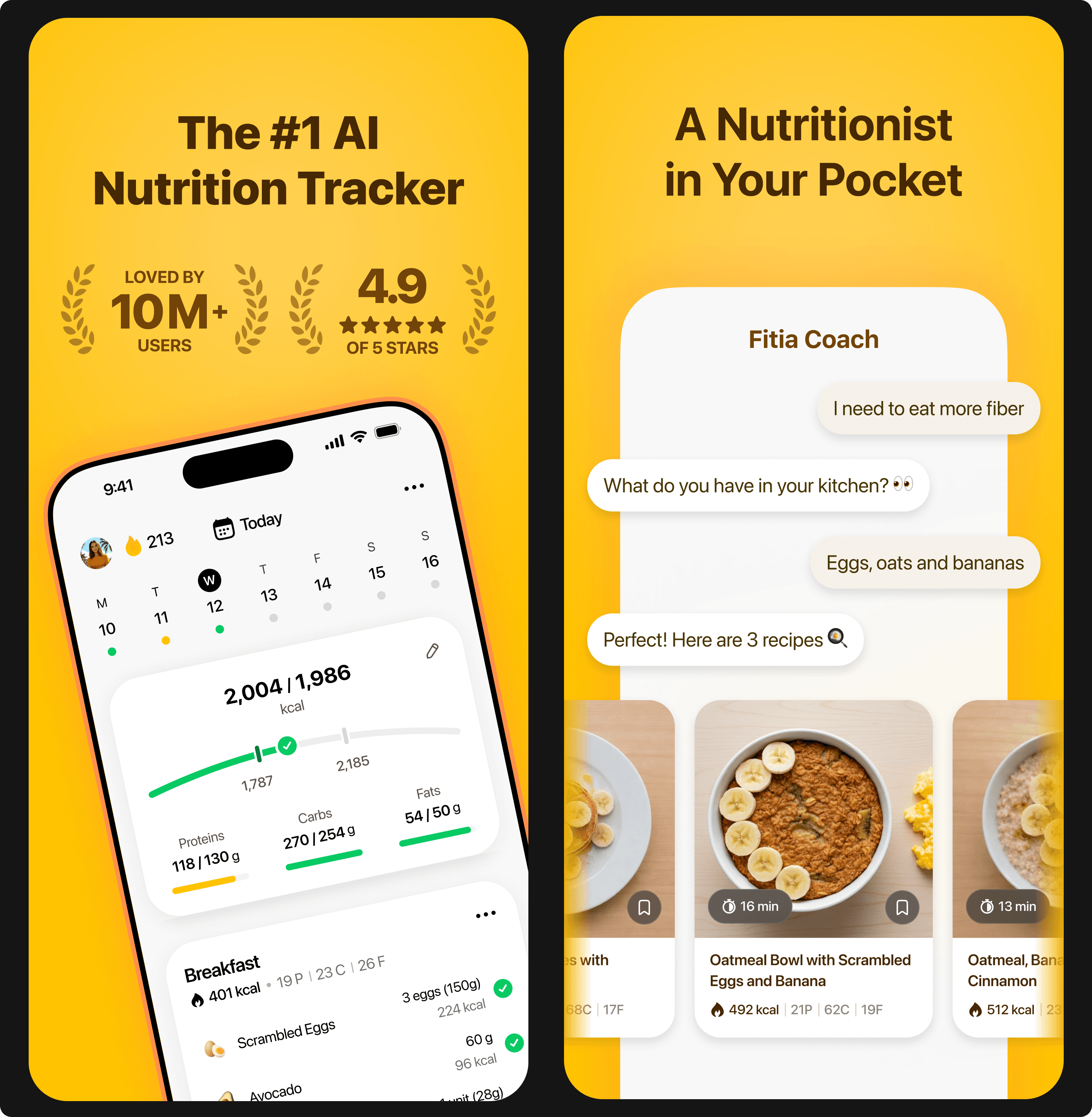
Apps that include some form of automated coaching layer on top of their tracker. The AI handles general questions ("how much protein should I eat for fat loss?"), generates meal plans or variations, and gives basic accountability nudges. No human contact, but also no waiting for an appointment.
- What you get: Daily tracking, AI-generated guidance for general nutrition questions, meal planning, sometimes habit nudges.
- What you don't get: Medical nutrition therapy, individualized programming for performance or medical conditions, human accountability.
- Best for: Healthy adults with general weight loss, body composition, or maintenance goals. People who've tried apps before and quit, and who want the lowest-friction way back in.
- Example pick: Fitia ships an AI Coach alongside a verified US food database and an automated meal plan generator that respects your goal and dietary preferences. The AI Coach handles the kind of questions you'd normally save for your nutritionist appointment ("what's a good high-protein breakfast under 400 calories," "why am I always hungry on a deficit") and answers in seconds. It can also suggest the right meal swaps depending on the occasion. For someone testing whether they need a paid coach at all, this tier is the right starting place. Premium runs $19.99/month or $59.99/year ($89.99/year family plan).
Tier 2: Hybrid programs ($30 to $200 a month)
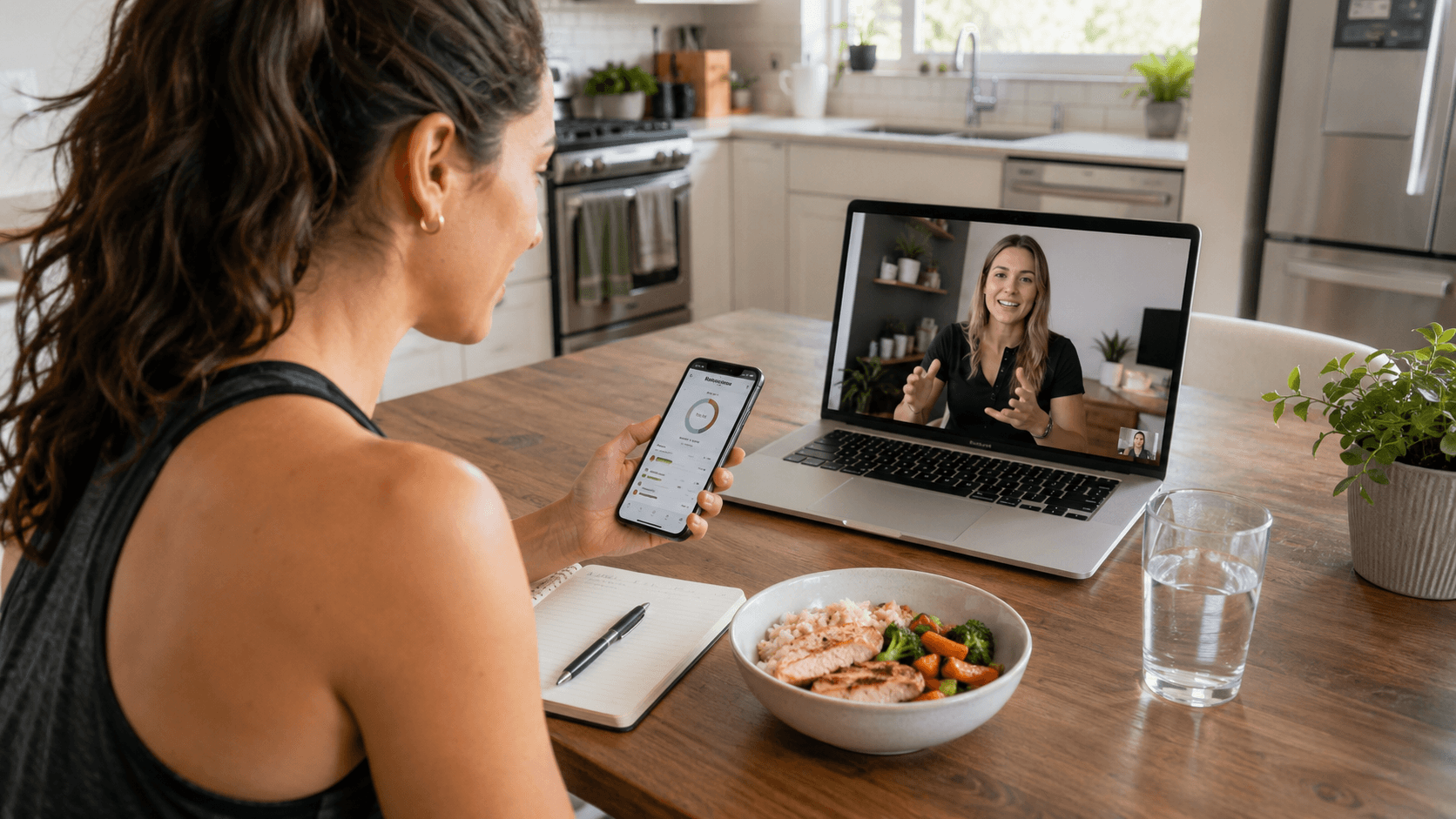
Programs that combine an app or tracking platform with some form of human check-in, usually weekly or biweekly, and usually with a certified nutrition coach rather than a registered dietitian.
- What you get: Structured macro targets, a weekly accountability call or message check-in, behavior coaching, group support in some programs.
- What you don't get: Daily access to your coach, medical nutrition therapy, deep individualization beyond what a certified coach is trained to provide.
- Best for: Healthy adults who want human accountability and a coach who can ask the harder questions ("why did you miss check-ins this week?"), but who don't need clinical-grade individualization.
- Examples in the US market: Working Against Gravity (macro coaching with weekly check-ins, certified coaches).
- Watch out for: Coach credentials vary significantly within this tier. Ask before signing.
Tier 3: Registered dietitian, 1:1 ($150 to $300 a session, or $1,500 to $3,000+ for packages)

A licensed RD providing individualized nutrition care via telehealth. Often covered partially or fully by US health insurance when there's a qualifying medical diagnosis (diabetes, chronic kidney disease, eating disorders, sometimes obesity with comorbidities).
- What you get: Medical nutrition therapy. A care plan calibrated to your medical history, labs, medications, and individual goals. Real clinical accountability. Insurance billing potential.
- What you don't get: Daily contact (you'll typically meet every 2 to 4 weeks).
- Best for: Anyone with a medical condition (diabetes, kidney disease, food allergies, IBS, eating disorder history). Athletes with serious performance goals. Pregnant or postpartum people. Anyone whose insurance covers MNT.
- Where to find one: Direct telehealth platforms, hospital-affiliated outpatient dietetics departments, the Academy of Nutrition and Dietetics' "Find a Nutrition Expert" directory.
Start free → Not sure which tier fits? Start Fitia's free trial and try the AI Coach + meal plan combination before paying for human coaching. Many US users find Tier 1 covers what they actually need.
Pricing and program details verified against publicly available 2026 information where possible; confirm directly with each program before subscribing. This article is educational and not a substitute for individualized medical or nutrition advice. If you have a medical condition, work with a registered dietitian.
Does online nutrition coaching actually work? What the research shows
Here's the part most coaching programs don't lead with. The latest evidence on app-based and coach-supported nutrition interventions converges on a clear pattern.
A 2022 systematic review and meta-analysis in JMIR mHealth and uHealth pooled 34 randomized controlled trials of mobile-app-based weight loss interventions and found that the combination of an app, a tracker, and a behavioral support layer produced the strongest results, with about 3.77 kg of weight loss at six months (Antoun et al., 2022). The same review found that neither the type nor the number of app features was associated with weight loss. Features were essentially decoration.
What helped the most was the human or structured support layer wrapped around the app.
A 2021 single-arm study of mobile-app-based dietary self-monitoring in US adults with overweight or obesity reached a complementary finding: the strongest predictor of weight loss was consistency of monitoring over time, defined as the number of weeks where users hit at least three days of self-monitoring (Payne et al., 2021).
Completeness of logging (hitting your full calorie goal each week) was not significantly associated with weight loss. What worked was showing up across weeks.
A 2021 systematic review in Public Health Nutrition extended this across 59 studies: both lower-intensity and higher-intensity self-monitoring strategies produced statistically significant weight loss compared to control groups, with the authors noting that abbreviated, less burdensome approaches may actually encourage adherence (Raber et al., 2021).
For US users specifically, telenutrition delivered by registered dietitian nutritionists has been associated with improved outcomes across cardiovascular disease, obesity, and diabetes self-management in research summarized by a 2021 review in Healthcare (Brunton et al., 2021).
What this all adds up to:
- The support layer matters more than the technology. A $20/year app with consistent daily use will outperform a $3,000 program you abandon in a couple of weeks.
- Credentials matter for medical care. If you have a medical condition, the evidence base for telenutrition with an RD is solid. Don't skimp on Tier 3 for that case.
- Consistency beats intensity. A coach you check in with biweekly and an app you use daily will outperform a "premium" program you can't sustain.
How to spot a bad online nutrition coach or app: red flags to watch for
Before paying for any online nutrition coaching program or app in the US, watch for these.
- "Certified Nutritionist" with no specified credentialing body. The term is unregulated in most US states. Always ask: "Certified by whom?" If the answer is vague, the certification is probably not rigorous.
- Specific weight loss promises in specific timeframes. "Lose 30 pounds in 30 days" is a violation of professional ethics for any credentialed practitioner. It's just a marketing tactic.
- No intake of medical history or current medications. A coaching program that signs you up without screening for medical conditions, eating disorder history, or medication interactions is not providing clinical care, and may not even meet certified-coach scope of practice standards.
- Apps with crowdsourced-only food databases and no verification process. Peer-reviewed studies have documented meaningful nutrient errors in popular US trackers when entries come exclusively from user submissions. Look for apps that source from verified databases (USDA, NCCDB, or proprietary verified entries) or that have an editorial review step.
- Heavy supplement upsells. A coaching program where most of the revenue or upsell is supplement-based should be evaluated on its coaching merits, not on the supplements.
- No macro adaptation as your weight changes. Your maintenance calories drop as you lose weight, which means a static daily target stops producing a deficit after a few weeks. Quality apps and coaching programs recalibrate your macros as you progress; static-target setups stall progress without telling you why.
Conclusion
Online nutrition coaching in the US in 2026 is more accessible, more affordable at the low end, and more clinically capable at the high end than it has ever been. The trade-off is that the category is also more crowded, with credentials and quality varying widely.
Use this to figure out which tier fits:
- Tier 1 (app + AI): If you're starting out or testing whether you need human support, begin here.
- Tier 2 (hybrid program): If your barrier is accountability and you want a human coach who'll check in, this is the middle ground.
- Tier 3 (RD 1:1): If you have a medical condition, specific performance goals, or insurance that covers MNT, this is the gold standard.
Whichever tier fits your situation, the research is clear: the support layer matters more than the platform, and consistency matters more than intensity. Pick the one you'll actually use.
Ready to start at Tier 1? Download Fitia. You'll get an AI Coach, a verified US food database, and an automatic meal plan generator in one app, for a fraction of what most US coaching programs charge per month.
FAQ
What is the best online nutrition coach in the US in 2026?
The right pick depends on what you need. For medical conditions, a registered dietitian (RD) providing 1:1 telehealth is the right fit and may be insurance-covered. For structured human accountability without a medical case, a hybrid program with certified coaches is the middle ground. For general guidance at the lowest price, an app with AI coaching like Fitia covers the basics for under $100 a year. Match the tier to your barrier.
Can I just use an app instead of paying for a human coach?
For many US adults, yes. Consistency of self-monitoring is the strongest predictor of weight loss, and lower-intensity strategies still produce significant results (Payne et al., 2021; Raber et al., 2021). An app with an AI coaching layer handles daily decisions for healthy adults with general goals. Scale up to a hybrid program or RD if you have a medical condition or need human accountability.
Are online nutrition apps and coaches actually effective?
Yes, with a caveat. A 2022 meta-analysis of 34 randomized trials found that combining an app, a tracker, and a behavioral support layer produces about 3.77 kg of weight loss at six months, and that the support layer matters more than the number of features (Antoun et al., 2022). The caveat: any service only works if you actually use it. A cheaper service you stick with beats a premium one you abandon.
How do I know if someone is a real nutritionist in the US?
"Nutritionist" is unregulated in most US states, so the term alone is meaningless. The credentials that matter are Registered Dietitian (RD/RDN), credentialed by the Commission on Dietetic Registration, and Certified Nutrition Specialist (CNS), credentialed by the Board for Certification of Nutrition Specialists. Both require a master's degree and supervised practice hours. Certified nutrition coaches (PN Level 1, NASM-CNC, ISSN-SNS) handle general behavior coaching but can't provide medical nutrition therapy. If someone says "certified nutritionist" without naming the body, ask which one.
Will my US health insurance cover online nutrition coaching?
Sometimes, but only for Medical Nutrition Therapy (MNT) provided by a registered dietitian with a qualifying medical diagnosis. Coverage is common for diabetes, chronic kidney disease, and eating disorders, and is expanding for obesity. Certified nutrition coaches, health coaches, and app-based AI services are almost never covered. Ask your insurance about MNT benefits and whether the RD is in-network.
About the Author
 | Marcela Perez-Albela R. is a registered dietitian and nutritionist from Universidad Peruana de Ciencias Aplicadas (UPC), with more than half a decade of experience in nutrition and public health, including clinical work through SERUMS with the Peruvian Air Force. At Fitia, she works as Operations Analyst, combining her nutrition background with her drive to make healthy living more accessible. She believes small, consistent changes in how people eat can make a real difference in their lives. |
References
- Antoun, J., Itani, H., AlArab, N., & Elsehmawy, A. (2022). The Effectiveness of Combining Nonmobile Interventions With the Use of Smartphone Apps With Various Features for Weight Loss: Systematic Review and Meta-analysis. JMIR mHealth and uHealth, 10(4), e35479. https://doi.org/10.2196/35479
- Brunton, C., Arensberg, M. B., Drawert, S., et al. (2021). Perspectives of Registered Dietitian Nutritionists on Adoption of Telehealth for Nutrition Care during the COVID-19 Pandemic. Healthcare, 9(2), 235. https://doi.org/10.3390/healthcare9020235
- Payne, J. E., Turk, M. T., & Kalarchian, M. A. (2021). Adherence to mobile-app-based dietary self-monitoring: Impact on weight loss in adults. Obesity Science & Practice, 8(3), 279–288. https://doi.org/10.1002/osp4.566
- Raber, M., Liao, Y., Rara, A., et al. (2021). A systematic review of the use of dietary self-monitoring in behavioural weight loss interventions: delivery, intensity and effectiveness. Public Health Nutrition, 24(17), 5885–5913. https://doi.org/10.1017/S136898002100358X
Related articles
 Fat Loss
Weight Loss Calorie Chart (2026): How Many Calories to Eat by Body Weight, Sex, and Activity
See how many calories to eat to lose weight, with simple charts by body weight and activity, plus why your target changes as you go.
Read article
Best Calorie Counter App for Muscle Gain in the US (2026): 4 Apps Compared for Lifters
The 4 best calorie counter apps for US lifters in 2026, compared on macros, database, adaptation, and meal planning.
Read article
The Lazy Person's Guide to Food Tracking in the US (2026)
Four levels of low-effort food tracking for busy US adults, from photo logging to automated meal plans. Pick the one you can actually keep doing daily.
Read article