5 Things Everyone Gets Wrong About Calorie Tracking Apps (US, 2026)
Five US dieting myths taken apart with peer-reviewed evidence and what to do instead.
- Published
- 13 min read
- 13 min read

TL;DR: Most people in the US don't quit calorie tracking apps because the apps are bad. They quit because of the assumptions they bring to them: that, regardless of database type, numbers are always exact, that more features mean better results, that the default target works for the entire diet, that they should eat back what their watch says they burned, and that one missed week means failure. This guide takes apart all five, with the research behind each, and shows what to do instead.
Table of contents
- Myth 1: "The calorie number in the database is always exact"
- Myth 2: "More features mean better results"
- Myth 3: "I can use the app's default target for the entirety of the diet"
- Myth 4: "I should always eat back the calories my watch says I burned"
- Myth 5: "If I skipped logging for a week, I failed"
- A dietitian's take: how to use a calorie app without these traps
- Conclusion
- FAQ
Calorie tracking apps work. That part isn't in question. The issue is that a lot of what US users believe about these sort of apps is slightly off, and those small misunderstandings could lead many to turn a useful tool into a deleted one in just a couple of days. Here are the five that cause the most trouble, and what the evidence actually says about them.
Myth 1: "The calorie number in the database is always exact"

Why people believe it. Every time you search for a food in any app database, the number shows up to the single calorie, giving you the perception that it must be correct and up to date.
What's actually true. The reality is a big "it depends" that shows up across every app. Sure, lots of databases use verified and up-to-date info, which is why it's important to check where your tracker is pulling its nutritional data from. But then you discover that there are other apps, including some of the biggest US apps, with user-submitted databases that haven't been validated or compared against their original source.
That introduces real error. A 2024 comparative study in JMIR mHealth and uHealth tested popular trackers (including MyFitnessPal and Lose It!) against US Department of Agriculture reference data and found they significantly underestimated saturated fat (errors of roughly 14% to 40%) and cholesterol (errors of roughly 26% to 60%), with the problem traced to the apps' own databases rather than to regional food differences (Ho et al., 2024).
A separate 2024 validation study in BMJ Nutrition, Prevention & Health concluded that the validity of the nutrition information MyFitnessPal provides is questionable, precisely because so many entries are contributed by users with no way to verify the accuracy of the energy and nutrient values (Banal et al., 2024).
What to do instead. Look for apps that source their nutritional data from verified sources or that have a verification process built into their quality control. That doesn't mean you can't go with the shiny or popular ones out there, but you should expect some degree of estimation, with a margin of error of roughly 10% in either direction on certain foods, and be prepared to verify food entries yourself against third-party sources.
👉 You may also like: MyFitnessPal vs. Lose It! vs. Fitia (2026): A Calorie Counter Food Database Comparison — a closer look at how these databases actually compare.
Myth 2: "More features mean better results"

Why people believe it. App stores compete on feature lists. It's natural to assume the app with the food scanner, the barcode reader, the full body scan, and all sorts of integrations must produce better outcomes than a simpler one.
What's actually true. The research points the other way. A 2022 systematic review and meta-analysis in JMIR mHealth and uHealth pooled 34 randomized controlled trials of weight loss apps and found that neither the type nor the number of app features was associated with weight loss (Antoun et al., 2022). What did move the needle was the human and behavioral support layer wrapped around the app, rather than the feature count inside it. The combination of an app, a tracker, and behavioral support produced the strongest result in that review (about 3.77 kg of weight loss at six months).
This lines up with the broader self-monitoring literature: across formats and intensities, what predicts weight change most reliably is consistency of use (Payne et al., 2021; Raber et al., 2021).
What to do instead. If an app first catches your eye by how it's designed or the colors it uses, and that makes you think "hey, maybe I won't mind opening this app every day," that's a good first step toward an app that will make consistency of use easier. From there, you can start looking into whether logging is fast and whether it helps you decide what to eat next. Avoid picking an app that feels sluggish to you because it has a multitude of features. Also, a meal plan or coaching layer that lowers your daily decision-burden is the kind of "feature" you want to look for, since the evidence actually supports that it keeps you engaged.
Myth 3: "I can use the app's default target for the entirety of the diet"
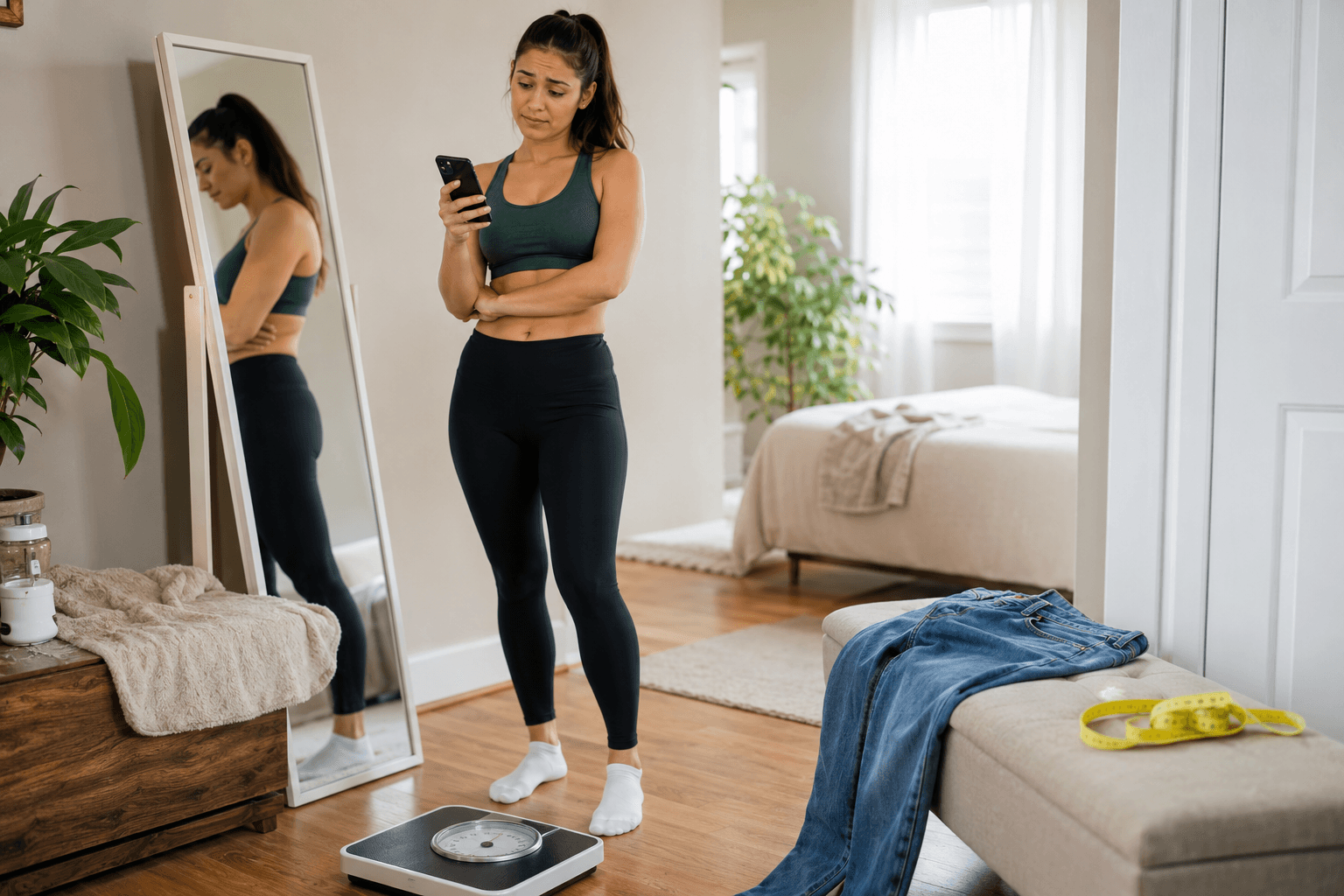
Why people believe it. Every app's onboarding will ask you a few questions, sometimes a lot, then hand you a calorie and macro target number. It feels personalized and authoritative, so people accept it as the one target they can adhere to during the entirety of their diet.
What's actually true. Defaults are formulas plus assumptions. They give you a reasonable starting target, but they aren't designed to stay fixed for the entire diet. As you lose weight, your maintenance calories drop too (a smaller body burns less at rest), which means the same target that produced a deficit at 200 lb stops producing one at 180 lb.
The other issue is the pace setting itself. A flat "1.5 to 2 lb per week" selection translates into roughly a 750 to 1,000 kcal daily deficit, which can be reasonable for a larger person but brutal for a smaller one, large enough to drive the hunger, fatigue, and dropout that ends the diet. The defaults aren't malicious, but given their static nature and how your body changes, you'll need a plan to adapt.
What to do instead. Pick an app that recalibrates the target as your weight changes. Your maintenance calories drop as you lose weight (a smaller body burns less at rest), which means the deficit number needs to update along the way. It also helps to choose a moderate pace (roughly 0.5 to 1% of body weight per week is the sustainable range for most adults) rather than the most aggressive paces. Fitia, for example, asks for your goal and preferred pace and then sets a deficit around that when onboarding, and as your weight moves or reaches a plateau, the targets recalibrate.
Myth 4: "I should always eat back the calories my watch says I burned"
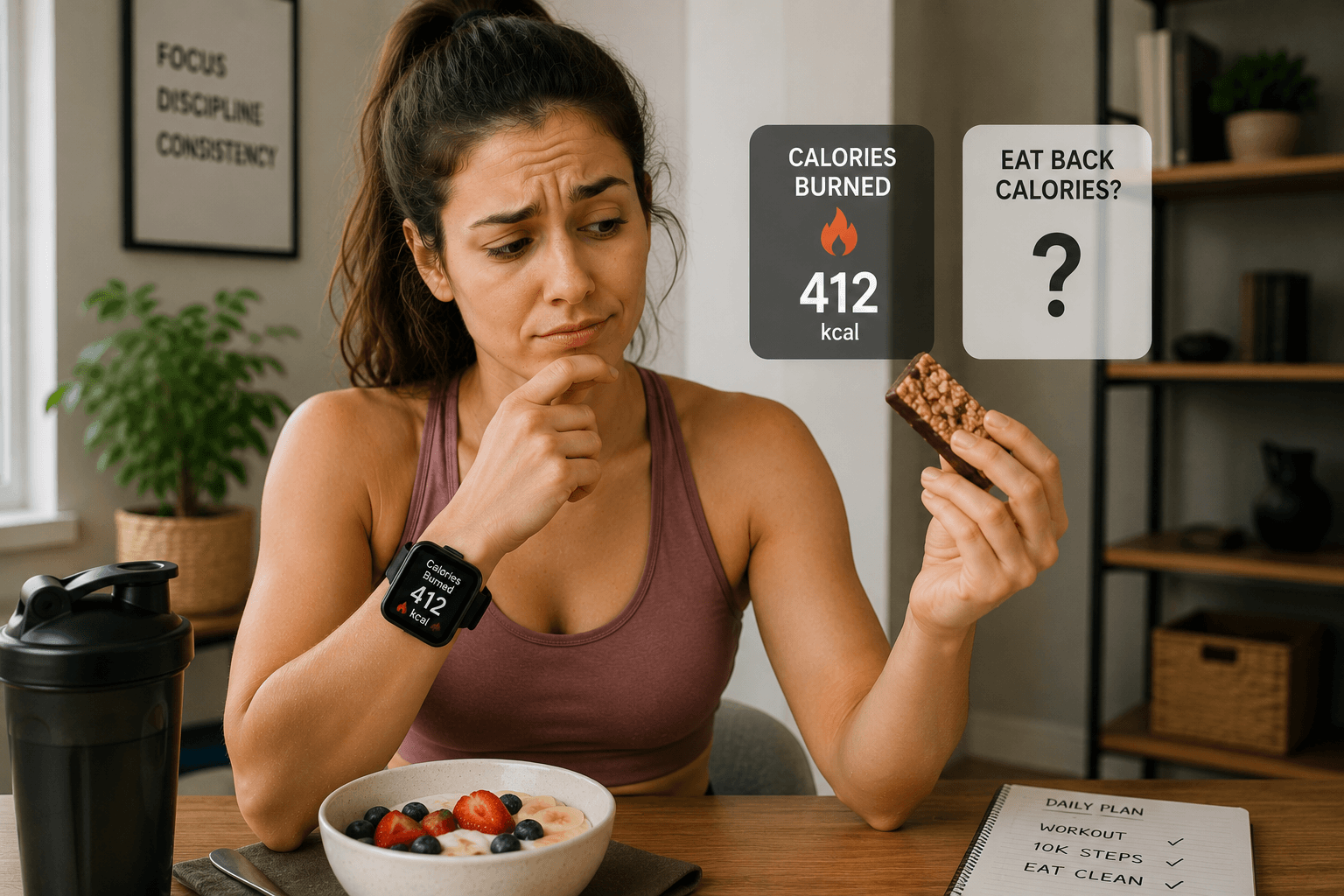
Why people believe it. The watch reports a confident number ("you burned 612 calories"), and many apps invite you to log that workout, which then adds those calories back to your daily budget. The loop feels designed to be trusted.
What's actually true. Wearable calorie-burn estimates may not be as accurate as you think. A 2022 systematic review in the Journal of Medical Internet Research of 65 studies found that for energy expenditure, the mean absolute percentage error was above 30% for every device brand tested, and none of the devices proved accurate at measuring it, even though some of the same devices were good at counting steps or reading heart rate (Germini et al., 2022).
Other 2021–2022 validation work reached the same conclusion, with smartwatch energy-expenditure errors commonly landing in the 30%-plus range and frequently overestimating during walking and running (Slade et al., 2021; Le et al., 2022). If you eat back a burn number that's overstated by a third, you quietly erase the deficit you worked to create.
What to do instead. First, let's acknowledge that it's okay for apps to give more power to their users. If you like syncing exercise calories from your watch to your calorie tracker, that's still fine, as long as it's done consistently and not on and off each week. And wearables may improve over time. Still, the recommendation is to pick a default activity level that suits you and keep it for the duration of your diet. This means the daily target won't fluctuate based on workouts, and you may experience some jumps up and down daily when weighing yourself, but the weekly trend on the scale is what you should keep your eye on when assessing progress anyway.
Myth 5: "If I skipped logging for a week, I failed"
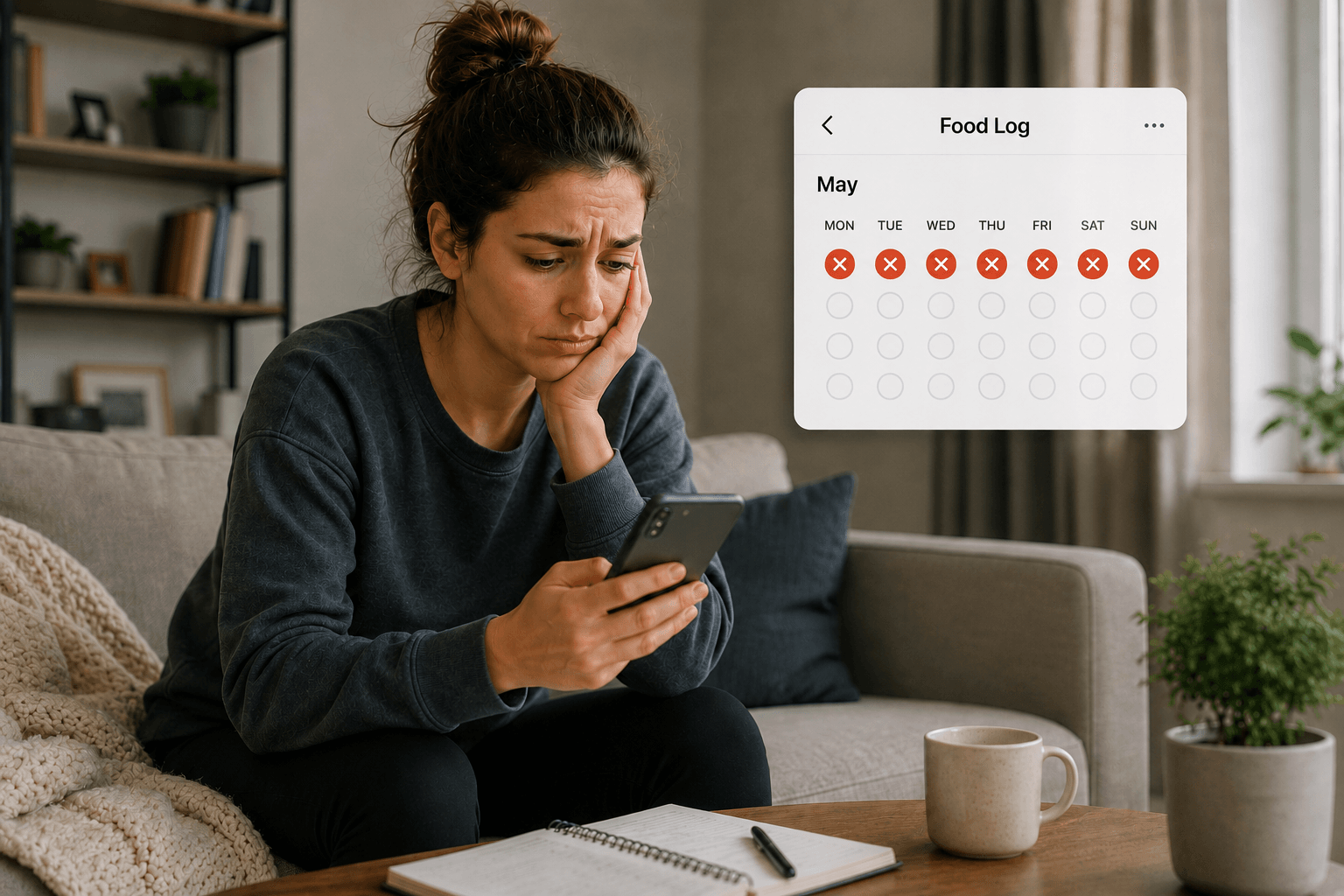
Why people believe it. Tracking apps reward streaks and visualize gaps. A blank week looks like failure, and "I already broke it" is one of the most common reasons people abandon the app entirely.
What's actually true. The evidence frames this very differently. Consistency over time is the strongest predictor of results, and consistency is built by returning after gaps rather than by never having them (Payne et al., 2021).
The systematic review evidence shows self-monitoring supports weight loss across many formats and intensity levels, which means a missed stretch is just a pause rather than a permanent setback (Raber et al., 2021). The people who do well are the ones who log through the messy weeks and come back after the ones they miss.
What to do instead. The reason people don't come back after a gap is usually friction: facing a blank diary and not knowing what to enter. Apps that make re-entry cheap, with one-tap repeat meals, a plan already loaded, or fast photo and voice logging, make the return much easier.
👉 This may interest you: How to Choose a Food Diary App That Lasts Past Week Three — what separates the apps people stick with from the ones they abandon.
A dietitian's take: how to use a calorie app without these traps
Most of the clients I've worked with in the past who "failed" at using a calorie tracking app really made things harder for themselves before even downloading it, because they ran into one of the five assumptions above and concluded the practice doesn't work for them. Here's some practical advice that can help you avoid walking the same path.
Anchor to the trend rather than the day. Because, depending on your app, database entries may carry inaccuracies, no single day's scale number is precise enough to react to. Weigh your progress over two to three weeks using a weekly trend. One high day inside a good fortnight means nothing.
Set protein first, then let the rest fall into place. A floor of roughly 0.55 to 0.7 g of protein per pound of body weight per day (about 1.2 to 1.6 g/kg) supports satiety and protects lean mass while you're in a deficit. Most app defaults under-prescribe it. Hitting protein does more for hunger and body composition than chasing a perfect calorie number.
Choose a pace you can sustain rather than the fastest one. The aggressive default is the single most common reason a deficit becomes unbearable for smaller adults. Dial it back to a moderate rate and you'll actually reach the finish line.
Preferably, don't bank exercise calories. Given how inaccurate burn estimates can be depending on the device, eating them back is the easiest way to stall without understanding why. It may be a better idea to just set an honest activity level (which most apps let you do) and leave the daily target alone.
Make returning easy. If you know you're going to take a vacation or maybe go to a wedding, and that will make calorie tracking very unlikely to happen, accept it and tell yourself you'll get back on track with your nutrition once that period is past. It can make things easier if the app has a coaching layer included, or if it offers a meal plan personalized for you that you can step back into.
Conclusion
If you live in the US and are looking to get into calorie tracking apps, beware of the assumptions covered here. Falling into one of these traps may be the reason you abandon your chosen app in just a couple of weeks, or even days:
- Understand the sort of database you're working with, and be ready to verify entries if your app doesn't do that for you already.
- More features don't beat consistent use.
- The default target needs to be adjusted eventually.
- Your watch's calorie burn estimate may not be as reliable as you hope.
- And one missed week is not a failure.
Get those five straight and calorie tracking stops being something you do for just a few days and starts being something you can actually keep up with.
Start free → Try Fitia's free trial and set up a sustainable target with a verified database from day one.
FAQ
Are calorie tracking apps accurate in 2026?
It depends on what app and feature you're looking into. Apps with crowdsourced databases (like MyFitnessPal and Lose It!) have documented errors on some nutrients, with peer-reviewed studies finding meaningful underestimation of saturated fat and cholesterol (Ho et al., 2024). Apps with verified databases, like Fitia or Cronometer, are closer to reference values. On the other hand, AI-aided food scanners often have a margin of error to consider that may be influenced by database accuracy, model training, and photo quality.
Should I eat back the calories my fitness watch says I burned?
You can, but it's preferable not to. A 2022 systematic review found that wearable energy-expenditure estimates had errors above 30% for every brand tested and that none were accurate at measuring calories burned (Germini et al., 2022). It's often recommended to set your activity level honestly at the start and rely on your weight trend instead.
Does the app with the most features work best?
No. A meta-analysis of 34 randomized controlled trials found that neither the type nor the number of app features was associated with weight loss (Antoun et al., 2022). What predicts results is consistent logging and the support structure around the app, like meal planning or coaching, rather than the length of the feature list.
I missed a week of logging. Should I just quit?
No. Consistency over time predicts results, and consistency includes returning after gaps (Payne et al., 2021). Pick an app that makes restarting fast, with repeat meals or a ready-made plan, so coming back is easier.
What's the most important thing to get right in a calorie app?
Protein intake and pace. Hit a protein floor of about 0.55 to 0.7 g per pound of body weight, and choose a moderate deficit rather than the fastest default. Those two choices do more for hunger, adherence, and body composition than obsessing over a perfectly accurate calorie number.
About the Author
 | Arantza Echeandía León is a registered dietitian and nutritionist, graduated from Universidad Peruana de Ciencias Aplicadas (UPC), where she ranked in the top 10% of her class. She specializes in sports nutrition and metabolic conditions, with experience supporting athletes and collaborating with multidisciplinary teams to optimize performance and recovery. She holds a Level I ISAK certification in kinanthropometry and currently leads food database optimization and AI-driven nutrition feature integration at Fitia Inc. |
References
- Ho, D. K. N., Chiu, W.-C., Kao, J. Y., et al. (2024). Reliability Issues of Mobile Nutrition Apps for Cardiovascular Disease Prevention: Comparative Study. JMIR mHealth and uHealth, 12, e54509. https://doi.org/10.2196/54509
- Banal, M. G., Bongga, D. C., Angbengco, J. M., et al. (2024). MyFitnessPal smartphone application: relative validity and intercoder reliability among dietitians in assessing energy and macronutrient intakes of selected Filipino adults with obesity. BMJ Nutrition, Prevention & Health, 7(1), 54–60. https://doi.org/10.1136/bmjnph-2023-000770
- Antoun, J., Itani, H., AlArab, N., & Elsehmawy, A. (2022). The Effectiveness of Combining Nonmobile Interventions With the Use of Smartphone Apps With Various Features for Weight Loss: Systematic Review and Meta-analysis. JMIR mHealth and uHealth, 10(4), e35479. https://doi.org/10.2196/35479
- Payne, J. E., Turk, M. T., & Kalarchian, M. A. (2021). Adherence to mobile-app-based dietary self-monitoring: Impact on weight loss in adults. Obesity Science & Practice, 8(3), 279–288. https://doi.org/10.1002/osp4.566
- Raber, M., Liao, Y., Rara, A., et al. (2021). A systematic review of the use of dietary self-monitoring in behavioural weight loss interventions: delivery, intensity and effectiveness. Public Health Nutrition, 24(17), 5885–5913. https://doi.org/10.1017/S136898002100358X
- Germini, F., Noronha, N., Borg Debono, V., et al. (2022). Accuracy and Acceptability of Wrist-Wearable Activity-Tracking Devices: Systematic Review of the Literature. Journal of Medical Internet Research, 24(1), e30791. https://doi.org/10.2196/30791
- Slade, P., Kochenderfer, M. J., Delp, S. L., & Collins, S. H. (2021). Sensing leg movement enhances wearable monitoring of energy expenditure. Nature Communications, 12, 4312. https://doi.org/10.1038/s41467-021-24173-x
- Le, S., Wang, X., Zhang, T., et al. (2022). Validity of three smartwatches in estimating energy expenditure during outdoor walking and running. Frontiers in Physiology, 13, 995575. https://doi.org/10.3389/fphys.2022.995575
Related articles
 Fat Loss
Weight Loss Calorie Chart (2026): How Many Calories to Eat by Body Weight, Sex, and Activity
See how many calories to eat to lose weight, with simple charts by body weight and activity, plus why your target changes as you go.
Read article
Best Calorie Counter App for Muscle Gain in the US (2026): 4 Apps Compared for Lifters
The 4 best calorie counter apps for US lifters in 2026, compared on macros, database, adaptation, and meal planning.
Read article
Best Online Nutrition Coach in the US (2026): What to Look For Before You Pay
Online nutrition coaching in the US 2026: three tiers, what the research says, and the red flags to spot before you pay for an app or coach.
Read article