
Jan 09, 2025
Deload Weeks: What They Are and How to Do Them Right
If you’ve been lifting weights for a while, chances are you’ve heard about deload weeks.
In the gym world, this term is usually tied to a lighter training week designed to help your body recover both physically and mentally after extended periods of intense effort.
The truth is, this concept goes by different names and variations depending on the context and the goals it’s meant to achieve.
In this article, we’ll dive into the logic behind deload weeks, their key features, and the best scenarios for incorporating them into your routine.
What’s the Logic Behind a Deload Week?
TL;DR: Training improves your fitness, but it also creates fatigue that can limit your performance. Luckily, fatigue decreases faster than fitness, and that’s where deload weeks make a difference. Whether you’re into high-performance sports or lifting weights at the gym, these weeks help manage fatigue, boost performance, and keep you progressing without compromising your well-being.
Fitness-Fatigue Model
In 1982, researcher E.W. Bannister developed a two-factor model applied to sports performance (later reviewed by Chiu and Barnes in 2003):
FITNESS - FATIGUE = PERFORMANCE
This model, known as the Fitness-Fatigue Model, suggests that sports performance is equal to fitness minus the degree of accumulated fatigue.
As shown in the image below, after a training session, performance potential increases, but so does fatigue, which limits the full expression of fitness.
However, after a short recovery period, fatigue decreases while performance potential remains high, allowing for optimal short-term performance.
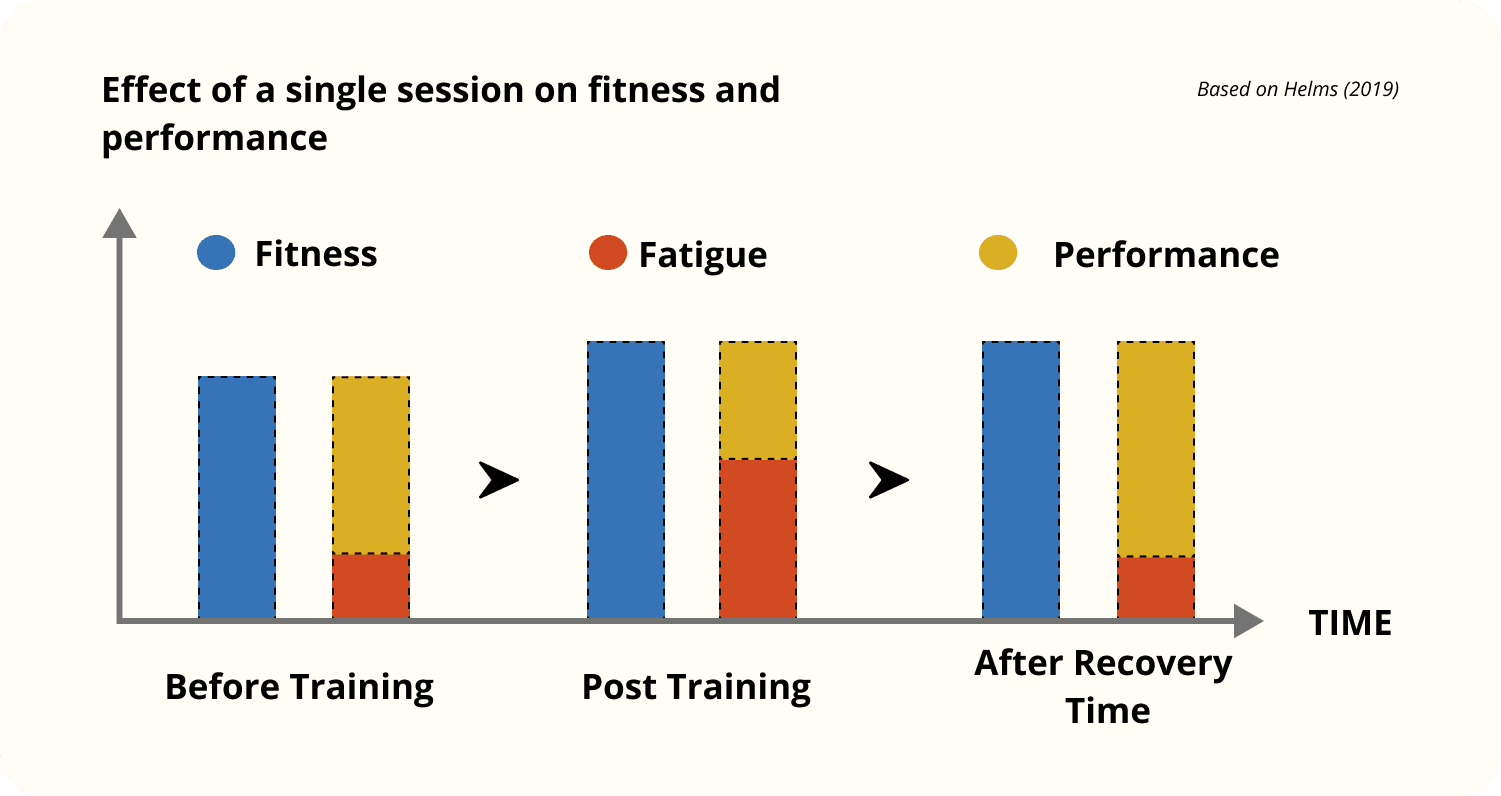
This happens because fitness and fatigue decrease at different rates, with fatigue diminishing much faster.
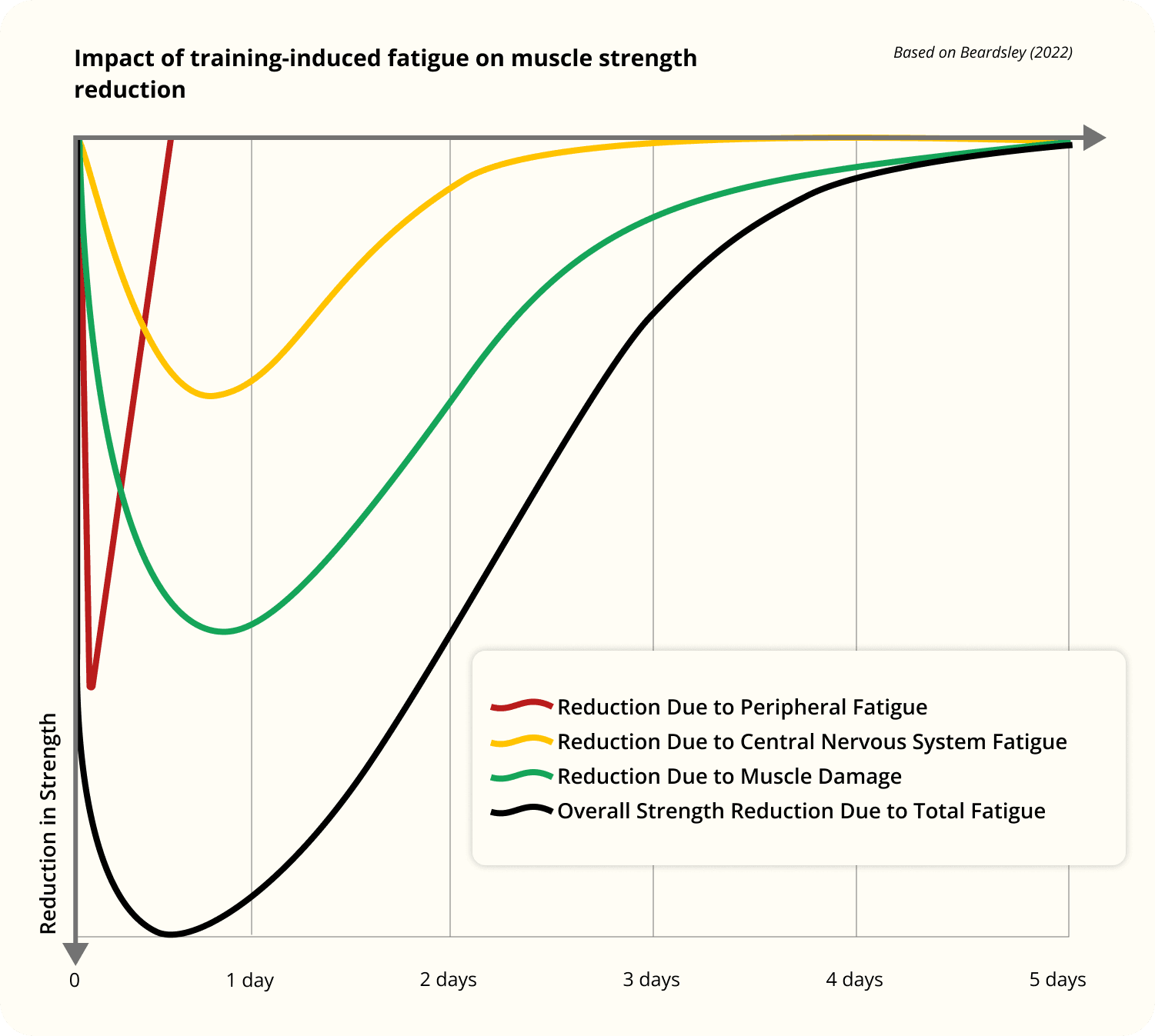
For example, in the next chart, you can see the factors that constitute fatigue and how they significantly decrease between the second and third day after training.
Key Points of the Chart:
- Peripheral Fatigue (Metabolic): This type of fatigue directly impacts the muscles you worked during training and often feels like a burning sensation. Fortunately, it subsides within a few hours (5).
- Central Nervous System Fatigue (Neural): This fatigue affects your ability to voluntarily recruit muscle strength. It usually disappears almost entirely by the second day unless the training caused significant muscle damage (6).
- Muscle Damage: This is the type of fatigue that takes the longest to recover from. Its duration depends on your training, specifically the type of exercises, intensities, and volume you used (7).
Fatigue, therefore, decreases rapidly and at a faster rate than fitness, except in cases of overtraining or injury. This has been particularly observed in strength and endurance sports, where fitness tends to remain stable even with minimal training (1).
Additionally, other factors also influence fatigue and the ability to achieve optimal performance, such as daily life stress (8) or minor injuries that, while not requiring medical intervention, may necessitate adjustments to the usual training schedule (9).
For these reasons, incorporating periods of reduced physical demand, such as deload weeks, makes a lot of sense within a training plan. They’re even used in more athletic contexts, like pre-competition phases or before maximum strength tests, where they’re referred to as "tapering."
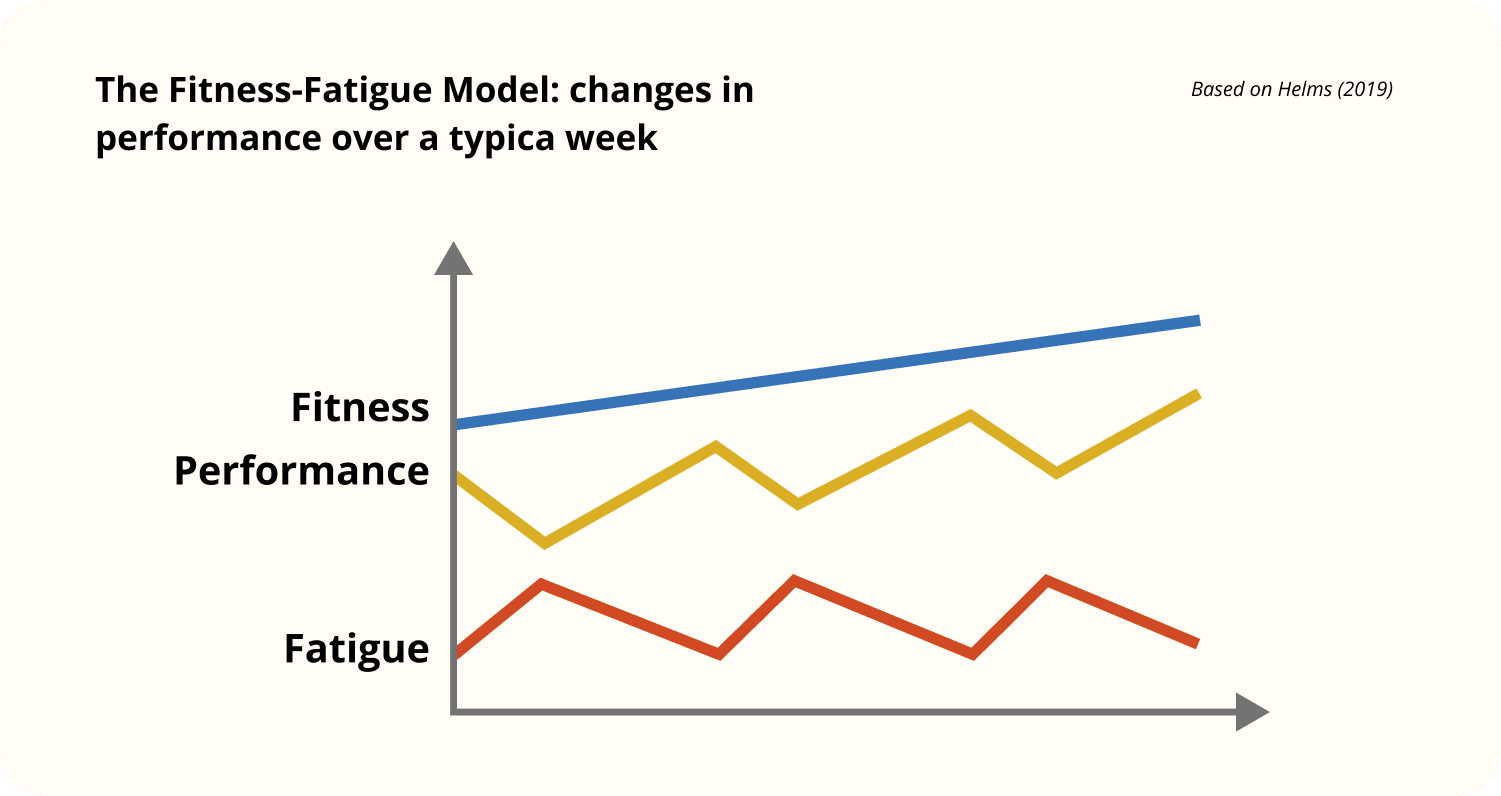
Finally, remember that performance doesn’t always improve linearly, even when fitness progress is steady. Plus, fatigue never completely disappears if you’re training consistently (and when it does, fitness starts to decline).
That’s why it’s so important to find the right balance: you can’t always be in a deload phase, as it wouldn’t create enough overload to drive new adaptations and keep progressing.
How to Implement a Deload Week
In the sports world, various strategies have been developed to reduce fatigue and maximize performance before a competition. These periods, known as "tapering," typically last between 1 and 4 weeks and may include a linear reduction in training load or a more drastic decrease, among other characteristics (10).
It’s worth noting that for those who train in gyms or practice strength sports, a simple deload week resembles a "taper." However, the approach to reducing fatigue is less aggressive since the primary goal is not to maximize performance but to simply facilitate recovery.
Below are the recommended parameters for implementing a deload week in practice:
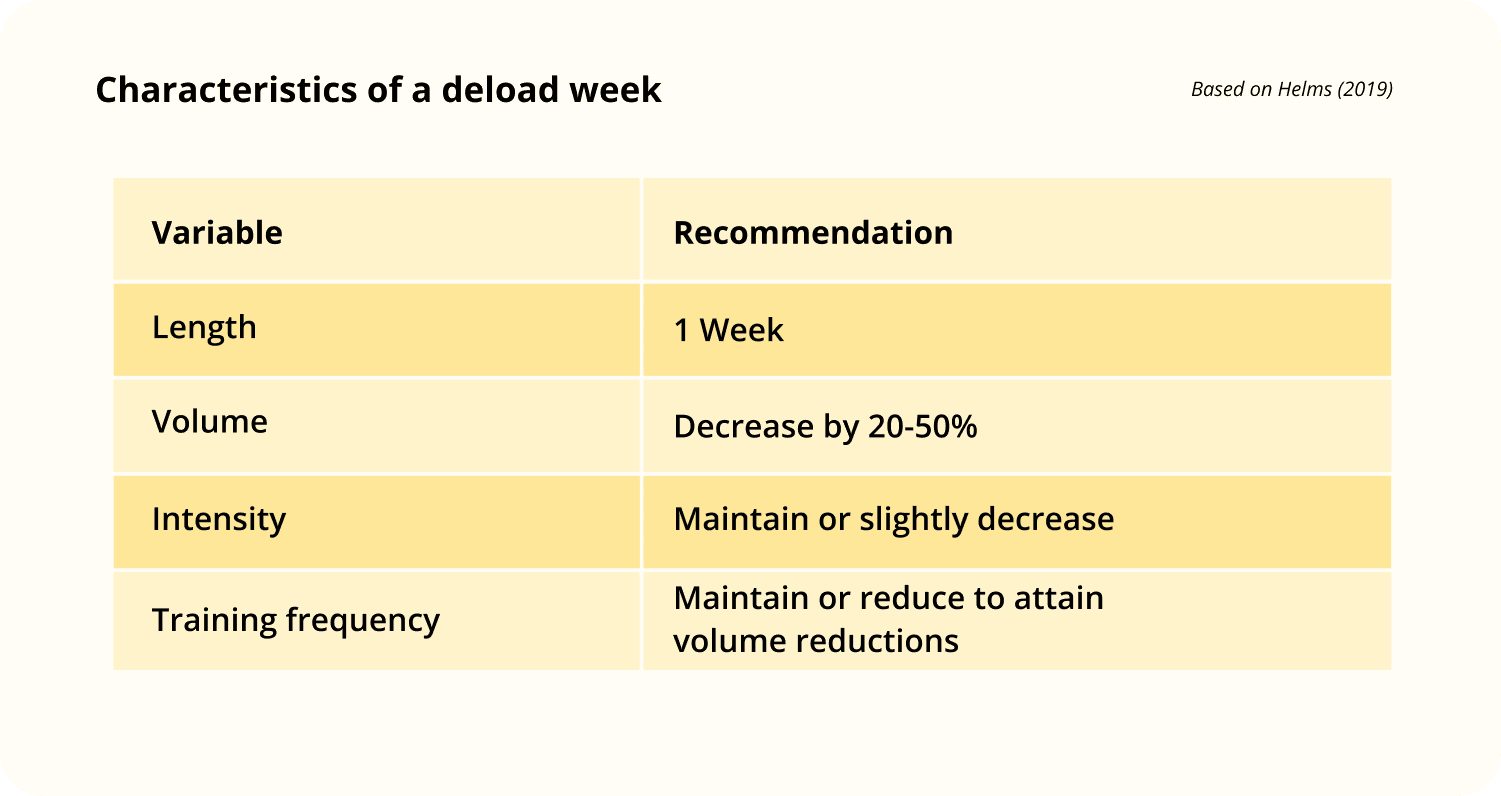
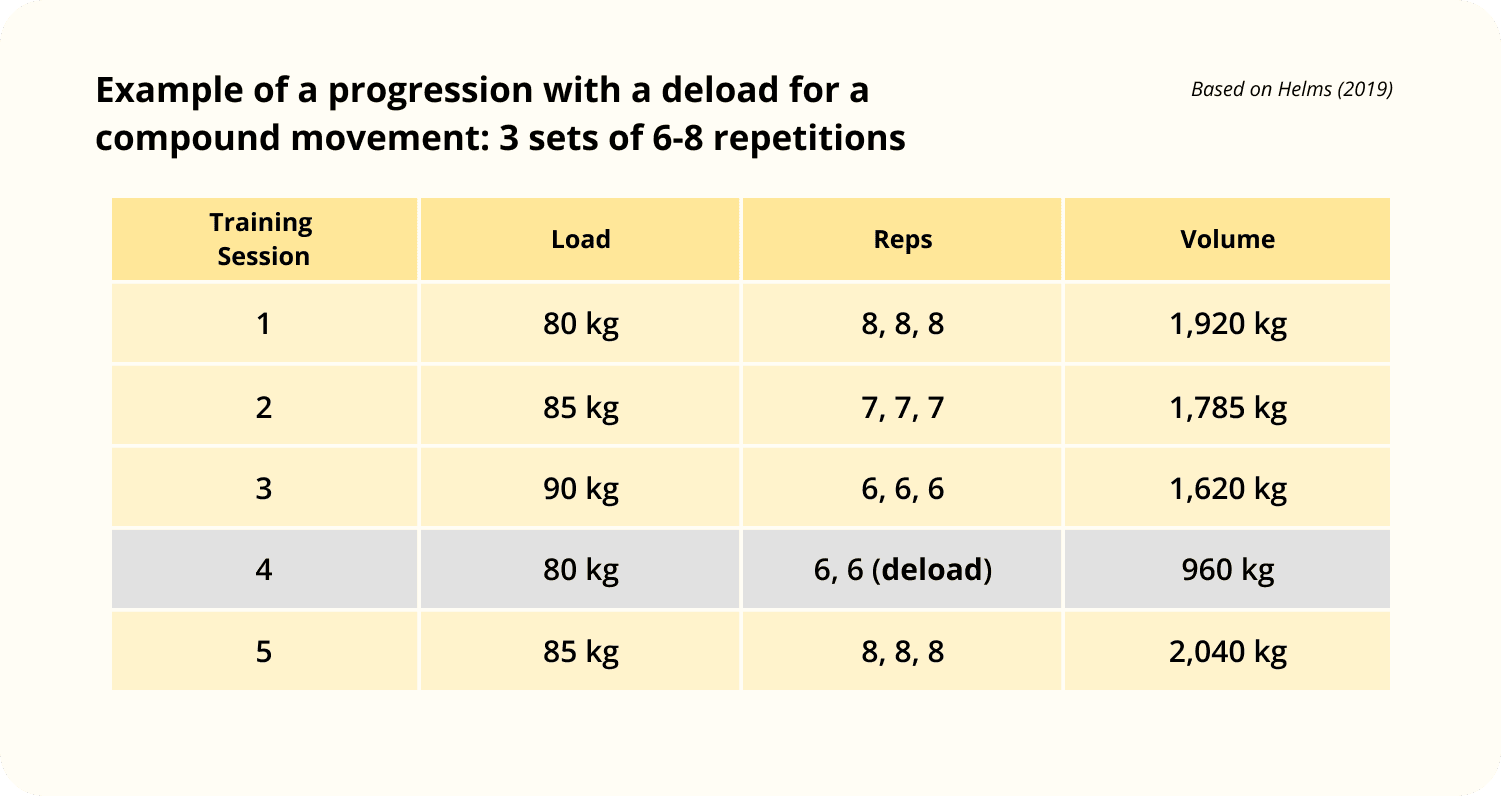
Generally, one week is enough to effectively reduce fatigue. Training volume, calculated as sets x reps x weight, should be reduced by 20% to 50%. For example, if you usually perform 3 sets of 8 reps with 50 kg (total volume of 1200 kg), during a deload week, you could do 2 sets of 6 reps with the same weight, representing a 50% reduction in total volume.
As for intensity—the weight used—it should be maintained or slightly decreased. However, the perceived effort (measured by velocity, RPE, or RIR) should be lower than usual, which happens naturally when reducing the number of reps per set.
Finally, training frequency, or the number of sessions per week, can remain the same or be reduced if needed to achieve the appropriate volume.
For better clarity, here’s a practical example of how to program a deload for a compound exercise.
When to Implement a Deload Week?
Deload weeks can be used to bridge different training blocks if:
- You plan to continue a similar training program but with heavier loads in the next block.
- You intend to reduce volume in the next program while increasing loads or perceived effort levels.
- You want to test your maximum strength in one or more movements (in this case, it would be considered "tapering").
Similarly, deload weeks can also be used as introductory weeks:
- When starting a new program with unfamiliar movements that require different adaptations, or even when switching gyms and needing to get accustomed to new plates, heights, bars, etc. In this case, these weeks serve more as preparation than recovery.
- When transitioning from a low-volume strength block to a high-volume one. Here, the introductory week acts as a bridge to help you adapt to the increased repetitions without being too challenging in terms of loads.
Finally, before including a deload week between training blocks, it’s helpful to ask yourself the following questions to determine if it’s truly necessary:
- Do you feel unmotivated to go to the gym?
- Has your sleep quality worsened?
- Are you noticing a decrease in loads or repetitions?
- Is your stress level higher than usual?
- Are you experiencing more aches or pains than normal?
What to do based on your answers:
- 0-1 affirmative answers: You can start the next training block without needing a deload week.
- 2 or more affirmative answers: A deload week is recommended.
- Affirmative answer only to aches and pains: Opt for a week of training with high repetitions and low loads, which will allow better recovery for your joints and connective tissues.
- Preventive deload: If, after 15 weeks, you consistently respond with 0-1 affirmative answers, it might be a good idea to include a deload week as a preventive measure.
In Summary...
- Fitness and fatigue are direct outcomes of training, and their balance defines performance. However, fatigue tends to diminish faster than fitness. For this reason, achieving a good balance between training overload and fatigue management is key to improving fitness and reaching optimal performance.
- In sports, gradually reducing training volume while maintaining intensity can reliably increase maximum strength performance after a period of overload. This approach is commonly referred to as "tapering."
- For the general population, a conservative volume reduction of 20% to 50% is sufficient to decrease fatigue between training blocks, without the need for more drastic measures.
- Deload weeks are typically performed between training blocks with similar stimuli but different intensity demands, helping to manage the transition effectively.
- When used as introductory weeks, they act as a bridge between low-volume and high-volume blocks. In this case, the primary goal is to prepare the body for new demands rather than focus on recovery.
References
References
- Helms, E. (2019, March). Implementing deloads, part 1 [Video]. MASS. https://www.massmember.com/products/mass-subscription/categories/1167606/posts/3868306
- Helms, E. (2019, April). Implementing deloads, part 2 [Video]. MASS. https://www.massmember.com/products/mass-subscription/categories/1241973/posts/4134322
- Bannister, E.W. Modeling elite athletic performance. In: Physiological Testing of the High-Performance Athlete. J.D. MacDougall, H.A. Wenger, and H.J. Green, eds. Champaign, IL: Human Kinetics, 1991. Pp. 403–424.
- Chiu, Loren Z.F. MS, CSCS; Barnes, Jacque L.. The Fitness-Fatigue Model Revisited: Implications for Planning Short- and Long-Term Training. Strength and Conditioning Journal 25(6):p 42-51, December 2003.
- Beardsley, C. (16 de octubre de 2018). What determines training frequency? Medium. https://sandcresearch.medium.com/what-determines-training-frequency-62ec783f908f
- Carroll TJ, Taylor JL, Gandevia SC. Recovery of central and peripheral neuromuscular fatigue after exercise. J Appl Physiol (1985). 2017 May 1;122(5):1068-1076. doi: 10.1152/japplphysiol.00775.2016. Epub 2016 Dec 8. PMID: 27932676.
- Hubal MJ, Rubinstein SR, Clarkson PM. Mechanisms of variability in strength loss after muscle-lengthening actions. Med Sci Sports Exerc. 2007 Mar;39(3):461-8. doi: 10.1249/01.mss.0000247007.19127.da. PMID: 17473772.
- Bartholomew JB, Stults-Kolehmainen MA, Elrod CC, Todd JS. Strength gains after resistance training: the effect of stressful, negative life events. J Strength Cond Res. 2008 Jul;22(4):1215-21. doi: 10.1519/JSC.0b013e318173d0bf. PMID: 18545186.
- Strömbäck E, Aasa U, Gilenstam K, Berglund L. Prevalence and Consequences of Injuries in Powerlifting: A Cross-sectional Study. Orthop J Sports Med. 2018 May 14;6(5):2325967118771016. doi: 10.1177/2325967118771016. PMID: 29785405; PMCID: PMC5954586.
- Pritchard, Hayden BSc1,3; Keogh, Justin PhD2,3,4; Barnes, Matthew PhD5; McGuigan, Michael PhD, CSCS*D3. Effects and Mechanisms of Tapering in Maximizing Muscular Strength. Strength and Conditioning Journal 37(2):p 72-83, April 2015. | DOI: 10.1519/SSC.0000000000000125
Fitia: Meal Plans & Calorie Counter
We use cookies to enhance your browsing experience, analyze site traffic, and personalize content. By clicking 'Accept', you consent to the use of these technologies in accordance with our Privacy Policy.