Should You Eat Before Weight Training to Boost Your Performance?
Find out how eating carbohydrates before training can boost your weightlifting performance, backed by recent studies.
- Published
- Updated
- 5 min read
- 5 min read

Why Is Eating Before Working Out Recommended?
Over the past decades, scientific research has focused on understanding how eating, especially carbohydrates, before exercising impacts performance.
However, most of these studies have primarily examined endurance sports, such as cycling and long-distance running.
Thanks to this research, we know that running low on glycogen (the fuel derived from carbohydrates) can negatively impact performance in endurance sports. On the other hand, consuming carbohydrates before training can make a big difference, enhancing your capacity and overall performance.
Recent studies, such as those by Pöchmüller et al. (2016) and Nielsen et al. (2020), support the importance of pre-workout nutrition. In particular, Nielsen highlights that combining carbohydrates and proteins further enhances performance by not only providing energy but also helping to mitigate muscle damage caused by training.
With this evidence, it seems logical to assume that eating carbohydrates before training is also essential for those who lift weights and aim to build muscle mass.
However, there are reasons that complicate the direct application of these recommendations from endurance sports to strength training or weightlifting.
Next, we will explore the mechanisms that support pre-workout nutrition and delve into the ambiguities surrounding this practice in the context of weight training.
You might find this article interesting 👉 What to Eat Before a Workout? Quick and Easy Pre-Workout Snacks
What Mechanisms Support Eating Carbohydrates Before Weight Training?
There are various mechanisms that could theoretically explain how consuming carbohydrates before training can enhance performance in weightlifting.
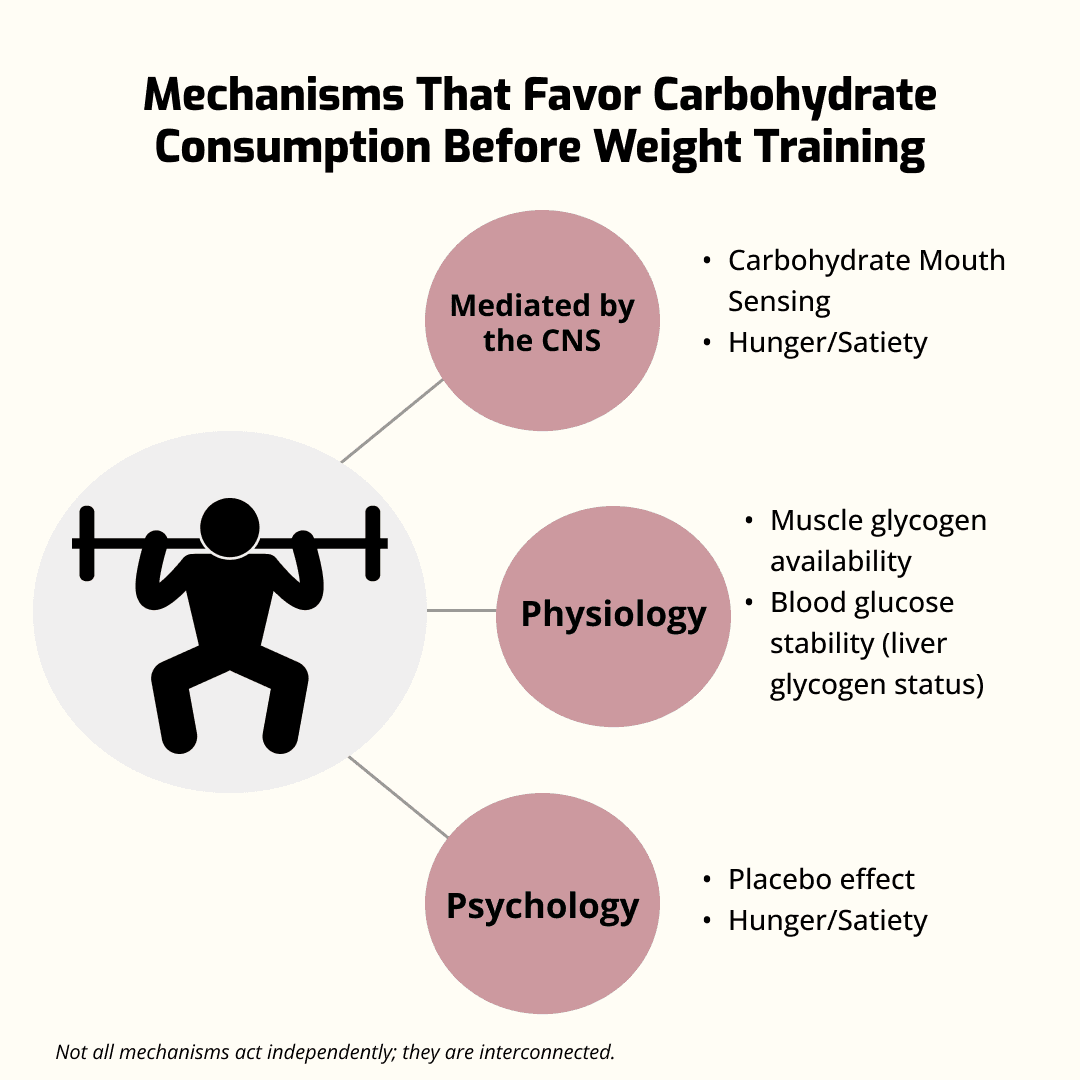
These mechanisms can be categorized into psychological factors, physiological factors, and those mediated by the central nervous system:
1. Psychology
Mental state plays a significant role in physical performance. Consuming carbohydrates before training can create a placebo effect, making a person feel stronger and more prepared to start their session.
On the other hand, training on an empty stomach could negatively impact the perception of one's ability to perform, which in turn may affect actual performance.
Additionally, the sensation of hunger can be a significant distraction, reducing focus and concentration needed for an effective workout.
2. Carbohydrate Availability (Physiology)
The body stores glycogen in the muscles and liver from the consumption of carbohydrates, using it as a primary energy source during physical activity. If glycogen levels are low due to fasting or insufficient intake after previous sessions, performance may be compromised.
Similarly, low liver glycogen levels can destabilize blood glucose, potentially leading to episodes of hypoglycemia, which further reduces performance capacity.
3. Mediated by the Central Nervous System
The brain plays a key role in regulating physical performance by assessing the body's energy status. For instance, receptors in the mouth can send signals to the brain about energy availability, directly influencing performance.
Similarly, feelings of hunger or satiety can also impact the body's response to the physical demands of training.
These mechanisms highlight the theoretical importance of consuming carbohydrates before training. In the next section, we will explore what science has revealed about these factors in real-world scenarios.
What Does Science Say About Eating Carbohydrates Before Weight Training?
There are arguments questioning the magnitude of the benefits of consuming carbohydrates before weight training, suggesting these benefits may not be comparable to those observed in endurance sports. After all, endurance activities involve continuous, prolonged efforts, such as an hour of cycling, whereas weightlifting sessions consist of 30- to 60-second sets with long rest periods in between.
This ambiguity is highlighted by Cholewa et al. (2019), who noted that differences in intensity, volume, and rest times between sets in strength and physical training result in distinct metabolic responses, which could explain varying carbohydrate needs based on the type of activity.
Additionally, individual responses to low-carbohydrate diets vary significantly. In a study by Chatterton et al. (2017), involving five athletes (Olympic and powerlifters), two gained strength, two showed no changes, and one lost strength after following a low-carbohydrate, high-fat diet.
However, Hokken et al. (2021) reported that localized glycogen depletion in muscle fibers could impair performance even with modest overall muscle glycogen depletion.
This suggests that, while weightlifting may seem less energy-demanding compared to endurance sports, it still requires sufficient carbohydrate availability for optimal performance.
On the other hand, Mohamed Nashrudin Naharudin and his team conducted three studies comparing performance under different conditions:
- With and without breakfast.
- Result: Eating breakfast before training improved performance.
- No breakfast, high-carbohydrate breakfast, and low-carbohydrate placebo breakfast.
- Result: Even a low-carbohydrate placebo breakfast supported performance.
- Solid high-carbohydrate breakfast (high satiety) versus liquid high-carbohydrate breakfast (low satiety).
- Result: Satiety levels were the most critical factor for predicting performance, especially in sessions with low to moderate volumes and short durations.
Furthermore, Henselmans et al. (2022) indicated that consuming carbohydrates before training is more relevant for those training in a fasted state, such as early in the morning, and less critical for those who have already eaten prior meals.
Finally, King et al. (2022) concluded in their meta-analysis that pre-training carbohydrate intake, regardless of dose (starting at 0.3 g/kg), is particularly beneficial for high-volume, long-duration workouts exceeding 45 minutes.
In summary...
The importance of consuming carbohydrates before training depends on several factors, such as the type of exercise, training volume, duration, and the individual's energy status. For low-volume strength training, like that performed by powerlifters, the impact is minimal and more closely tied to satiety perception and individual response.
However, as training volume and duration increase, carbohydrate intake before training becomes more relevant to ensure optimal performance. This is particularly true for high-intensity sessions or when glycogen reserves are low, such as during fasted workouts or after insufficient carbohydrate intake following the last session.
Additionally, recent studies have shown that even moderate amounts of carbohydrates (0.2-0.3 g/kg) before training can be beneficial, especially for prolonged or high-volume workouts.
Therefore, while consuming carbohydrates before training is not strictly necessary in all cases, it can be an effective strategy to optimize performance, particularly in conditions that demand higher energy and endurance.
References
- Helms, E. (2022). Pre-training meals: An update – Protein and nutrient timing [Video]. MASS (Monthly Applications in Strength Sport). https://www.massmember.com/products/videos-by-category/categories/2156518487/posts/2182845678
- Pöchmüller M, Schwingshackl L, Colombani PC, Hoffmann G. A systematic review and meta-analysis of carbohydrate benefits associated with randomized controlled competition-based performance trials. J Int Soc Sports Nutr. 2016 Jul 11;13:27. doi: 10.1186/s12970-016-0139-6. PMID: 27408608; PMCID: PMC4940907.
- Kloby Nielsen LL, Tandrup Lambert MN, Jeppesen PB. The Effect of Ingesting Carbohydrate and Proteins on Athletic Performance: A Systematic Review and Meta-Analysis of Randomized Controlled Trials. Nutrients. 2020 May 20;12(5):1483. doi: 10.3390/nu12051483. PMID: 32443678; PMCID: PMC7284704.
- Cholewa JM, Newmire DE, Zanchi NE. Carbohydrate restriction: Friend or foe of resistance-based exercise performance? Nutrition. 2019 Apr;60:136-146. doi: 10.1016/j.nut.2018.09.026. Epub 2018 Oct 6. PMID: 30586657.
- Chatterton, S., et al., The effect of an 8-week low carbohydrate high fat (LCHF) diet in sub-elite Olympic weightlifters and powerlifters on strength, body composition, mental state and adherence: a pilot case-study. Journal of Australian Strength and Conditioning, 2017. 25(2).
- Hokken R, Laugesen S, Aagaard P, Suetta C, Frandsen U, Ørtenblad N, Nielsen J. Subcellular localization- and fibre type-dependent utilization of muscle glycogen during heavy resistance exercise in elite power and Olympic weightlifters. Acta Physiol (Oxf). 2021 Feb;231(2):e13561. doi: 10.1111/apha.13561. Epub 2020 Oct 4. PMID: 32961628.
- Paoli A, Cenci L, Pompei P, Sahin N, Bianco A, Neri M, Caprio M, Moro T. Effects of Two Months of Very Low Carbohydrate Ketogenic Diet on Body Composition, Muscle Strength, Muscle Area, and Blood Parameters in Competitive Natural Body Builders. Nutrients. 2021 Jan 26;13(2):374. doi: 10.3390/nu13020374. PMID: 33530512; PMCID: PMC7911670.
- Naharudin MN, Yusof A, Clayton DJ, James LJ. Starving Your Performance? Reduced Preexercise Hunger Increases Resistance Exercise Performance. Int J Sports Physiol Perform. 2022 Mar 1;17(3):458-464. doi: 10.1123/ijspp.2021-0166. Epub 2021 Dec 6. PMID: 34872065.
- Henselmans M, Bjørnsen T, Hedderman R, Vårvik FT. The Effect of Carbohydrate Intake on Strength and Resistance Training Performance: A Systematic Review. Nutrients. 2022 Feb 18;14(4):856. doi: 10.3390/nu14040856. PMID: 35215506; PMCID: PMC8878406.
- King A, Helms E, Zinn C, Jukic I. The Ergogenic Effects of Acute Carbohydrate Feeding on Resistance Exercise Performance: A Systematic Review and Meta-analysis. Sports Med. 2022 Nov;52(11):2691-2712. doi: 10.1007/s40279-022-01716-w. Epub 2022 Jul 9. PMID: 35809162; PMCID: PMC9584980.
Related articles
 Muscle Gain
Best Nutrition App for Weight Gain in the US (2026): A Practical Comparison of Calorie Surplus & Macro Tracking Tools
Compare the best weight gain apps in the US for 2026. See which calorie surplus and macro tracking features actually help you bulk lean and stay consistent.
Read article Muscle Gain
The Best Calorie Counter Apps for Muscle Gain: What the Evidence Says You Actually Need
We compared the top calorie counter apps for muscle gain in 2026, with what the research says about protein, surplus, and tracking that actually works.
Read article Muscle Gain
Why Most Calorie Counter Apps Make Muscle Gain Harder Than It Needs To Be
Most calorie apps are built for fat loss. Learn why they fail for muscle gain and what to look for to actually build lean mass.
Read article