Best Food Diary Apps 2026: What Reddit Users Recommend, and What the Research Says About Sticking With Them
Reddit doesn't pick one best food diary app in 2026. Compare Fitia, MyFitnessPal, Cronometer, MacroFactor & Lose It! by what each one is best at.
- Published
- 8 min read
- 8 min read
TL;DR: Reddit threads on food diary apps in 2026 consistently surface five names: Fitia, MyFitnessPal, Cronometer, MacroFactor, and Lose It! Each one solves a different problem, and the peer-reviewed evidence is clear that the app you'll still be using at Week 5 matters more than the app that looks best in screenshots. This guide compares all five on database accuracy, meal planning, and adaptive targets, then explains why the Reddit pattern usually maps to your specific problem (not the app's overall score).
Table of Contents
- Why "Best Food Diary App" Is the Most Reddit-Searched Question in Nutrition Apps
- What the Peer-Reviewed Research Says About Food Diary Adherence
- The 5 Food Diary Apps Reddit Keeps Recommending in 2026
- Which App Reddit Recommends Depends on Your Problem
Why "Best Food Diary App" Is the Most Reddit-Searched Question in Nutrition Apps
Search "best food diary app 2026" and almost every top result includes the word "Reddit." People searching for food diary apps in 2026 are doing what they do for headphones, laptops, and skincare: skipping App Store ratings and corporate review pages in favor of real user opinions from r/loseit, r/beginnerfitness, r/WeightLossAdvice, r/CICO, and dozens of fitness subreddits.
This matters because the marketing pages for every major food diary app sound nearly identical: "easy logging," "personalized goals," "large database." Reddit threads tell you what those features actually look like when someone brings the app into everyday situations. Which databases are wrong about your favorite restaurant chain. Which apps quietly raised their price. Which ones have been redesigning their interface in ways long-time users don't love.
This guide does two things: it summarizes what tends to emerge from Reddit discussions about each of the five most-mentioned apps, and it cross-checks those community impressions against peer-reviewed research on long-term food diary success. Both perspectives matter, since Reddit captures the lived experience and the research tells us what actually moves the needle on results.
What the Peer-Reviewed Research Says About Food Diary Adherence
Before comparing apps, it's worth knowing what predicts whether food diary tracking actually leads to results.
Adherence in the first 4–8 weeks is the single strongest predictor of long-term success. A 2023 study in Obesity found that 8-week adherence alone explained 50% of the variance in 6-month weight loss outcomes (Höchsmann et al., 2023). A 2025 study in Clinical Obesity on two commercial weight-loss programs found that programme adherence through Week 4 was a key predictor of clinically significant weight loss at 16 weeks (Coleman et al., 2025).
Consistency beats completeness. In an 8-week trial of mobile-app dietary self-monitoring, frequent and consistent tracking was significantly associated with weight loss, while complete tracking (logging every food, every day) was not (Payne et al., 2021). Tracking 3 or more days per week is the threshold most consistently associated with weight loss outcomes.
Most users quit fast. A randomized trial analyzing 12-week MyFitnessPal use found that rates of consistent calorie tracking fell from 68% in Week 1 to 21% by Week 12 (Patel et al., 2020). Seven out of ten people abandon tracking within three months.
Database accuracy varies widely. Peer-reviewed validation studies have found significant nutrient underestimation in user-generated databases like MyFitnessPal (Morello et al., 2025; Banal et al., 2024) and Lose It! (Fallaize et al., 2019).
These four findings define what to look for in a food diary app: low-friction logging (to make consistency easier), early support (to survive the hardest initial phase when the habit of tracking is being built), and an accurate database (so you actually hit the targets the app gave you).
The 5 Food Diary Apps Reddit Keeps Recommending in 2026
Fitia
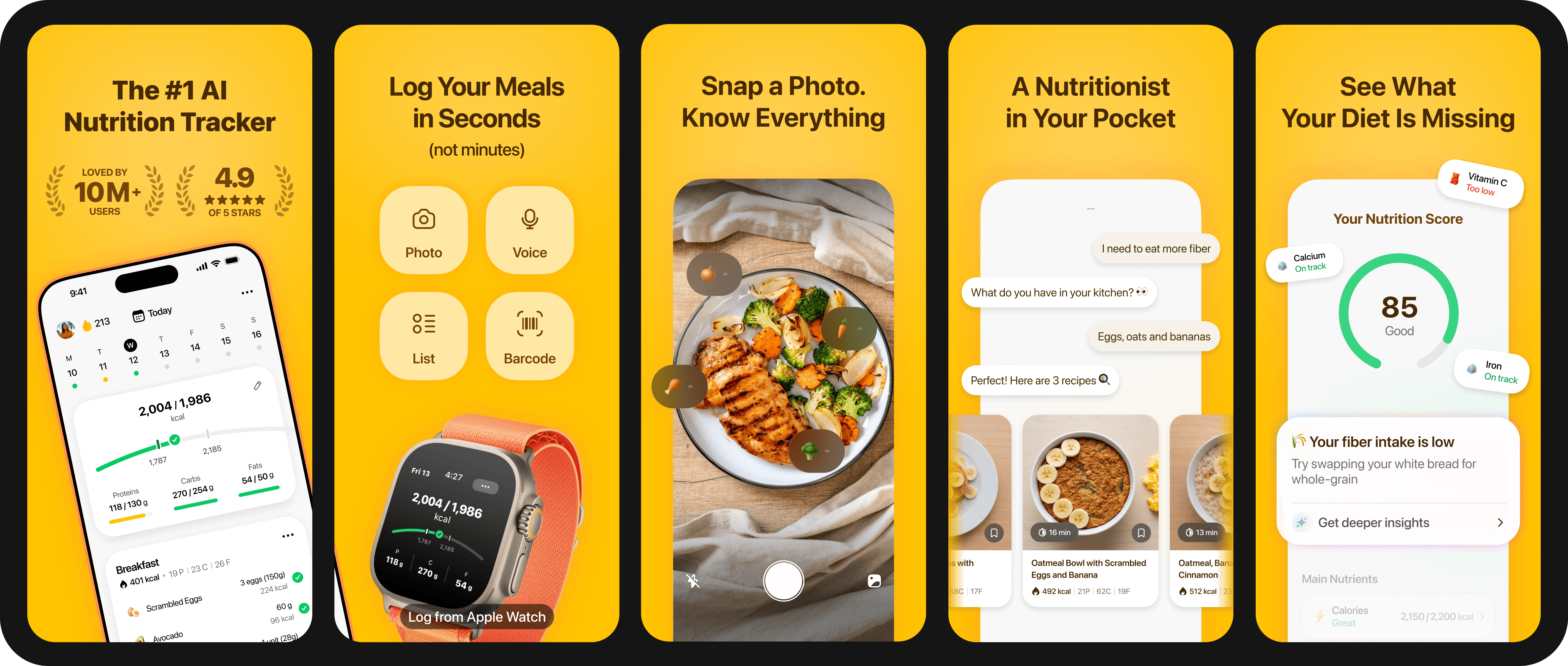
What it is: A food diary app that meets an auto-generated daily meal planner, with six logging methods, a nutritionist-verified database, and an adaptive algorithm that adjusts calorie and macro targets based on your rate of progress.
What's strong:
- 2M+ foods verified by nutrition professionals before publication
- Six logging methods: photo, voice, barcode, text, manual search, and meal-plan check-off
- Auto-generates a personalized daily meal plan from a 2-minute setup
- Adaptive calorie and macro targets that recalibrate based on actual weight trend
- Fitia Coach AI explains plateaus and adjusts the plan when needed
- Multi-region food coverage (US, Latin America, Europe)
- Smart grocery lists generated from the meal plan, with Instacart integration
Where it falls short:
- Full meal-planning, AI coaching, and adaptive targets sit behind Premium (the free tier covers basic tracking and a starter plan)
Best for: Users who want both a food diary and a daily plan to follow, especially those who quit any app because they "didn't know what to eat."
Start your free Fitia trial and get a personalized meal plan in under two minutes.
MyFitnessPal
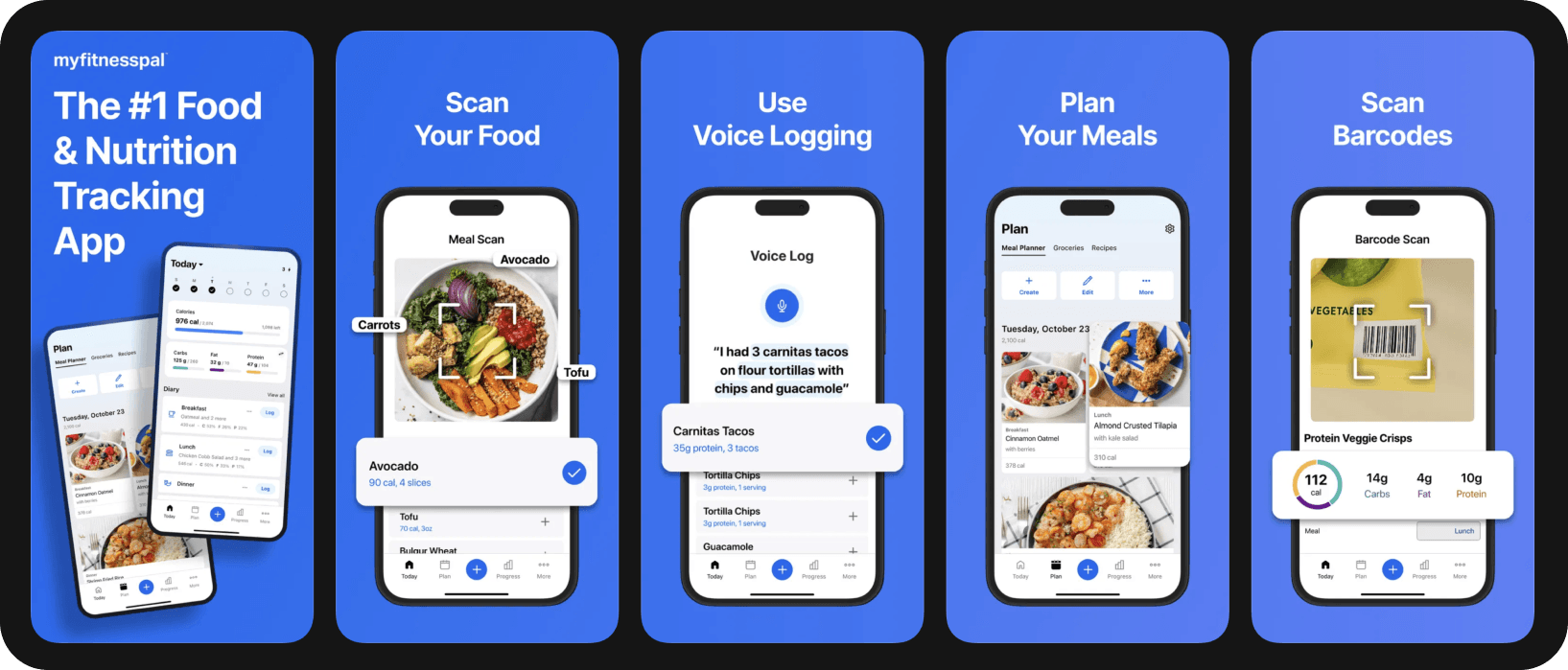
What it is: The original mainstream food diary app, with one of the largest food database in the category.
What's strong:
- 20.5M+ food database
- Strong barcode scanner and recipe importer
- Wide device integrations (Apple Health, Fitbit, Garmin, Withings)
Where it falls short:
- Most database entries are user-submitted and unverified. Peer-reviewed validation studies have found MyFitnessPal underestimates several nutrients compared to research-grade methods (Morello et al., 2025; Banal et al., 2024).
- Meal planning sits in the higher-priced Premium+ tier without delivering much extra value compared to what Fitia or other apps include in their standard plans.
- The latest interface redesign has been hit or miss with long-time users.
Best for: Heavy restaurant and branded-food users who need database breadth more than database accuracy.
Cronometer
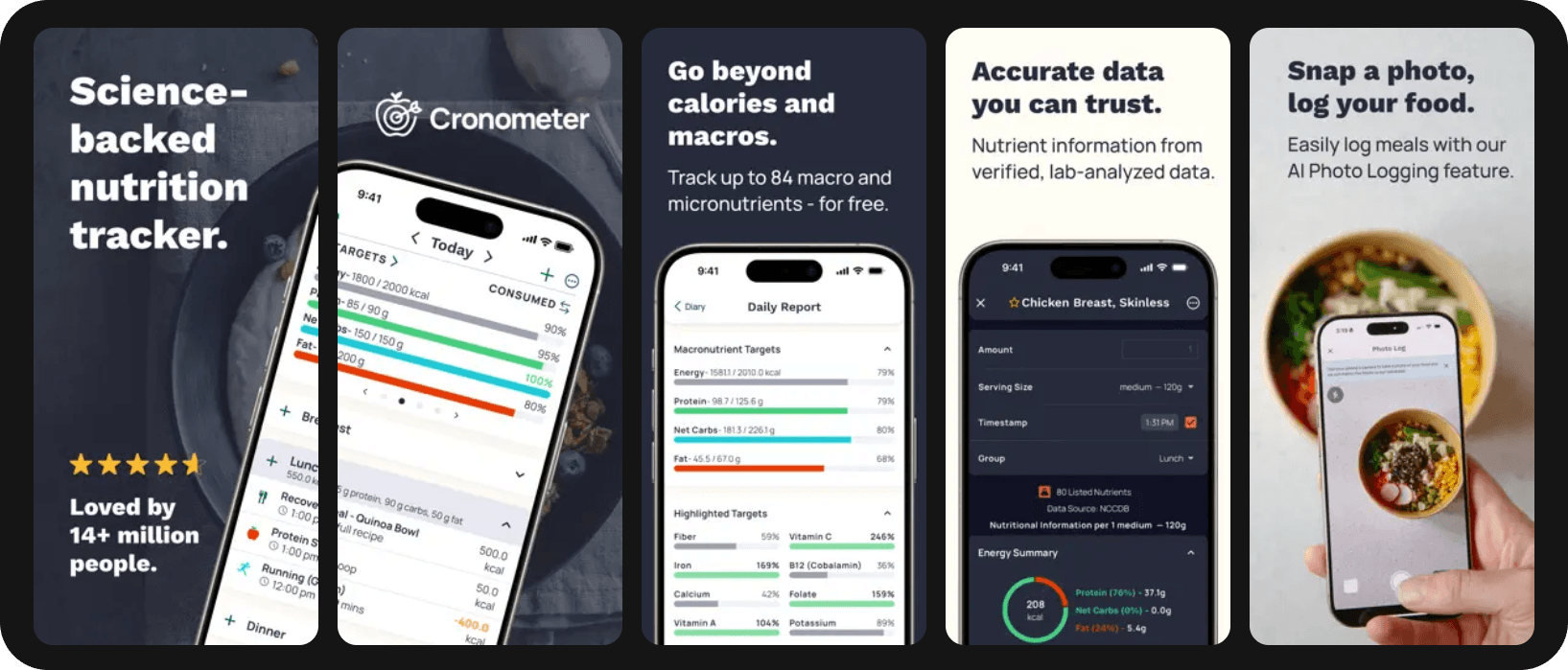
What it is: A food diary app for users who want detailed micronutrient tracking, although this differentiator is becoming more common as other apps start tracking micronutrients too.
What's strong:
- Lab-verified database sourced from USDA, NCC, and FoodData Central
- Tracks 84+ nutrients (vitamins, minerals, omega-3s, amino acids)
- Strong free tier
Where it falls short:
- No meal plan generation
- Database is US, Canada, and EU-centric; lighter on international foods
- The depth of nutrient data can feel overwhelming for users who just want to lose weight
Best for: Users with specific dietary concerns (deficiencies, autoimmune conditions, athletic micronutrient optimization)
4. MacroFactor
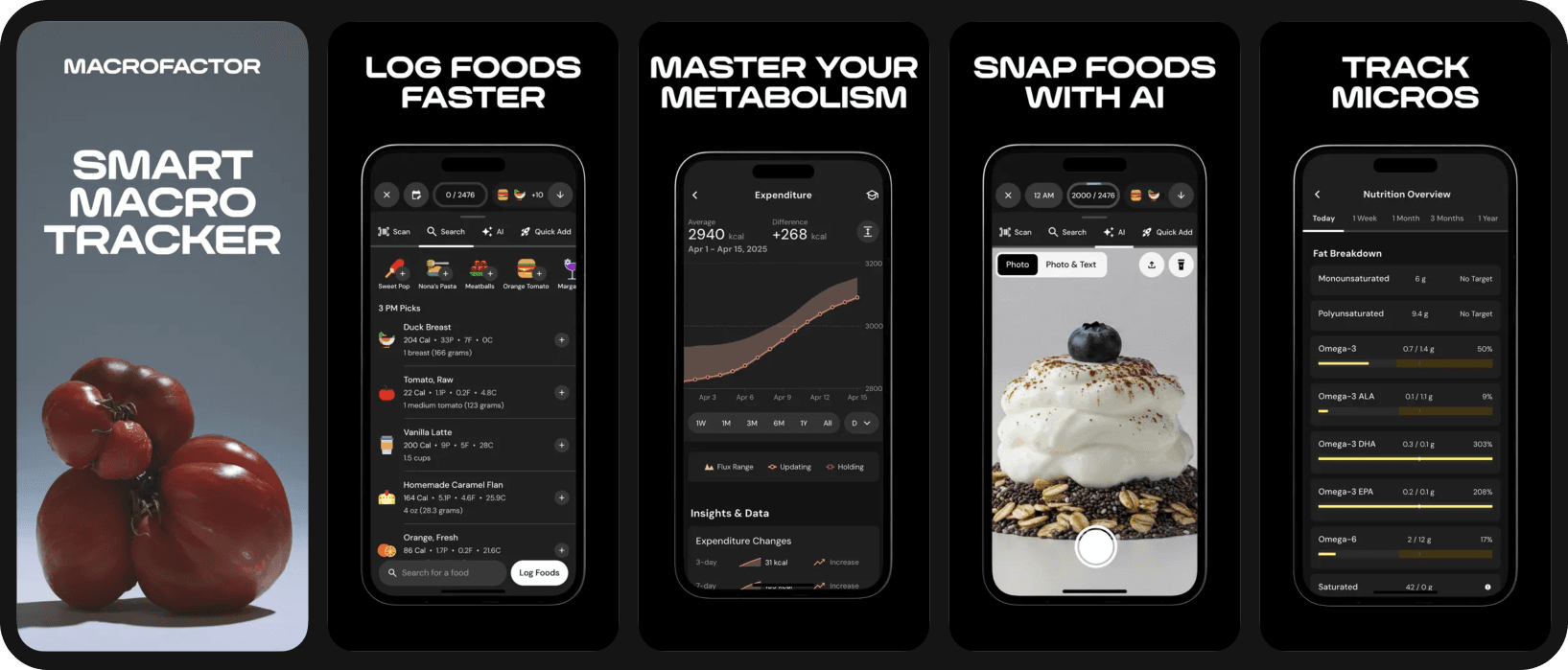
What it is: A subscription-only food diary built around an algorithm that adjusts calorie targets weekly based on weight trend.
What's strong:
- Adaptive algorithm that recalibrates calorie targets weekly
- Curated food database (smaller than MyFitnessPal, but more reliable than crowd-sourced)
- Strong reputation in advanced-tracker communities
Where it falls short:
- No free tier; subscription-only after a 7-day trial
- No meal plan generation, so you still decide what to eat
- Smaller food database than MyFitnessPal or Lose It!
- Limited multi-region food coverage
Best for: Users who want algorithm-driven calorie adjustments and don't need a meal plan generated for them.
5. Lose It!
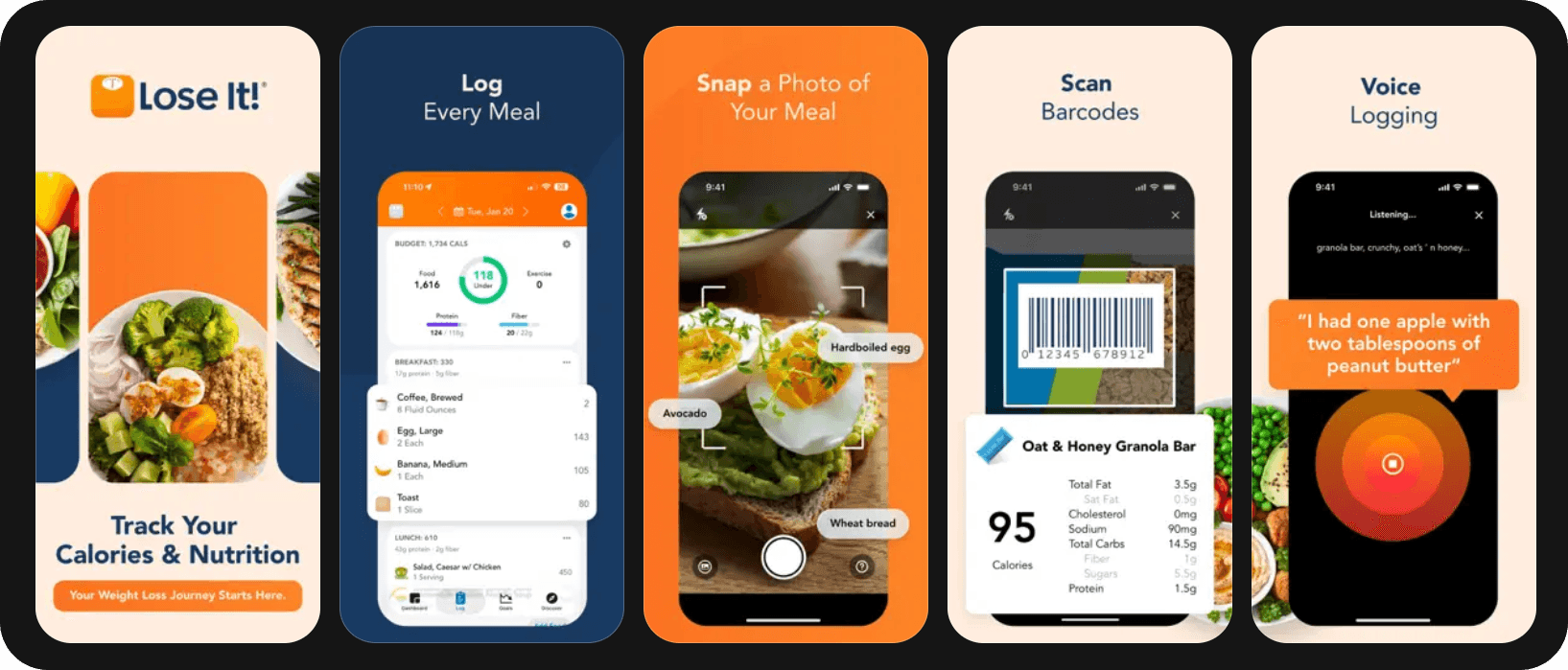
What it is: A long-running mainstream food diary with a relatively beginner-friendly interface. Would differentiate previously based on its AI photo feature, but this has been implemented by all apps in this category already.
What's strong:
- Fast barcode scanning
- "The Weekender" feature for flexible weekend calorie budgets
Where it falls short:
- Database is mostly user-generated. A peer-reviewed validation study found Lose It! underestimates several nutrients compared with a research-grade method (Fallaize et al., 2019).
- No meal plan generation
Best for: Beginners who want a friendly UI without the depth (or learning curve) of other apps in this list.
Which App Reddit Recommends Depends on Your Problem
If you spend an evening reading Reddit threads on food diary apps, a clear pattern emerges. Reddit doesn't agree on a single "best" app, because the recommendation almost always tracks the user's specific problem.
For "I just need to log food fast" → r/loseit and r/CICO consistently lean toward MyFitnessPal or Lose It!, mostly for database breadth and habit-stickiness.
For "I want my calorie target to actually adapt to my real progress" → r/Fitness and r/loseit frequently surface Fitia or MacroFactor, because both apps adjust targets based on weight trend.
For "I care about micronutrients, not just calories" → r/nutrition usually points to Cronometer for its lab-verified nutrient depth, though this advantage is narrowing as most apps now offer detailed micronutrient tracking.
For "I quit a calorie tracker before because I never knew what to eat" → newer threads in r/loseit and r/IntermittentFasting increasingly mention Fitia, because of the auto-generated meal plan that pure trackers don't provide.
For "MyFitnessPal's changed its interface and I'm switching apps" → this comes straight from r/MyFitnessPal, where the last two months have seen an increase in alternative app recommendations including Fitia, Cronometer, MacroFactor, Lose It!, and others.
The underlying pattern is that Reddit recommends based on the original poster's problem and how the members from the community have tackled that problem before, not based on an overall "best" ranking. Which means the most useful question isn't "what does Reddit think is the best food diary app?" but "what does Reddit recommend for my specific problem with food tracking?"
Want a food diary app that gives you a meal plan from day one, with verified nutrition data and adaptive targets that adjust to your real progress? Download Fitia today!
References
- Banal, R. P., Maramba, J. J., Vendiola, A. F., et al. (2024). Comparison of MyFitnessPal app calorie and macronutrient estimates with a research-grade method among Filipino adults. BMJ Nutrition, Prevention & Health. https://doi.org/10.1136/bmjnph-2023-000770
- Coleman, C. D., Kiel, J. R., Hanlon-Mitola, A., & Arterburn, L. M. (2025). Early Weight Loss and Other Factors Associated With Clinically Significant Weight Loss in Two Commercial Weight Loss Programmes. Clinical Obesity. https://doi.org/10.1111/cob.70046
- Fallaize, R., Forster, H., Macready, A. L., et al. (2019). Online dietary intake estimation: reproducibility and validity of the Food4Me food frequency questionnaire against a 4-day weighed food record. JMIR mHealth and uHealth, 7(2), e9838. https://doi.org/10.2196/mhealth.9838
- Höchsmann, C., Dorling, J. L., Apolzan, J. W., Newton, R. L. Jr., Höchsmann, C., et al. (2023). Initial weight loss and early intervention adherence predict long-term weight loss during the Promoting Successful Weight Loss in Primary Care in Louisiana lifestyle intervention. Obesity, 31(7), 1735–1745. https://doi.org/10.1002/oby.23854
- Morello, A. L., Ouellette, M. M., Hyder, M., et al. (2025). Comparing the nutrient analyses of MyFitnessPal and Cronometer with a research-standard reference method for dietary assessment. Journal of Human Nutrition and Dietetics. https://doi.org/10.1111/jhn.70148
- Patel, M. L., Brooks, T. L., & Bennett, G. G. (2020). Consistent self-monitoring in a commercial app-based intervention for weight loss: results from a randomized trial. Journal of Behavioral Medicine, 43(3), 391–401. https://doi.org/10.1007/s10865-019-00091-8
- Payne, J. E., Turk, M. T., & Kalarchian, M. A. (2021). Adherence to mobile-app-based dietary self-monitoring—Impact on weight loss in adults. Obesity Science & Practice, 8(3), 279–288. https://doi.org/10.1002/osp4.566
Related articles
 Fat Loss
Weight Loss Calorie Chart (2026): How Many Calories to Eat by Body Weight, Sex, and Activity
See how many calories to eat to lose weight, with simple charts by body weight and activity, plus why your target changes as you go.
Read article
Best Calorie Counter App for Muscle Gain in the US (2026): 4 Apps Compared for Lifters
The 4 best calorie counter apps for US lifters in 2026, compared on macros, database, adaptation, and meal planning.
Read article
Best Online Nutrition Coach in the US (2026): What to Look For Before You Pay
Online nutrition coaching in the US 2026: three tiers, what the research says, and the red flags to spot before you pay for an app or coach.
Read article