Nov 12, 2025
How to Read a Nutrition Label: Common Mistakes to Avoid
Many times, when choosing a product, we go by the first thing we read on the label, whether it says light, low-fat, sugar-free, or shows how many calories, carbohydrates, proteins, and fats it contains.
But there’s much more on a label to pay attention to than just the front or the nutrition facts panel.
Here, we’ll show you how to read a nutrition label correctly so you can make smarter and healthier food choices.
Plus, with Fitia, you can scan any product’s barcode and instantly see its key attributes, like whether it’s high in sodium, high in sugar, or high in fiber. This makes reading and understanding nutrition information much easier. Download it for free here.
Can You Trust the Front Labels on Food Packages?
Not really. The front of the package gives you an idea of what the product is, but it doesn’t tell the whole story.
In fact, studies show that most consumers focus more on front-of-package labels than on the nutrition facts panel or ingredients list, which can lead to confusion and poor food choices (1, 2, 3)
You’ll often see front labels with terms like “light,” “low-fat,” “low-sugar,” or “gluten-free.” But these claims don’t automatically mean the product is the best or the healthiest option.
It’s important to understand some of the common misconceptions:
- “Light” or “low-fat” isn’t the same as “0% fat.” The first two mean the product has reduced fat content, while “0% fat” means all fat has been removed.
- “Low sugar” doesn’t mean “no sugar.” It only indicates that the sugar content is lower, but it could still be relatively high.
- “No sugar” isn’t the same as “no added sugars.” The latter means no extra sugars were added, but the product may still contain natural sugars.
How to Read the Ingredients List on a Food Label
Many people overlook this part, but the ingredients list is one of the most important sections on a food label. It shows what you’re actually consuming and, believe it or not, also reveals how much of each ingredient is in the product (3, 4).
When reading the ingredients, the first three listed are the most important.
That’s because ingredients appear in descending order by weight: the main ingredient (the one used in the largest amount) comes first, followed by the second, and so on.
A classic example: a product labeled “whole-wheat bread” might list “enriched wheat flour” first instead of “whole-wheat flour,” with a little wheat bran as the fourth or fifth ingredient. This means it’s not truly whole-wheat bread, but rather white flour bread with added bran.
So, always check the full ingredients list, don’t rely solely on the claims on the front of the package.
How to Read the Nutrition Facts Table Correctly
1. Check the Serving Size First
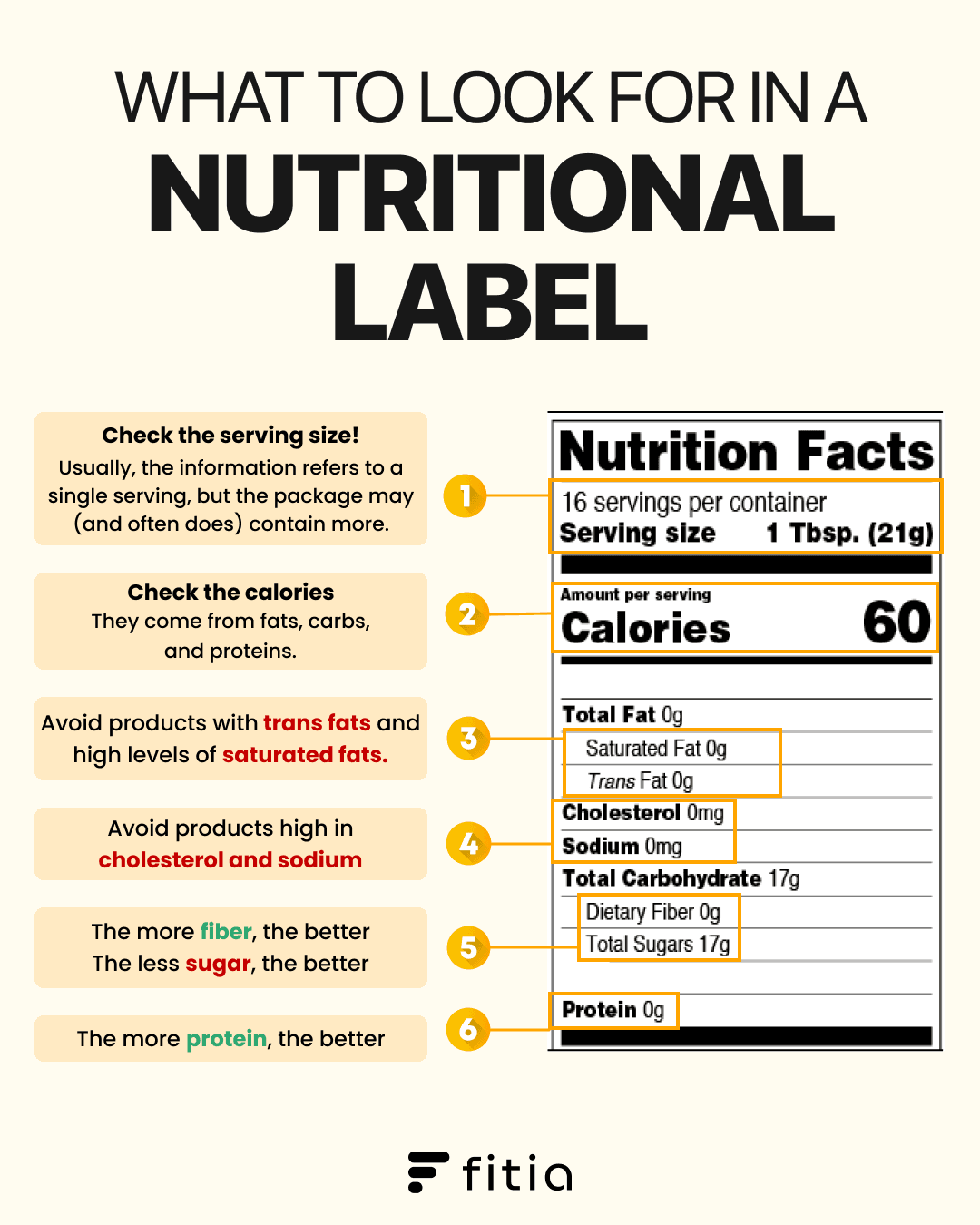
The most common mistake when reading a nutrition label is checking the calories and macros per serving without noticing how many total servings are in the package (3).
For example, if a product says 120 kcal per serving but the package contains three servings and you don’t realize it, you’re actually consuming 360 kcal.
That’s why it’s crucial to always check the number of servings per container.
Another common mistake is confusing “per 100 g” values with the actual serving size. If your serving is 200 g or even 30 g, ignoring that difference can seriously distort the real nutritional value (5).
2. Look Closely at the Type of Fats
In the fat section, you’ll usually find four types: trans fats, saturated fats, monounsaturated fats, and polyunsaturated fats.
- Trans fats are the lowest quality and considered the most harmful. When consumed in excess, they can negatively impact cardiovascular health by raising LDL (“bad” cholesterol) and lowering HDL (“good” cholesterol) (6, 7). It’s best to avoid foods containing trans fats whenever possible.
- Saturated fats come next. Their intake should be limited, as research links them to a higher risk of heart disease. Experts recommend keeping them below 10% of your total daily calories.
- Monounsaturated and polyunsaturated fats are known as “healthy fats” and are typically found in plant-based foods like seeds and nuts. Keep in mind that many nutrition labels don’t list these in detail, so it’s helpful to check ingredient sources.
3. Pay Attention to Sodium and Cholesterol Levels
Sodium: It’s recommended to limit sodium intake to less than 2,300 mg per day. Too much sodium can raise blood pressure by causing fluid retention in the body, which may lead to heart disease, stroke, heart failure, or kidney damage.
Cholesterol: For years, it was believed that dietary cholesterol increased blood cholesterol levels and the risk of heart disease. However, current research doesn’t fully support this claim (10). Many countries, including the U.S., have removed the 300 mg/day cholesterol limit from dietary guidelines.
Still, it’s important to remember that most high-cholesterol foods are also rich in trans or saturated fats, which can raise the risk of cardiovascular disease.
4. Check the Carbohydrates, Fibre, and Sugars Section
Carbohydrates are our main source of energy throughout the day. This section usually includes fiber and sugars.
Fiber: It’s best to choose foods with a good amount of fiber. Fiber supports gut health, helps regulate blood sugar levels and appetite, promotes weight management, and is linked to a lower risk of certain cancers (such as colon cancer). The recommended fiber intake is 14 g per 1,000 kcal consumed.
Sugars: On the other hand, it’s important to limit sugar intake, especially from foods high in added sugars. Studies show that consuming too much added sugar can harm your health and increase the risk of metabolic diseases like obesity and diabetes (9, 10).
According to the FDA, added sugars should make up less than 10% of total daily calories. For example, on a 2,000 kcal diet, no more than 200 kcal (about 50 grams) should come from added sugars. Keep in mind that 1 gram of sugar provides 4 kcal (11).
It’s also important to note that this recommendation applies only to added sugars, not to the naturally occurring sugars found in whole foods like fruits.
5. Review the Protein Content Carefully
Protein is an essential macronutrient, not only for muscle growth and tissue repair, but also for supporting the immune system, nutrient transport, and metabolism.
It also helps control appetite by regulating levels of leptin, the hormone responsible for satiety.
Make sure to prioritize foods rich in protein as part of your daily diet.
Final Takeaway: Make Every Food Choice an Informed One
Learning how to read a nutrition label correctly is one of the simplest yet most powerful steps toward healthier eating. By paying attention to serving sizes, fats, sodium, fiber, and added sugars, you can better understand what’s really in your food and make smarter choices every day.
And if you want to make this process easier, Fitia can help. With just one scan, you can instantly see if a product is high in sugar, sodium, or fat, and discover better alternatives that match your nutrition goals.
Start building healthier habits today — download Fitia for free and take control of your nutrition in seconds.
FAQs About Reading Nutrition Labels
What should I check first on a nutrition label?
Always start with the serving size. It tells you how much the nutrition information actually refers to, not the whole package.
Are front-of-package labels reliable?
Not entirely. Claims like “low-fat” or “sugar-free” can be misleading. Always verify details in the nutrition facts table and ingredients list.
How much sugar per day is healthy?
According to the FDA, added sugars should be less than 10% of total daily calories — about 50 grams for a 2,000 kcal diet.
What’s the best way to identify healthy fats?
Look for foods high in monounsaturated and polyunsaturated fats from sources like olive oil, nuts, and seeds, and avoid trans fats whenever possible.
How can I tell if a product is healthy overall?
Consider the full picture: serving size, total calories, sodium, fiber, and added sugars. Using an app like Fitia simplifies this process by analyzing all these factors for you instantly.
How does Fitia help with nutrition labels?
Fitia lets you scan barcodes, see nutrient breakdowns, and track your food automatically, helping you make better, faster decisions every day.
References
References
- S Setareh Sanjari, Steffen Jahn, Yasemin Boztug, Dual-process theory and consumer response to front-of-package nutrition label formats, Nutrition Reviews, Volume 75, Issue 11, November 2017, Pages 871–882, https://doi.org/10.1093/nutrit/nux043
- Malloy-Weir L, Cooper M. Health literacy, literacy, numeracy and nutrition label understanding and use: a scoping review of the literature. J Hum Nutr Diet. 2017 Jun;30(3):309-325. doi: 10.1111/jhn.12428. Epub 2016 Oct 12. PMID: 27731526.
- Miller, Lisa M Soederberg et al. “Developing Nutrition Label Reading Skills: A Web-Based Practice Approach.” Journal of medical Internet research vol. 19,1 e16. 13 Jan. 2017, doi:10.2196/jmir.6583
- Ni Mhurchu C, Eyles H, Jiang Y, et al. Do nutrition labels influence healthier food choices? Analysis of label viewing behaviour and subsequent food purchases in a labelling intervention trial. Appetite. 2018 Feb 1;121:360-365. doi: 10.1016/j.appet.2017.11.105. Epub 2017 Nov 27. PMID: 29191745.
- Miller LM, Cassady DL. The effects of nutrition knowledge on food label use. A review of the literature. Appetite. 2015;92:207-216. doi:10.1016/j.appet.2015.05.029
- Wanders, Anne J et al. “Trans Fat Intake and Its Dietary Sources in General Populations Worldwide: A Systematic Review.” Nutrients vol. 9,8 840. 5 Aug. 2017, doi:10.3390/nu9080840
- de Souza RJ, Mente A, Maroleanu A, et al. Intake of saturated and trans unsaturated fatty acids and risk of all cause mortality, cardiovascular disease, and type 2 diabetes: systematic review and meta-analysis of observational studies. BMJ. 2015 Aug 11;351:h3978. doi: 10.1136/bmj.h3978. PMID: 26268692; PMCID: PMC4532752.
- Soliman GA. Dietary Cholesterol and the Lack of Evidence in Cardiovascular Disease. Nutrients. 2018 Jun 16;10(6):780. doi: 10.3390/nu10060780. PMID: 29914176; PMCID: PMC6024687.
- Rippe JM, Angelopoulos TJ. Added sugars and risk factors for obesity, diabetes and heart disease. Int J Obes (Lond). 2016 Mar;40 Suppl 1:S22-7. doi: 10.1038/ijo.2016.10. PMID: 27001643.
- Stanhope KL. Sugar consumption, metabolic disease and obesity: The state of the controversy. Crit Rev Clin Lab Sci. 2016;53(1):52-67. doi:10.3109/10408363.2015.1084990
- U.S. Food and Drug Administration. (2020, February 25). Added sugars on the Nutrition Facts label. U.S. Department of Health and Human Services. https://www.fda.gov/food/nutrition-facts-label/added-sugars-nutrition-facts-label
Fitia: Meal Plans & Calorie Counter
We use cookies to enhance your browsing experience, analyze site traffic, and personalize content. By clicking 'Accept', you consent to the use of these technologies in accordance with our Privacy Policy.