How to Track Calories Eating Out (Without Wrecking Your Progress)
Eating out is where most calorie trackers fall apart. Learn the exact protocol that keeps your deficit intact, no matter what's on the menu.
- Published
- Updated
- 7 min read
- 7 min read
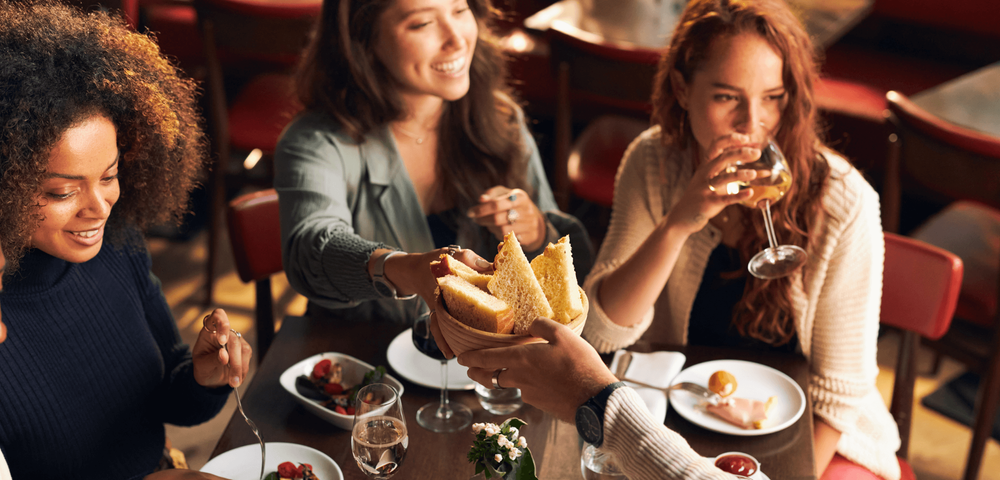
TL;DR: Eating out doesn't wreck progress. Underestimating restaurant calories does. The average restaurant meal exceeds 900 kcal, diners consistently underestimate by hundreds of calories per occasion, and photo logging alone doesn't fix it. A simple pre-meal protocol — look up the menu, pre-log your order, use the protein-plus-sides formula when databases fail, and log sauces separately — converts restaurant meals from a tracking blind spot into a known quantity.
Table of Contents
- Why restaurant meals have more calories than you think
- Why calorie tracking breaks down when you eat out
- The most effective way to track calories at a restaurant
- The 4-step protocol for tracking restaurant meals accurately
- Where Fitia fits the restaurant problem
- FAQ
Why restaurant meals have more calories than you think
For some, going to a restaurant while on a weight loss journey and trying to track without affecting your progress can look like a self-control problem, but veteran trackers know that's not really the case. The real issue is something even research points to: caloric underestimation.
First, let's all agree that restaurant meals tend to be high in calories. A 2018 observational study published in the BMJ analyzed the energy content of 13,396 main meals across 27 major UK restaurant chains and found that the average meal contained 977 kcal — yet only 9% of those meals met public health recommendations of ≤600 kcal, and nearly half (47%) exceeded 1,000 kcal (Robinson, Jones, & Whitelock, 2018).
Importantly, the authors noted that full-service restaurants served meals that were, on average, 268 kcal higher than fast food equivalents — a finding that cuts against the common assumption that sit-down restaurants are the safer bet.
Second, there's a well-documented gap between what people actually eat and what they think they're eating when dining out. A 2024 study in Nutrition and Health using instrumental variable methods to account for selection bias found that eating dinner out — compared with eating the same meal at home — added approximately 388 kcal of additional intake per occasion (Cho, 2024).
Earlier research cited in the public health literature has reported that up to 90% of diners underestimate the calorie content of their restaurant meals, in some cases by as much as 600 kcal per meal (Radwan et al., 2017).
Put together, the picture is clear: restaurant meals are calorically denser than home cooking and are systematically underestimated by the people eating them.
Why calorie tracking breaks down when you eat out
Technology-based logging does not automatically solve the issue. A 2020 systematic review and meta-analysis in Clinical Nutrition evaluating image-based dietary assessment methods found that while smartphone photo logging produced reasonable population-level accuracy, per-meal error was meaningful and driven largely by mismatches between database entries and actual foods — a problem that is most acute in mixed dishes where ingredients are layered or concealed in sauces (Ho et al., 2020).
This describes most restaurant food precisely. A 2020 randomized validation study in JMIR mHealth and uHealth confirmed the pattern: without active user verification, significant differences appeared between AI photo logs and reference dietary records for total energy, protein, carbohydrates, percent fat, saturated fatty acids, and iron (Ji et al., 2020).
The most effective behavioral lever at restaurants is not post-meal logging accuracy, but pre-meal planning.
The most effective way to track calories at a restaurant
A 2019 meta-analysis in Obesity Reviews covering 41 app-based mobile nutrition interventions found a significant positive effect on obesity indices (Hedges' g = 0.30; 95% CI 0.15–0.45, p < 0.001), with the most common ingredient in effective interventions being a goals and planning component alongside feedback and monitoring (Villinger et al., 2019).
Pre-logging a restaurant meal before you order does exactly that. It lets you see how the meal fits into your day before you sit down, so you can adjust the rest of your intake around it, arrive with a plan, and avoid overeating simply because the food is in front of you. It forces a concrete decision at the moment behavior can still be influenced, rather than trying to do damage control after the fact.
Restaurant meals don't need to wreck your progress. They only do when you treat them as a tracking exception instead of the moment your tracking matters most.
The 4-step protocol for tracking restaurant meals accurately
After many years helping clients navigate this exact problem, here is the protocol I now hand to every new client when they mention they have plans to eat out. The whole thing takes a couple minutes and saves a lot of time and anxiety.
Step 1: Look up the menu before you arrive
Most US chain restaurants now post calorie counts online — required by federal menu labeling law for chains with 20 or more locations, enforced since May 2018, with a 2020 audit finding 94% compliance among the top 200 chains (Cleveland, Simon, & Block, 2020). Independent restaurants typically don't post calories, but their menus are usually online. Five minutes scrolling the menu before you leave the house is the highest-leverage move in this entire protocol. You will never make a more rational ordering decision than from the comfort of your couch.
Step 2: Pre-log the meal in your tracker.
Pick what you plan to order and log it before you arrive. This converts the restaurant from an unknown variable into a known constraint. Apps with verified restaurant databases make this straightforward. For independent restaurants without database entries, build a custom entry once based on the menu description and reuse it every time you go back.
Step 3: Default to the "protein + visible sides" formula
When databases fail you — small restaurants, regional chains, foreign cuisines — fall back to a structural template: a clearly identifiable protein (grilled chicken, fish, steak by the ounce), a clearly identifiable carb (a cup of rice, a potato, a bread roll), a clearly identifiable vegetable side. Estimate each component separately rather than trying to log the assembled dish. This approach recovers most of the accuracy lost when a dish-level database entry doesn't exist.
Step 4: Log dressings, sauces, and oils as separate line items
This is where a large portion of the underreporting bias documented in the literature lives. A Caesar salad might be 200 kcal of romaine and chicken plus 350 kcal of dressing. Log only the salad and you've missed more than half the meal's calories. Ask for dressings on the side; portion control follows naturally when the calorie cost is visible.
Where Fitia fits the restaurant problem
Fitia's verified 10M+ food database includes strong US chain coverage and substantial independent restaurant data, plus the ability to build custom entries from menu descriptions and save them for repeat logging. The AI photo logging works as a second-pass tool for when you forgot to pre-log: photograph the dish before the first bite, verify the AI's portion estimate, and save. The combination — verified data, photo backup, and custom-entry reuse — addresses the most common restaurant tracking failure modes in a single workflow.
Eating out doesn't have to derail your progress. Download Fitia for free today!
FAQ
How accurate are calorie counts on restaurant menus?
Better than nothing, but not guaranteed. US chains with 20+ locations are required to post counts, and a 2020 audit found 94% compliance (Cleveland et al., 2020). Independent restaurants have no requirement. Round up, not down, especially where portion size varies.
Should I use photo logging for restaurant meals?
With verification. AI photo logging is useful for capturing a meal quickly, but accuracy drops significantly on mixed restaurant dishes (Ho et al., 2020; Ji et al., 2020). Always tap to verify and correct the portion estimate before saving.
How do I track a restaurant meal when I don't know the menu in advance?
Use the protein-plus-sides formula: estimate each component separately, log conservatively, and save it as a custom entry for next time. Most people find 5 to 10 saved entries cover the bulk of their regular eating-out rotation.
Can I hit my calorie deficit eating out three or more times per week?
Yes, with deliberate logging. Restaurant meals are consistently underlogged by several hundred calories per occasion. Pre-log from the menu, order structurally, and round up. The clients who make it work treat the protocol as non-negotiable, not optional.
About the Author
 | Fiorella Ricardi is a licensed nutritionist from Universidad Científica del Sur, where she graduated in the top fifth of her class. She brings hands-on experience across clinical, public health, and food service nutrition. For the past two years, she has worked at Fitia as Operations Lead, focused on improving the accuracy of internal food entry data and ensuring users see correct, reliable nutritional insights inside the app. |
References
- Robinson, E., Jones, A., & Whitelock, V. (2018). (Over)eating out at major UK restaurant chains: observational study of energy content of main meals. BMJ, 363, k4982. https://doi.org/10.1136/bmj.k4982
- Cho, S. (2024). Measuring the precise effect of eating out on calorie intake: The case of Korea. Nutrition and Health. https://doi.org/10.1177/02601060241297857
- Radwan, H., Faroukh, E. M., & Obaid, R. S. (2017). Menu labeling implementation in dine-in restaurants: the public's knowledge, attitude and practices. Archives of Public Health, 75(1). https://doi.org/10.1186/s13690-017-0177-9
- Ho, D. K. N., Tseng, S.-H., & Wu, M.-C. (2020). Validity of image-based dietary assessment methods: A systematic review and meta-analysis. Clinical Nutrition, 39(10), 2945–2959. https://doi.org/10.1016/j.clnu.2020.08.002
- Ji, Y., Plourde, H., & Bouzo, V. (2020). Validity and usability of a smartphone image-based dietary assessment app compared to 3-day food diaries in assessing dietary intake among Canadian adults: Randomized controlled trial. JMIR mHealth and uHealth, 8(9), e16953. https://doi.org/10.2196/16953
- Villinger, K., Wahl, D. R., & Boeing, H. (2019). The effectiveness of app-based mobile interventions on nutrition behaviours and nutrition-related health outcomes: A systematic review and meta-analysis. Obesity Reviews, 20(10), 1465–1484. https://doi.org/10.1111/obr.12903
- Cleveland, L. P., Simon, D., & Block, J. P. (2020). Federal calorie labelling compliance at US chain restaurants. Obesity Science & Practice, 6(2), 207–214. https://doi.org/10.1002/osp4.400
Related articles
 Fat Loss
Weight Loss Calorie Chart (2026): How Many Calories to Eat by Body Weight, Sex, and Activity
See how many calories to eat to lose weight, with simple charts by body weight and activity, plus why your target changes as you go.
Read article
Best Calorie Counter App for Muscle Gain in the US (2026): 4 Apps Compared for Lifters
The 4 best calorie counter apps for US lifters in 2026, compared on macros, database, adaptation, and meal planning.
Read article
Best Online Nutrition Coach in the US (2026): What to Look For Before You Pay
Online nutrition coaching in the US 2026: three tiers, what the research says, and the red flags to spot before you pay for an app or coach.
Read article