8 Signs of Unhealthy Stool
Discover the 8 key signs of unhealthy stools and what they indicate about your digestive health. Learn when to seek medical advice for potential issues.
- Published
- Updated
- 9 min read
- 9 min read
The characteristics and shape of your stool can reveal a lot about your health, especially your digestive health.
Today, we bring you a list of signs to watch for in your stool.
Keep in mind that some of these signs may occasionally appear in your bowel movements without cause for concern.
However, if they occur very frequently and, especially if they are accompanied by other gastrointestinal symptoms such as pain, difficulty digesting food or other issues, it's probably best to consult a specialist.
On the other hand, keep in mind that with the Fitia app, you can get a personalized meal plan to improve your habits and meet your nutritional needs. Download Fitia for free here.
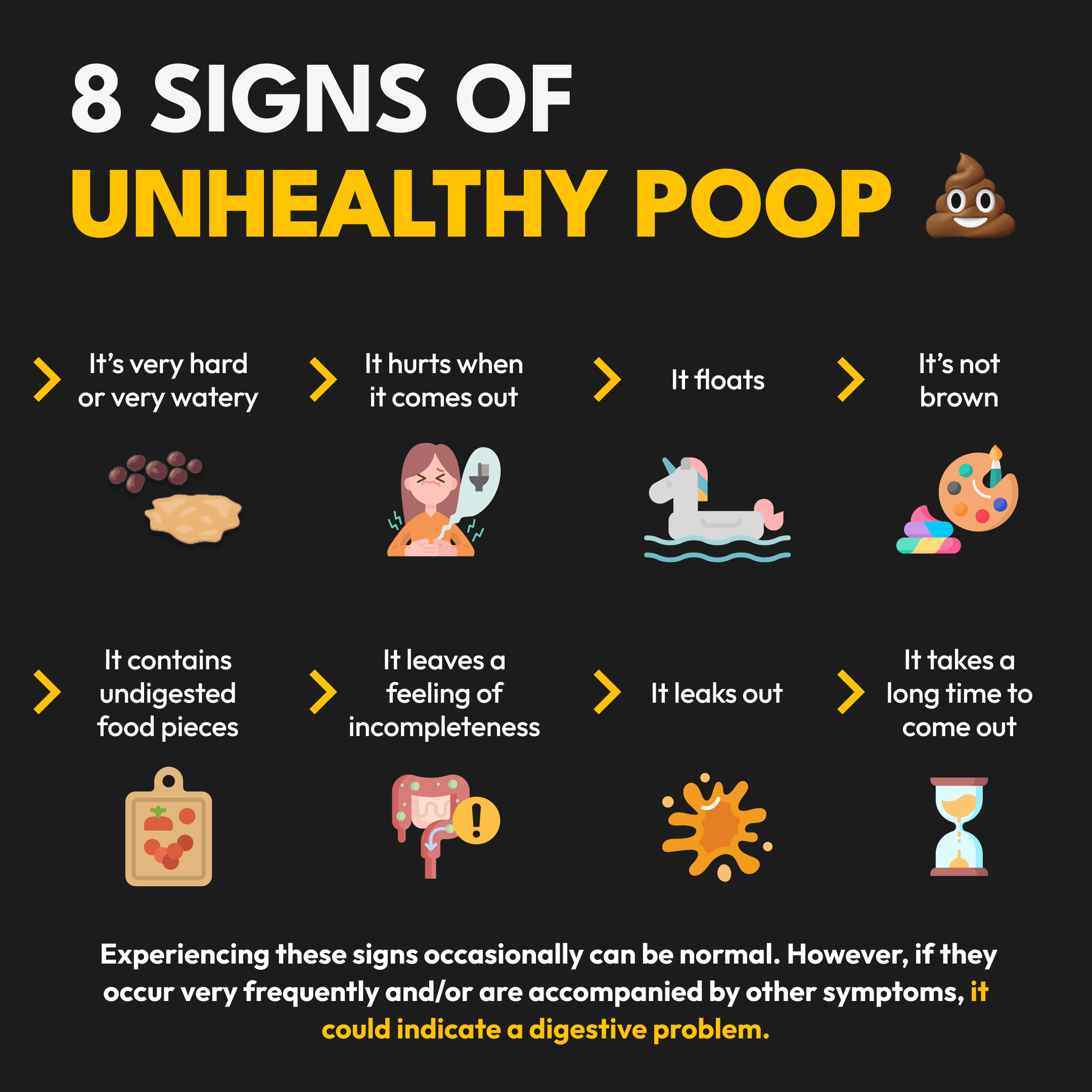
1. Very Hard or Very Watery
The consistency of your stool can be a significant indicator of how well your digestive system is functioning.
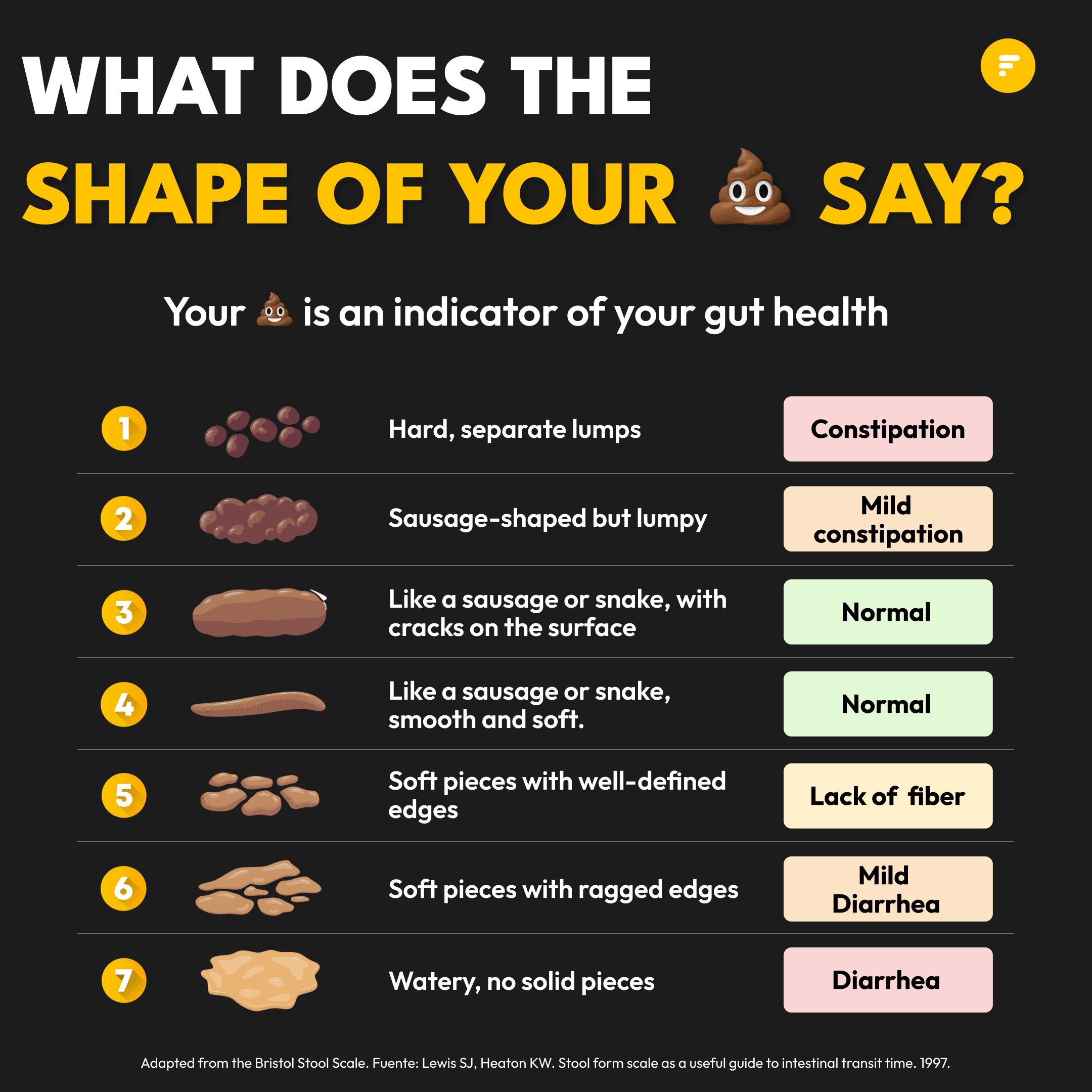
In fact, in 1992 a scale was developed and validated to more effectively evaluate the shape and consistency of stool: the Bristol Stool Scale (1,2).
This is still used in research and medical practices and has proven effective in assessing intestinal transit time (2).
The scale is as follows:
What Do Healthy Stools Look Like?
According to this scale, the ideal stools are types 3 and 4, as this indicates that your intestinal transit is at an optimal pace, allowing you to form well-shaped stools.
What Does It Mean if your Stools Are Hard?
If your bowel movements are mostly like types 1 and 2 (stools that appear as separate lumps or shaped like a sausage with lumps), it means your intestinal transit is slow.
This slow transit gives your intestines more time to absorb water from your stools, leaving them under-hydrated and hard.
When this happens, you will have difficulty passing stools and may suffer from constipation (to varying degrees).
To improve this, try increasing your intake of:
- Water and fiber (fiber retains water).
- Physical activity: Move more (especially if you lead a sedentary lifestyle).
- Consuming some laxative foods like prunes or dragon fruit (although you shouldn't rely on them every time you need to have a bowel movement)
👉 You might be interested in:
What Do Soft Stools Indicate?
On the other hand, if your stools are usually like 5, it might indicate that your fiber intake (especially soluble fiber) is very low. Fiber slows down intestinal transit time and gives more consistency to the stools.
Try increasing your intake of foods such as oats, seeds like chia and flaxseed, fruits, and vegetables.
What Does It Mean to Have Watery Stools?
Types 6 and 7 indicate different degrees of diarrhea. In this case, you should replenish the fluids and electrolytes you are losing.
Remember that both constant diarrhea and constipation can be indicators of underlying conditions or other health issues. Therefore, it’s best to consult your doctor.
Additionally, with the Fitia app, you can get a personalized meal plan to help you meet your fiber and water requirements, which can help regulate your intestinal transit. Download it for free here
2. Floating Stools
The fact that stools float can be due to various causes, and while not all are a cause for alarm, some may be related to underlying gastrointestinal dysfunction.
Some of the most common situations where floating stools may occur (3,4,5):
1. You’ve Consumed Foods That Cause Gas
Excess gas produced in the gastrointestinal tract can decrease the density of stool, causing it to float.
Some causes of excess gas in stool could be consuming foods high in fiber, cruciferous vegetables (such as broccoli, cabbage, cauliflower, etc.), legumes, apples, or even dairy products, especially if you have some level of lactose intolerance.
If this is the cause, you shouldn't worry too much about your stool, and you can easily identify it by evaluating what you've eaten in your recent meals.
2. You’ve Consumed a Lot of Fat
The presence of fat in stool can also cause it to float, as fats do not mix well with water and tend to float on the surface (5).
If you’ve consumed an excessive amount of fat in the last day, it’s possible that not all of it gets absorbed and ends up in your stool.
If this is the case and it normalizes the next day, then you don't need to worry.
3. Malabsorption of Nutrients
Malabsorption can occur when your body lacks the necessary enzymes to properly process nutrients or when the passage of food through your digestive tract is so rapid that there isn’t enough time for nutrients to be adequately absorbed.
In this context, malabsorption can lead to the two scenarios mentioned above: if you don't absorb carbohydrates well, your stool will have excess gas, and if you don't absorb fats well, they will end up in your stool.
If this is the case, floating stools will be more recurrent.
4. Mixed Irritable Bowel Syndrome
In a study, 26% of patients with a functional bowel disorder reported having floating stools. It was found that mixed irritable bowel syndrome was the only functional gastrointestinal disorder independently associated with floating stools, meaning that floating stools are a characteristic of these patients.
5. Intestinal Infections
Intestinal infections can also cause floating stools because they can alter the composition of the stool. These infections can lead to malabsorption or increased bacterial proliferation in the intestines, causing more gas.
6. Liver or Pancreatic Problems
The liver and pancreas produce substances responsible for digesting fats, namely bile and lipolytic enzymes, respectively.
If there is a problem with these organs, your production of bile and pancreatic enzymes can be affected, leading to improper fat digestion.
As a result, your stool will contain fats and float.
3. Leaves you feeling like you are not finished
This sensation can occur when there is constipation. In such cases, the stool may be so hard and difficult to pass that it results in what is known as incomplete evacuation (6).
However, what is known as rectal tenesmus is the sensation of needing to evacuate when there is really no stool to evacuate. This can happen when there is a non-fecal mass stimulating the urge to defecate (7).
This is typical with a rectosigmoid or rectal tumor, but it can also be present in other conditions such as dysentery, parasitism, hemorrhoids, ulcerative colitis, and others (7,8).
4. Not Brown in Color
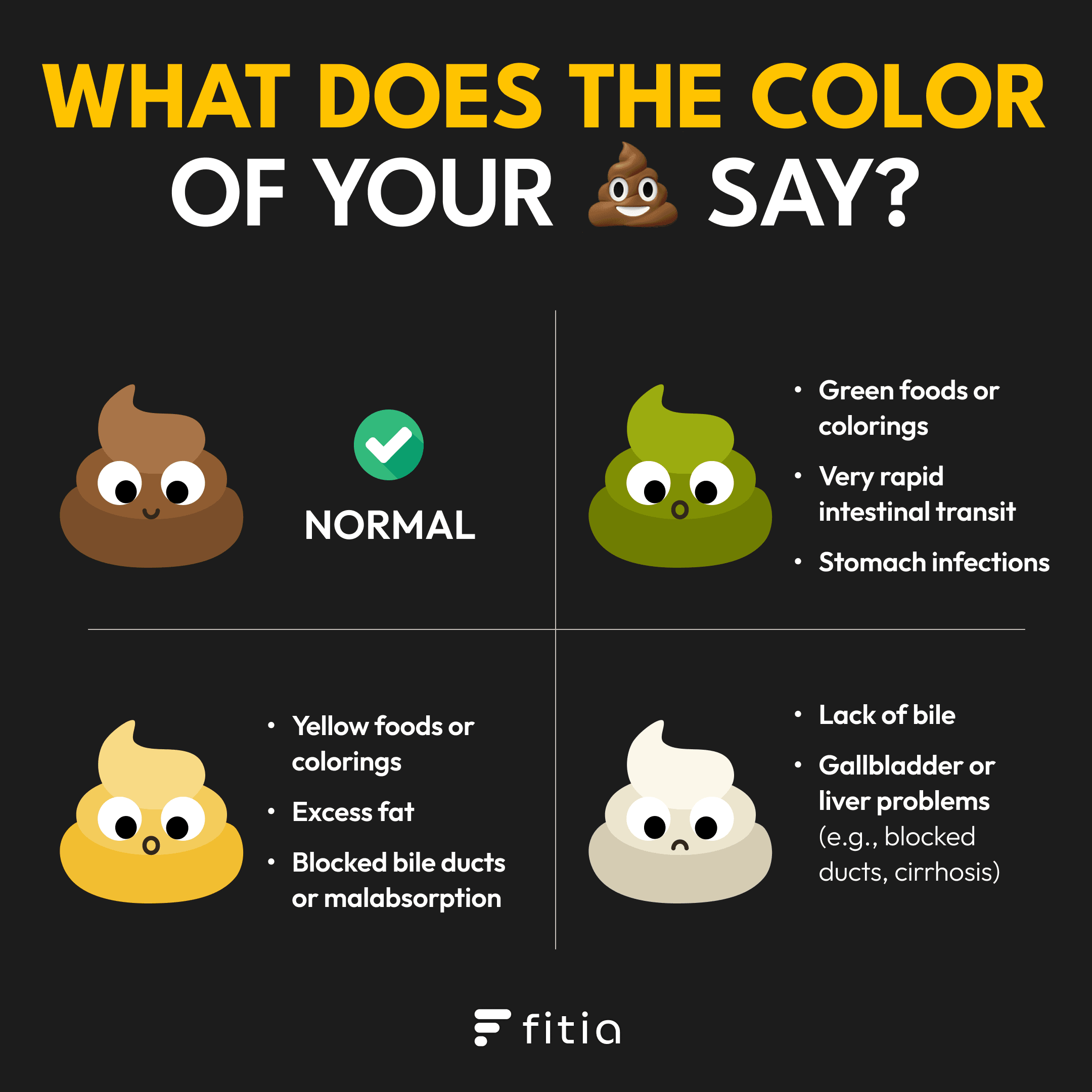
.Your stool should normally be brown, varying slightly towards lighter, darker, or brown with greenish hues.
Additionally, if you’ve eaten foods with strong natural or artificial colorings, this can be reflected in your stool.
In this sense, if you notice significant changes in the normal color of your stool that don’t have an obvious explanation (like eating something of that color), it could indicate an underlying problem.
In this case, it’s best to consult a medical professional.
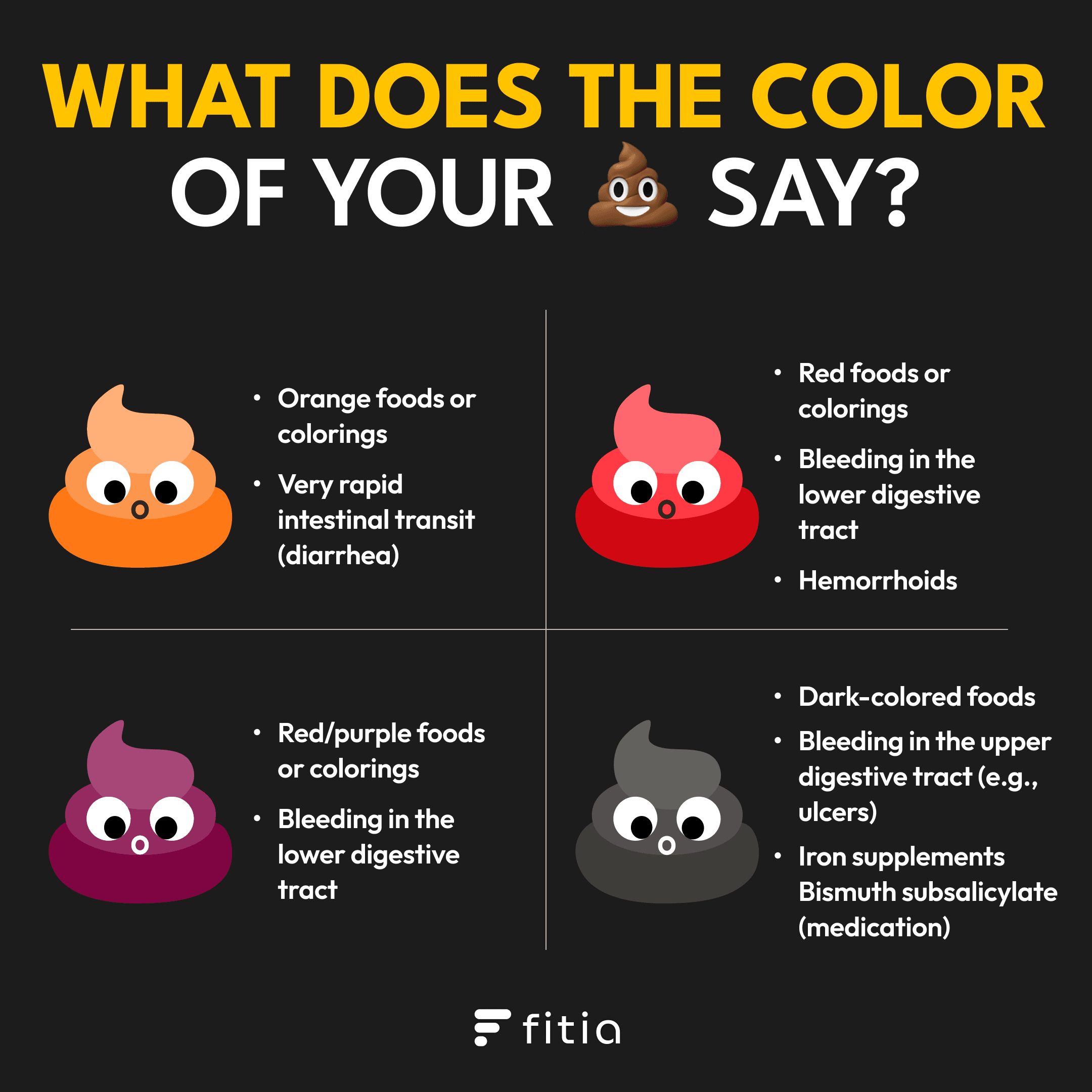
Here’s what different stool colors can indicate:
Green stools: What do they mean?
- You’ve eaten green foods or foods with green coloring, such as leafy greens, pesto sauce, or broccoli.
- Very rapid intestinal transit.
- Stomach infections.
Yellow stools: What do they mean?
- You’ve eaten yellow foods or foods with yellow coloring.
- There is an excess of fat.
- Blocked bile ducts or malabsorption.
White stools: When do they occur and What do they mean?
This occurs when there is a lack of bile, the substance that, when processed, becomes bilirubin and gives stool its brown color. When there isn’t enough bile, the stool lacks color. This can be due to liver problems (as bile is produced in the liver) or obstructions in the bile ducts or gallbladder.
Orange stools: Why does it happen?
- You’ve eaten orange foods or foods with orange coloring, such as orange soda, carrots, tangerines, papaya, etc.
- Very rapid intestinal transit (diarrhea).
Red or Purple stools: Why are they this color?
- You’ve eaten red or purple foods or foods with those colorings, such as beets, cranberries, gelatin, or lollipops.
- There is bleeding in the lower digestive tract.
- Presence of hemorrhoids.
Black stools: What Could This Color Indicate?
- Consuming dark-colored foods.
- There is bleeding in the upper digestive tract (e.g., ulcers).
- Using iron supplements.
- Taking bismuth subsalicylate (a medication used to treat indigestion, stomach pain, or diarrhea).
5. Contains Undigested Food
Finding pieces of undigested food in your stool can be normal if you’ve eaten foods that contain insoluble fibers that the human intestine cannot digest.
For example, seeds or the skins of fruits and vegetables. This should not be a cause for concern; in fact, consuming this type of fiber is beneficial for your health.
However, frequently finding large pieces of undigested food could indicate that your food is not being properly processed in the digestive system. This might happen when there is:
- A physical obstruction in the gastrointestinal tract preventing food from breaking down completely. Conditions that can cause this include Crohn's disease, ulcerative colitis, or colon cancer.
- Insufficient digestive enzymes: If the body does not produce enough digestive enzymes to break down food, some of it may not be fully digested. Pancreatic diseases, as mentioned earlier, are an example of this.
6. Painful Bowel Movements
Experiencing pain during defecation can be a symptom of various conditions.
This is one of the typical symptoms of constipation.
In constipation, the intestinal transit is very slow, causing the fecal matter to remain in the large intestine for an extended period.
When this happens, the intestine has more time to reabsorb the water from the stool bolus. Then, the stool becomes more compact and hard, causing pain when passing stool.
When this happens, the intestine has more time to reabsorb water from the fecal matter. As a result, the stool becomes more compact and hard, causing pain during defecation.
In other cases, painful bowel movements can indicate hemorrhoids or anal fissures, which are small tears in the skin around the rectum that can cause pain and bleeding during defecation.
Additionally, pain during defecation can also occur when there is inflammation in the intestine or rectum (proctitis) or anal abscesses.
If you frequently experience pain during bowel movements, it is important to consult a doctor to determine the underlying cause and receive appropriate treatment.
7. Takes a Long Time to Pass
While there is no exact "ideal" amount of time for a bowel movement, it generally shouldn't take too long.
The normal range is approximately 1 to 15 minutes.
Taking more than 15 minutes is starting to be considered a sign of constipation.
8. Explosive Diarrhea
When stools are expelled explosively, it usually indicates diarrhea (which could be acute or chronic).
However, it can also be present in other conditions such as colitis, inflammatory bowel disease, irritable bowel syndrome, or even a bacterial or viral infection.
These conditions can cause irritation or inflammation of the intestinal lining, leading to an increase in mucus and fluid production in the gastrointestinal tract and a decrease in the body's ability to absorb nutrients.
If you experience explosive bowel movements, it's important to seek medical attention immediately to determine the underlying cause and receive appropriate treatment.
References
- Heaton KW, Radvan J, Cripps H, Mountford RA, Braddon FE, Hughes AO. Defecation frequency and timing, and stool form in the general population: a prospective study. Gut. 1992 Jun;33(6):818-24. doi: 10.1136/gut.33.6.818. PMID: 1624166; PMCID: PMC1379343.
- Lewis SJ, Heaton KW. Stool form scale as a useful guide to intestinal transit time. Scand J Gastroenterol. 1997 Sep;32(9):920-4. doi: 10.3109/00365529709011203. PMID: 9299672.
- Levitt MD, Duane WC. Floating stools--flatus versus fat. N Engl J Med. 1972 May 4;286(18):973-5. doi: 10.1056/NEJM197205042861804. PMID: 5015442.
- Bouchoucha M, Devroede G, Benamouzig R. Are floating stools associated with specific functional bowel disorders? Eur J Gastroenterol Hepatol. 2015 Aug;27(8):968-73. doi: 10.1097/MEG.0000000000000380. PMID: 25966670.
- Hornsby VP. Floating faeces in steatorrhoea--a new sign. Clin Radiol. 1988 Jul;39(4):454. doi: 10.1016/s0009-9260(88)80308-8. PMID: 3180661.
- Collins B, Norton C. Managing passive incontinence and incomplete evacuation. Br J Nurs. 2013 May 23-Jun 12;22(10):575-9. doi: 10.12968/bjon.2013.22.10.575. PMID: 23752456.
- Manuela Stoicescu. Chapter 5 - The Semiology of the Bowel, Medical Semiology Guide of the Digestive System, Academic Press, 2020, Pages 337-437, ISBN 9780128196366, https://doi.org/10.1016/B978-0-12-819636-6.00005-9.
- Feuerstein JD, Moss AC, Farraye FA. Ulcerative Colitis. Mayo Clin Proc. 2019 Jul;94(7):1357-1373. doi: 10.1016/j.mayocp.2019.01.018. Erratum in: Mayo Clin Proc. 2019 Oct;94(10):2149. PMID: 31272578.
Related articles
 Fat Loss
Weight Loss Calorie Chart (2026): How Many Calories to Eat by Body Weight, Sex, and Activity
See how many calories to eat to lose weight, with simple charts by body weight and activity, plus why your target changes as you go.
Read article
Best Calorie Counter App for Muscle Gain in the US (2026): 4 Apps Compared for Lifters
The 4 best calorie counter apps for US lifters in 2026, compared on macros, database, adaptation, and meal planning.
Read article
Best Online Nutrition Coach in the US (2026): What to Look For Before You Pay
Online nutrition coaching in the US 2026: three tiers, what the research says, and the red flags to spot before you pay for an app or coach.
Read article