
May 25, 2024
What is NEAT? Discover the Secret to Burning More Calories Effortlessly
Physical activity not only helps burn calories, but also plays a crucial role in maintaining our health.
According to the World Health Organization, up to 5 million deaths per year could be prevented simply by being a bit more active.
However, we know that finding time for exercise can be challenging in our daily routines. But… what if we told you that staying active doesn't always mean having an intensive workout session?
In fact, any form of movement, regardless of its intensity, is beneficial.
Activities that seem as simple as walking or climbing stairs can make a difference and are so important that they even have a scientific name: NEAT, which stands for "Non-exercise activity thermogenesis".
In this article we show you what it is and how you can incorporate it into your fat loss process.
Remember that nutrition is essential when it comes to losing fat. With Fitia, you can have better control of your meals by knowing their calories and macronutrients. Download it for free here.
What is NEAT?
NEAT refers to energy expenditure not associated with scheduled or planned exercise. It refers to all those daily activities that help burn calories but are not part of a formal workout routine (1).
This includes the energy we expend walking to work, climbing stairs, walking our pets, cleaning our house, and any activity that involves movement. In other words, NEAT covers all types of movement that are not part of a workout (1).
Human beings are designed to move and having a high NEAT should be natural.
However, over the last 2 centuries, we have experienced a significant shift towards a sedentary lifestyle (2).
Low physical activity can lead to a decrease in NEAT, resulting in fewer calories burned throughout the day. This can make it more difficult to lose fat or maintain your weight.
Why does NEAT Help Weight loss?
Weight loss is a common goal for many, and although it is not the only determining factor, the key to achieving it lies in maintaining a caloric expenditure that exceeds our intake, creating the well-known calorie deficit. The creation of this calorie deficit is essential for losing fat and shedding those extra pounds. As we’ve mentioned in previous articles, there are various ways to achieve this calorie deficit:
- Reducing calorie intake.
- Increasing physical activity through exercise and sports.
- Increasing our daily physical activity outside of exercise (NEAT).
In this context, during your cutting phase, which typically involves reducing body fat while maintaining as much muscle mass as possible, increasing our daily physical activity (NEAT) could be a crucial component for several reasons:
1.Increased Total Caloric Expenditure.
The NEAT can be a great ally in those looking to increase their daily caloric expenditure.
This approach is supported by scientific studies demonstrating its effectiveness in significantly increasing the total number of calories you burn each day.
In one study, researchers selected 20 volunteers, including both lean and slightly obese individuals, to measure their total NEAT over a period of 10 days.
The study concluded that if the obese volunteers adopted the NEAT behaviors of the leaner group, they could expend an additional 350 kcal per day (3).
This approach is particularly relevant during periods of excessive caloric intake, where individuals who do not increase their NEAT tend to accumulate more adipose tissue compared to those who maintain a high level of NEAT (4).
For example, in the context of someone in a bulking phase (caloric surplus), consuming more calories than needed for maintenance, the increase in muscle mass will inevitably be accompanied by an increase in fat mass.
In this context, increasing daily activity outside of exercise (NEAT) plays a crucial role in minimizing fat accumulation.
👉You might be interested in: How to Gain Muscle?
2. Impact of NEAT During a Cutting Phase
As mentioned earlier, the key to cutting and losing fat is the "calorie deficit."
However, achieving a caloric deficit solely through exercise can require a significant amount of physical activity.
For instance, burning an additional 500 calories per day through exercise might require more than an hour of intense physical activity. Alternatively, you would need to walk or run about five miles a day for a week to lose one pound of fat.
It's important to highlight that seemingly simple activities, like walking at different speeds, are crucial during a cutting phase where calories might be limited.
Moreover, consistently maintaining a low NEAT can make it easier to gain weight after the dieting period (5).
Promoting an active lifestyle offers a more sustainable approach to achieving your goals, allowing you to avoid intense or extreme regimens.
Next, discover NEAT activities, an effective way to burn calories in your daily life.
What Can I Do to Increase NEAT?
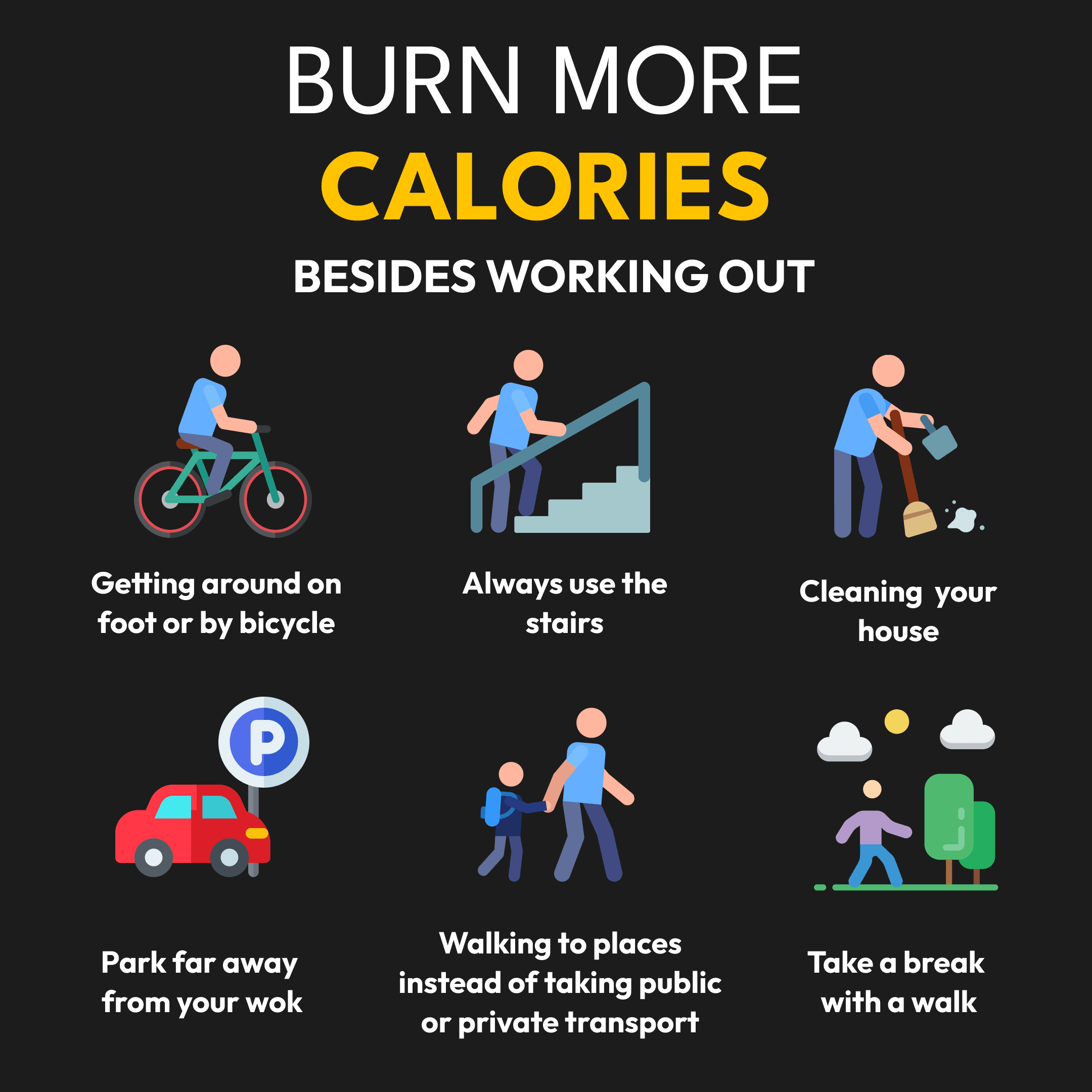
Making changes to your daily activities can influence your routine and help increase your NEAT. Here are some examples: 👇
- 🚶 Increase your daily steps, as they make a difference in weight management. A recent study concluded that more than 2500 steps a day is beneficial (6).
- 🪜 Opt for taking the stairs instead of the escalator.
- 🚲 Walk or use a bike for transportation instead of driving whenever possible.
- 🚍 If you use public transportation, get off a stop or two before your destination to increase your daily steps.
- 🛒 Do your shopping at a local store instead of online. Take active breaks if you spend a lot of time sitting.
- 👨💻 If you work at a desk, set hourly reminders to stand up and move around.
- 🧹 Do household chores like sweeping, gardening, etc.
- 🦮 Take your pet for a walk. Start gradually: a 10-minute walk can eventually turn into 30-minute walks.
Final Message:
- Implementing NEAT during your free time and daily activities can be essential for expending more energy than you consume.
- The choice of activities throughout the day can explain why one individual burns more calories through NEAT compared to another person of similar size.
- The benefits of NEAT include not only the additional calories burned but also a reduction in the occurrence of metabolic syndrome, cardiovascular events, and overall mortality.
References
References
- Levine JA. Non-exercise activity thermogenesis (NEAT): environment and biology. Am J Physiol Endocrinol Metab. 2004 May;286(5):E675-85.
- Levine, J.A., McCrady-Spitzer, S.K. (2018). Non-Exercise Activity Thermogenesis (NEAT) and Adiposity. In: Leitzmann, M., Jochem, C., Schmid, D. (eds) Sedentary Behaviour Epidemiology. Springer Series on Epidemiology and Public Health. Springer, Cham.
- Levine JA, Lanningham-Foster LM, McCrady SK, Krizan AC, Olson LR, Kane PH, Jensen MD, Clark MM. Interindividual variation in posture allocation: possible role in human obesity. Science. 2005 Jan 28;307(5709):584-6.
- Levine JA, Eberhardt NL, Jensen MD. Role of nonexercise activity thermogenesis in resistance to fat gain in humans. Science. 1999 Jan 8;283(5399):212-4.
- Trexler ET, Smith-Ryan AE, Norton LE. Metabolic adaptation to weight loss: implications for the athlete. J Int Soc Sports Nutr. 2014 Feb 27;11(1):7.
- Stens NA, Bakker EA, Mañas A, Buffart LM, Ortega FB, Lee DC, Thompson PD, Thijssen DHJ, Eijsvogels TMH. Relationship of Daily Step Counts to All-Cause Mortality and Cardiovascular Events. J Am Coll Cardiol. 2023 Oct 10;82(15):1483-1494.
Fitia: Meal Plans & Calorie Counter
We use cookies to enhance your browsing experience, analyze site traffic, and personalize content. By clicking 'Accept', you consent to the use of these technologies in accordance with our Privacy Policy.