What to Eat After Training?
Nutrition will help you recover and get better results. Learn how to put together your post-workout meals.
- Published
- Updated
- 8 min read
- 8 min read

The results you aim to achieve from your training are closely tied to your diet. Therefore, if you're looking to maximize your exercise performance, lose fat, or gain muscle mass, it's crucial to pay attention to what you eat throughout the day, especially around your workouts.
In this article, we’ll cover the essentials of what to include in your post-workout nutrition.
👉 You might be interested in: What to Eat Before a Workout? Quick and Easy Pre-Workout Snacks
Is Post-Workout Nutrition Important?
Training triggers a series of physiological changes related to nutrient metabolism, including:
- Partial depletion of glycogen stores (the form in which glucose is stored) in muscles, as glucose is used as an energy source.
- Breakdown of muscle proteins during and after training due to muscle damage from exertion, and the use of branched-chain amino acids (components of proteins) as a partial energy source.
- Loss of fluids and electrolytes (dehydration) through sweat.
After completing a workout, the body begins processes to recover and restore itself. Post-exercise, your body aims to replenish glycogen stores and promote muscle protein synthesis (the process of creating new muscle proteins, counteracting protein breakdown).
Therefore, having the right nutrients in sufficient quantities is crucial, as neither of these processes can occur optimally with exercise alone (1,2,3).
💡 Tip: In Fitia app, you can find thousands of post-workout meal ideas and incorporate them into your daily routine to see how they fit your needs. Download it for free here.
👉 You might be interested in: What is the Anabolic Window?
What to Include in Your Post-Workout Meal
To reap the benefits of a post-workout meal, it should contain a combination of carbohydrates and proteins, and also replenish the fluids and minerals lost during exercise.
Proteins for Muscle Repair
As mentioned earlier, when you exercise, muscle protein breakdown increases, but it also creates the ideal conditions for new muscle fiber formation.
However, this will only occur if you have sufficient amounts of essential amino acids, which serve as the foundation for new muscle proteins. Thus, consuming high-quality proteins is crucial to enhance muscle protein synthesis and minimize its degradation after training (1,2,3,4,5).
To achieve optimal protein synthesis, it's recommended to consume a meal containing between 0.4-0.55 grams of protein per kilogram of body weight. For example, if you weigh 70 kg, your post-workout meal should contain between 28 and 38.5 grams of protein.
Additionally, it's important that the protein source you consume is of high quality, providing a significant amount of essential amino acids (around 10 grams in the post-workout meal) (1,3)
However, some studies have shown that there are no significant differences in muscle protein synthesis and training-related adaptations whether you consume these high-quality proteins immediately before or after exercise (6).
In this context, the meal you have before your workout will be a determining factor in establishing the best timing for your post-workout nutrition (we will revisit this point later).
The ideal amount of protein you should consume to maximize muscle protein synthesis and reduce its degradation is between 0.4-0.55 g/kg of body weight. In addition, you should ensure that the protein source you consume is of high quality and provides you with at least 10g of essential amino acids.
💡 Remember, with Fitia, you can get a personalized meal plan that will cover your protein requirements. Download it for free here.
Carbohydrates to Replenish Glycogen
As we've mentioned before, muscles store glycogen. This compound is how glucose is stored in our body to be used later as an energy source.
Since you need to produce energy quickly during a workout, muscles use some of their stored glycogen for this purpose.
Therefore, consuming carbohydrates is mainly necessary to replenish these stores and prevent the body from breaking down more proteins for energy (1,3,7).
The ideal amount of carbohydrates to consume after a workout depends on several factors, such as:
- The type of training (strength or endurance)
- The duration and intensity of the exercise
- The amount of carbohydrates consumed before the workout (similar to protein intake)
In general, the recommendation is to maintain a 3:1 ratio of carbohydrates to proteins (in grams) in a post-workout meal to promote faster muscle glycogen recovery.
For example, if you weigh 70 kg and consume 30 grams of protein after your workout, it would be advisable to pair it with 90 grams of carbohydrates. It's important to understand that this is a reference range and can vary depending on your goals and caloric needs.
Additionally, it has been observed that those who need immediate carbohydrate intake are individuals who train on an empty stomach. Under these conditions, intake should ideally occur within the first 30 minutes to 1 hour, with a quantity of 1-1.5 grams of carbohydrates per kilogram of lean body mass (1,2). Moreover, long-duration cardiovascular exercises deplete a larger amount of muscle glycogen.
For instance, a person who goes for a one-hour run on an empty stomach will benefit the most from immediate carbohydrate consumption and will require a higher intake compared to someone who has done a strength training session.
The ideal amount of carbohydrates for post-workout consumption depends on the type, intensity, and duration of your training. The reference range is to consume between 1 - 1.5 g/kg of lean body mass (fat-free mass). If you're unsure of your lean body mass, you can use a 3:1 ratio relative to the protein you consume post-workout. This means the grams of carbohydrates should be three times the grams of protein.
Fluids to Hydrate
Finally, but no less importantly, you need to ensure you consume enough fluids to replenish the water and electrolytes lost through sweating during exercise.
The amount of water you should drink depends on your sweat rate, that is, how much you sweat during the session.
In fact, you don't need to consume a commercial rehydration drink unless you've undergone a very long workout (such as running for more than an hour). In most cases, mineral water will suffice.
Additionally, fresh fruits are a great way to replenish electrolytes and water. They also provide the carbohydrates you need after exercising.
When Should You Consume Your Post-Workout Meal?
There has been much debate about the optimal timing for post-workout nutrition, mainly because research on the subject has yielded mixed results. Until recently, there was talk of an "anabolic window of opportunity," with some studies suggesting that there was a one-hour window after exercise to consume food to prevent negative effects like muscle protein loss and to maximize protein synthesis (1,2,3).
However, more recent studies have shown that while there is indeed a recommended time to consume food after a workout, this window is much longer than just one hour. It actually depends greatly on the individual’s specific conditions.
As previously mentioned, a key factor is the meal consumed before the workout (2,8,9).
The amount of amino acids in the blood remains sufficient to induce muscle protein synthesis (along with the exercise stimulus) for about 5 to 6 hours after a protein-rich meal.
For example, if you train and your last meal was an hour ago, you will have a longer window of time for your next meal compared to someone who trained four hours after their last meal (2).
On the other hand, it's been found that insulin sensitivity is higher during the hour following a workout, making glycogen replenishment more efficient during this period compared to waiting two or more hours to consume carbohydrates.
However, complete glycogen replenishment takes about 24 hours. Therefore, it is equally, if not more important, to ensure adequate carbohydrate intake throughout the entire day (2,9).
Post-Workout Meal Ideas
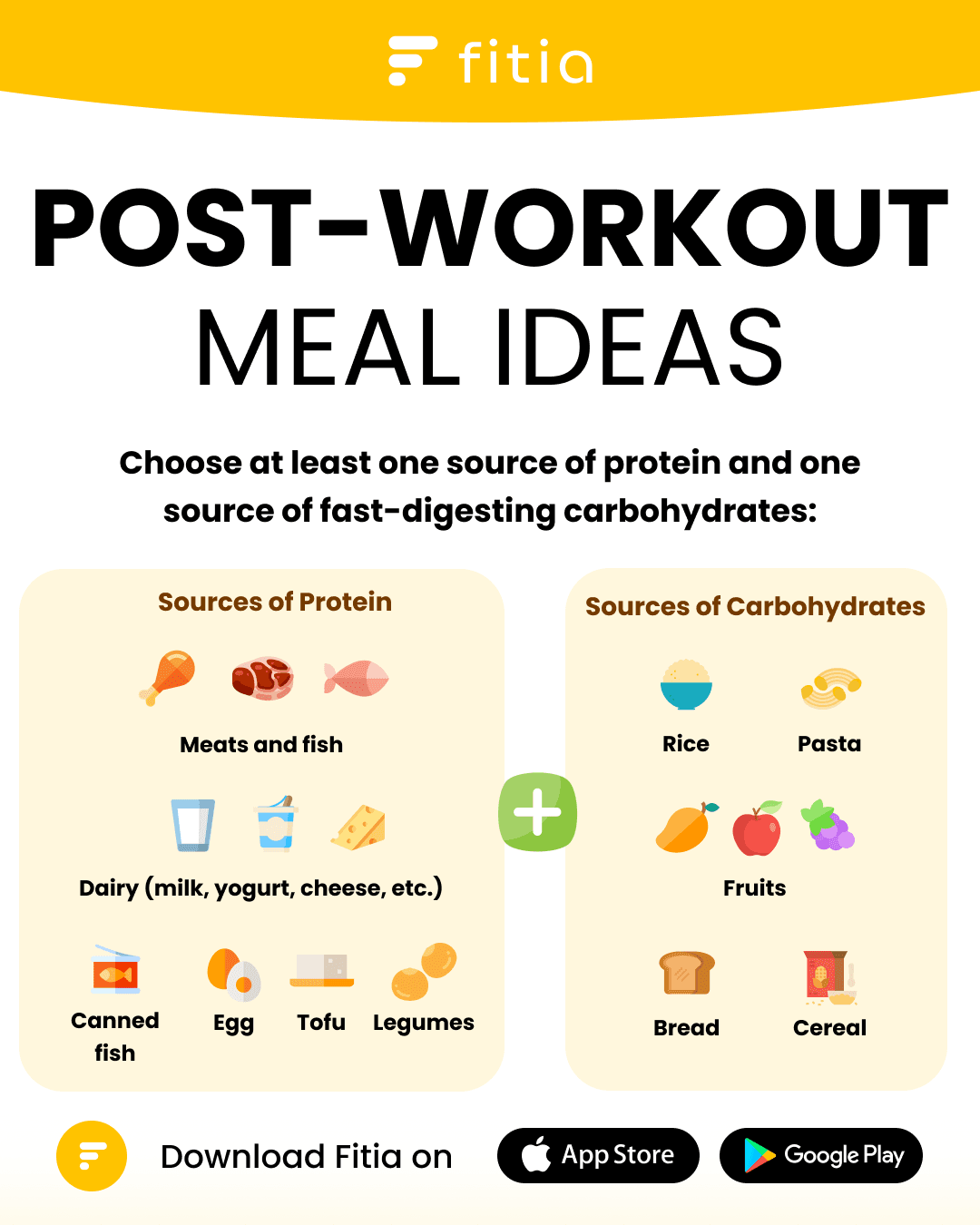
As Snacks or Breakfasts
- Tuna or Chicken Sandwich
- Scrambled Eggs with Toast
- Low-Fat Greek Yogurt or Skyr Bowl with Fruit and Granola
- Smoothie with Protein Powder and Fruit
- Oatmeal Porridge with Fruit and Egg Tortilla
- Fried Plantains with Scrambled Tofu
For Lunch or Dinner
- Baked Chicken and Sweet Potato with Fresh Salad
- Quinoa Bowl with Sweet Corn, Mustard Chicken, and Grilled Vegetables
- Lentil or Garbanzo Beans Salad with Tuna
- Chicken and Veggie Wrap
- Stir-Fried Noodles with Beef (Asian Style)
Conclusions
Consuming a combination of carbohydrates, proteins, and fluids is essential for recovery after a workout, helping to enhance its effectiveness.
However, there is no universal guideline on the optimal timing for post-workout nutrition, as it depends on various factors such as the type, intensity, and duration of the exercise, as well as the pre-workout meal.
Therefore, your post-workout meal could be consumed immediately after finishing the session, or up to 4 or 5 hours later.
💡 Tip: In Fitia app, you can find thousands of post-workout ideas. Download it for free here.
References
- Kerksick CM, Arent S, Schoenfeld BJ, et al. International society of sports nutrition position stand: nutrient timing. J Int Soc Sports Nutr. 2017;14:33. Published 2017 Aug 29. doi:10.1186/s12970-017-0189-4
- Schoenfeld, Brad J. Science and development of muscle hypertrophy. Human Kinetics, 2020.
- Poole C, Wilborn C, Taylor L, Kerksick C. The role of post-exercise nutrient administration on muscle protein synthesis and glycogen synthesis. J Sports Sci Med. 2010;9(3):354-363. Published 2010 Sep 1.
- Jäger R, Kerksick CM, Campbell BI, et al. International Society of Sports Nutrition Position Stand: protein and exercise. J Int Soc Sports Nutr. 2017;14:20. Published 2017 Jun 20. doi:10.1186/s12970-017-0177-8
- Rasmussen, BB, Tipton, KD, Miller, SL, Wolf, SE, and Wolfe, RR. An oral essential amino acid-carbohydrate supplement enhances muscle protein anabolism after resistance exercise. J. Appl. Physiol. 88: 386-392, 2000.
- Schoenfeld BJ, Aragon A, Wilborn C, Urbina SL, Hayward SE, Krieger J. Pre- versus post-exercise protein intake has similar effects on muscular adaptations [published correction appears in PeerJ. 2017 Aug 1;5:]. PeerJ. 2017;5:e2825. Published 2017 Jan 3. doi:10.7717/peerj.2825
- Levenhagen, DK, Gresham, JD, Carlson, MG, Maron, DJ, Borel, MJ, and Flakoll, PJ. Postexercise nutrient intake timing in humans is critical to recovery of leg glucose and protein homeostasis. Am. J. Physiol. Endocrinol. Metab. 280: E982-93, 2001.
- Schoenfeld, BJ, Aragon, AA, and Krieger, JW. The effect of protein timing on muscle strength and hypertrophy: a meta-analysis. J. Int. Soc. Sports Nutr. 10: 53-2783-10-53, 2013.
- Aragon AA, Schoenfeld BJ. Nutrient timing revisited: is there a post-exercise anabolic window?. J Int Soc Sports Nutr. 2013;10(1):5. Published 2013 Jan 29. doi:10.1186/1550-2783-10-5
Related articles
 Fat Loss
Weight Loss Calorie Chart (2026): How Many Calories to Eat by Body Weight, Sex, and Activity
See how many calories to eat to lose weight, with simple charts by body weight and activity, plus why your target changes as you go.
Read article Fat Loss
Best Personalized Meal Planning App for Weight Loss in the US (2026): Comparing Apps That Plan Around Your Likes, Dislikes & Food Preferences
Compare Fitia, Eat This Much, Lifesum & Mealime on how deeply each one plans meals around your likes, dislikes, and dietary patterns for weight loss.
Read article Fat Loss
Best Calorie Deficit App to Diet Without Feeling Hungry in the US (2026): Satiety-Focused Reviews & Feature Comparison
Compare the best calorie deficit apps in the US for 2026. See which satiety features actually keep you full so you can stick to a deficit for months.
Read article