
Apr 20, 2024
6 Mistakes You Should Avoid in a Volume Phase
Starting a "bulking" phase means that you're setting out to train and eat with the goal of gaining more muscle mass.
This involves stimulating your muscles through strength training and increasing your daily calorie intake to create a caloric surplus.
However, there are various ways to approach a bulking phase, and not all of them may be optimal for gaining and maintaining muscle mass.
Today, we're sharing six common mistakes people make during this stage, so you can avoid them.
💡 Also, remember that wirh the Fitia app you can get your personalized requirements to gain muscle according to your characteristics and your food preferences. Download it for free here.
1. Gaining Weight Too Quickly
Gaining muscle mass involves weight gain, which requires a caloric surplus (consuming more calories than you burn).
However, you must be cautious: when you create a caloric surplus, muscle mass increase will also be accompanied by a rise in fat. The amount of fat gained depends on the size of the surplus.
The only scenario where you might see muscle gain without weight gain is during body recomposition, where you simultaneously gain muscle and lose fat. However, this isn't possible for everyone.
In a future article, we'll explain how to achieve this and who might be able to do it.
So, if you gain weight quickly, you'll likely gain more muscle mass, but also more body fat.
After a bulking phase, you might want to enter a cutting phase to shed the fat you accumulated, which helps achieve a toned or defined appearance.
If this is your situation, it would be ideal to minimize fat gain during the bulking phase.
Gaining too much fat would require a longer or more aggressive deficit to lose it, and both scenarios typically result in more muscle loss than a shorter, moderate deficit would.
To illustrate this point, Ribeiro and colleagues recently published a study involving high-level bodybuilders.
They were separated into two groups: group 1 (aggressive surplus) consumed about 67.5 kcal/kg/day while group 2 (light surplus) consumed approximately 50.1 kcal/kg/day.
Participants followed a training plan designed to promote muscle growth for 4 weeks and at the end of the intervention, changes in lean mass and fat were assessed.
Based on this study and an article analyzing it, we have created a chart to help you better visualize the outcomes (2,3):
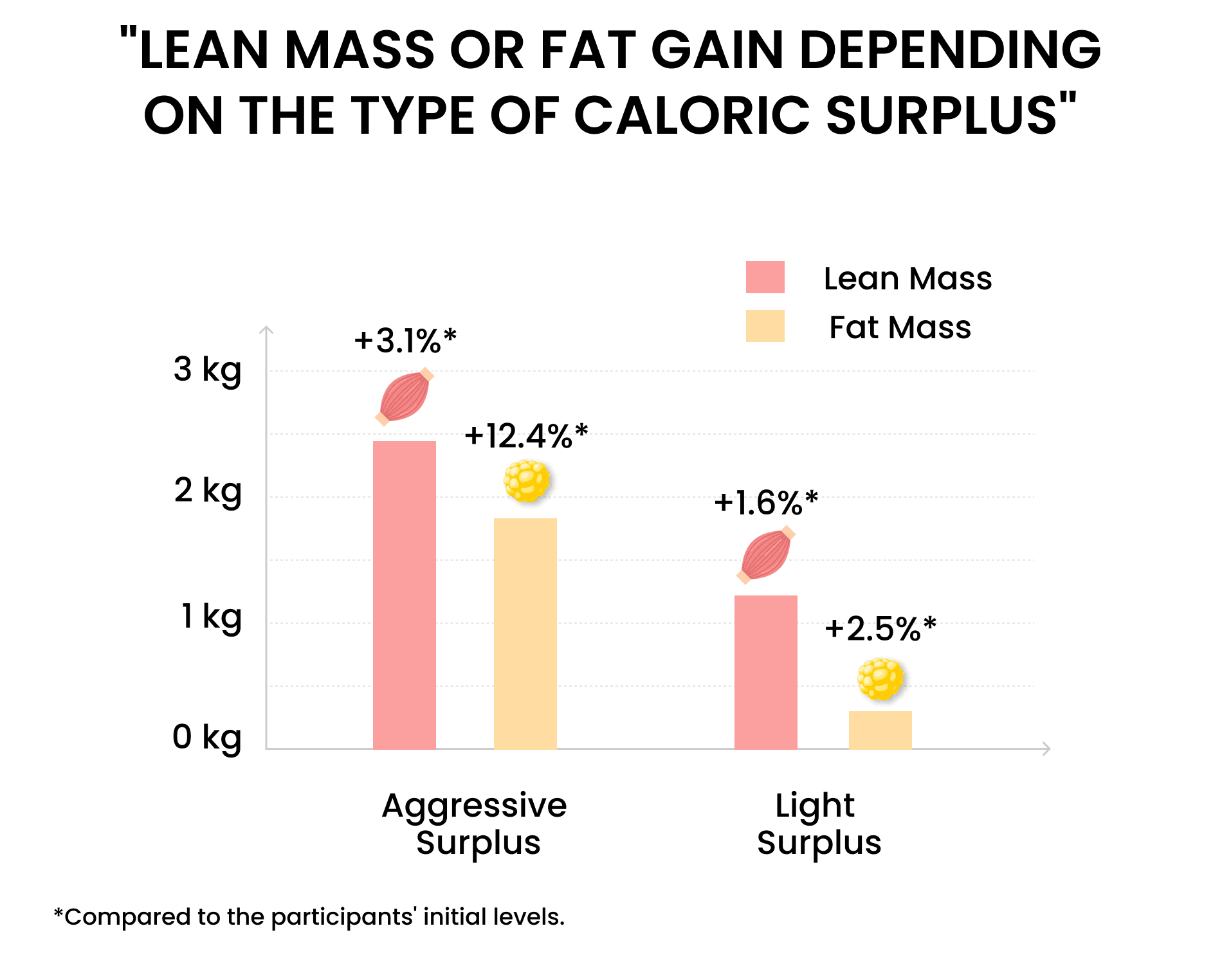 The group that consumed more calories gained more muscle mass, but also increased their fat disproportionately (lean mass to fat ratio of 4:3 vs 4:1).
This means that in the aggressive surplus group, 43% of the total weight gained was body fat, while in the light surplus group, it was only 20%.
With this, we can conclude that a slight caloric surplus (slow weight gain), leads to a "cleaner" muscle mass gain(2,3).
Although this study was performed in a highly trained population, other recommendations reach the same conclusions:
Weight gain during a bulking period should be slow to promote muscle mass gain without excessive fat accumulation (4,5,6).
Here are some practical recommendations for an appropriate bulking period:
- Aim to gain between 0.5 - 1.5% of your body weight per month (4). If you have a more advanced level of training, it's advisable to stay closer to the lower end of this range, while beginners might approach the upper limit due to their greater potential for muscle gain. For example, if you're a beginner starting at 80 kg, you should aim to gain no more than 1.2 kg in a month.
- You can consider increasing your caloric intake by 5 - 25% above your maintenance calories. For example, if your maintenance level is 2000 kcal, your bulking range would be between 2100 - 2500 kcal. We recommend sticking to the lower end of this range if you're aiming for a cleaner volume gain.
In summary, if you significantly increase your caloric intake (>25% above your maintenance calories or to a level that makes you gain more than 1.5% of your weight per month), you will gain weight too quickly and accumulate unnecessary fat
💡 Tip: The Fitia muscle gain meal plan uses a surplus at the recommended level. Download it for free here.
2. Not Worrying About Food Quality
We know that during a bulking phase you'll have a higher caloric goal, but that doesn't mean all your calories should come from "junk food" or that you should ignore the nutritional quality of your foods.
If the majority of the products you consume are ultra-processed (like fried snacks, donuts, cakes, etc.), it will be easier to exceed your total energy intake because these foods are calorie-dense but low in volume.
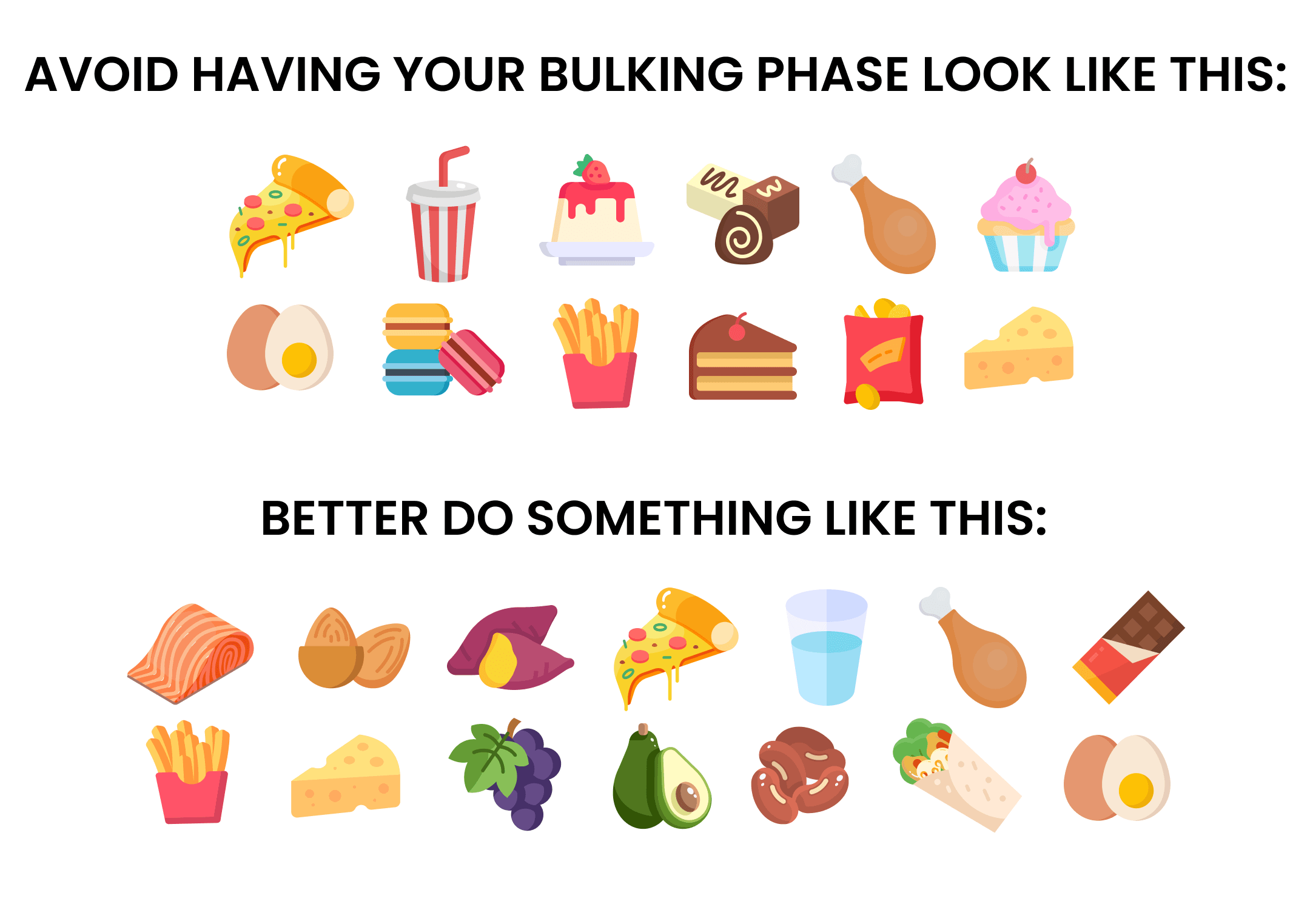
And lastly, these products typically provide minimal amounts of protein, and if they are a mainstay in your diet, it might lead to inadequate protein intake. This brings us to the next mistake.
Not paying attention to the nutritional quality of the foods you consume during the bulking phase can lead to excessive calorie intake and improper nutrient distribution.
3. Not Consuming Enough Protein
The goal of a bulking phase is to build more muscle mass, and this is only achievable with adequate protein intake.
Remember that muscle is primarily composed of water (75%) and protein (20%) (1). To facilitate muscle protein synthesis, you need to obtain protein from your diet.
Aim to consume between 1.6 and 2.2 g of protein per kilogram of body weight per day (assuming you are engaging in strength training). Research indicates that this range is optimal for maximizing muscle gain during a bulking phase (1,4,5).
For example, a person weighing 80 kg would need to consume between 128 and 176 grams of protein each day.
Keep in mind that exceeding this range will not provide additional benefits. Moreover, it might make you feel fuller, which isn't ideal since you need to consume more calories than usual (protein is the most satiating nutrient) (1,4,5).
Your protein intake should be within the range of 1.6 and 2.2 g/kg/day to maximize muscle mass gain during the bulking period.
With Fitia, you can get a meal plan that meets your calorie and nutrient requirements (including proteins for strength training). Download it for free here.
4. Not Performing Strength Training
Strength training provides the necessary stimulus for your muscles to increase in size through hypertrophy.
This is because it creates mechanical tension on the muscles (5). Without this type of training, muscle gain is simply not possible.
That's why doing cardiovascular exercises (running, cycling, dancing, etc.) does not lead to muscle growth. These activities have many other benefits, but if your goal is to gain muscle, cardio alone won't achieve it.
👉 You might be interested in: How to Gain Muscle?
Also, remember that you are providing your body with an increased amount of calories and nutrients. Therefore, you need to create the necessary stimulus for these to be used for muscle tissue synthesis.
If you don't, the extra energy you're consuming will likely be stored as fat.
You need to engage in strength training because that's the only way to provide the appropriate stimulus for your muscles to grow, through mechanical tension.
5. Not Implementing Progressive Overload
Our muscles have the ability to adapt to the stress they're subjected to from training, and there will come a point where we are comfortable with the current training volume. If you don't continue to elevate the level of your training, you will stop providing the necessary stimulus for your muscles to keep growing.
Therefore, you need to train following the principle of progressive overload, which means gradually increasing the stimulus your training provides to your muscles. You can achieve this in several ways:
- Increase the number of repetitions and sets you perform.
- Increase the weight you use.
- Decrease the rest time between sets.
- Improve the technique of the exercises you perform (more controlled movements, greater range of motion, etc.).
- Increase the difficulty of your workouts.
👉 You might be interested in: What is the Anabolic Window?
6. Lacking Patience
Gaining muscle mass is a slow process, even slower than losing fat.
As we discussed earlier, it's advisable to progress gradually for better results.
Typically, a bulking phase should last three to four times longer than a cutting phase (where you lose fat) 7)..
This means that for every month of cutting, you should have spent at least three months bulking.
Therefore, the most important thing for this process is to be consistent and patient. Changes won't be visible overnight, but this doesn't mean you aren't making progress.
References
References
- Slater, Gary John et al. “Is an Energy Surplus Required to Maximize Skeletal Muscle Hypertrophy Associated With Resistance Training.” Frontiers in nutrition vol. 6 131. 20 Aug. 2019, doi:10.3389/fnut.2019.00131
- Leaf, Alex, and Jose Antonio. “The Effects of Overfeeding on Body Composition: The Role of Macronutrient Composition - A Narrative Review.” International journal of exercise science vol. 10,8 1275-1296. 1 Dec. 2017
- Helms, E. When Gaining Muscle, the Tortoise Beats the Hare. Mass. 2019 vol 3, 6
- Helms, Eric, Andrea Valdez, and Andy Morgan. "The Muscle and Strength Pyramid." Nutrition (2018).
- Schoenfeld, Brad J. Science and development of muscle hypertrophy. Human Kinetics, 2020.
- Garthe, Ina et al. “Effect of nutritional intervention on body composition and performance in elite athletes.” European journal of sport science vol. 13,3 (2013): 295-303. doi:10.1080/17461391.2011.643923
- Helms, Eric, Andy Morgan, and Andrea Valdez. The Muscle & Strength Pyramid: Training. Muscle and Strength Pyramids, LLC., 2018.
Fitia: Meal Plans & Calorie Counter
We use cookies to enhance your browsing experience, analyze site traffic, and personalize content. By clicking 'Accept', you consent to the use of these technologies in accordance with our Privacy Policy.