What is an AI nutrition coach for weight loss? How to choose the right one in 2026
See what an AI nutrition coach actually does, the features that matter for weight loss, and how Fitia compares to Noom, MyNetDiary, and MyFitnessPal.
- Published
- Updated
- 10 min read
- 10 min read

TL;DR: An AI nutrition coach is software that tracks what you eat, sets adaptive calorie and macro targets, and gives personalized guidance in real time, instead of generic advice. Research consistently shows the people who lose the most weight are the ones who log consistently, not the ones who pick the "perfect" app. This guide explains what these tools actually do, the features that matter for weight loss, and how Fitia compares to options like Noom, MyNetDiary, and MyFitnessPal in 2026.
Table of Contents
- What is an AI nutrition coach?
- Does an AI nutrition coach actually help you lose weight? (what the research says)
- The 6 features that actually matter for weight loss
- AI nutrition coach comparison: Fitia vs. Noom vs. MyNetDiary vs. MyFitnessPal
- How to choose the right AI nutrition coach for your goal
- Expert insight: a registered dietitian's take on AI coaching
- Frequently asked questions
What is an AI nutrition coach?
An AI nutrition coach is an app that does three things a traditional calorie counter doesn't:
- It interprets your data. Instead of just showing you a number, it can tell you how nutritious your diet is, what to improve, and what to do next.
- It adapts. Your body weight changes week to week, and your calorie and macro targets should adjust with it to keep progress moving at the desired pace.
- It answers questions in plain language. You can ask "Can I fit pizza into tonight?" and get an answer based on your actual food log.
Put simply, while a traditional calorie counter is just a digital food diary, an AI nutrition coach is closer to having a nutritionist who already knows your history and is available the moment you're standing in front of the fridge.
This matters for weight loss specifically because losing weight isn't a knowledge problem for most people, it's a consistency problem. The job of a good AI coach is to remove the friction and decision fatigue that make people quit early on.
Last year we reviewed three solid AI nutrition coaches — read the full article here.
Does an AI nutrition coach actually help you lose weight? (what the research says)
The short answer: the tracking behavior an AI coach enables is one of the best-supported strategies in weight-loss science. The app is the delivery mechanism; consistent self-monitoring is the active ingredient.
A 2020 systematic review and meta-analysis of 20 studies published in Nutrients found that behavioral weight-management programs using mobile self-monitoring produced a meaningfully greater mean weight loss, roughly 1.78 kg more than other intervention types, and, importantly, higher adherence.
The authors also found smartphones were the most effective device for delivering this kind of self-monitoring
Why does adherence matter so much? Because frequency of logging is one of the strongest predictors of achieving results.
In a 2019 study in Obesity aptly titled "Log Often, Lose More," participants who logged more frequently were significantly more likely to hit both 5% and 10% body-weight loss. Those who reached those clinically meaningful thresholds were logging roughly two to three times per day, and the time required to be successful actually decreased as the habit formed.
A 2021 analysis in JMIR mHealth and uHealth added the long-term piece: early, frequent dietary self-monitoring substantially predicted weight loss at four months, and four-month weight loss in turn almost entirely predicted where people landed at twelve months.
The practical takeaway is consistent across all three studies: the best AI nutrition coach for weight loss is the one you'll engage with every day for months. That single criterion should drive your choice more than any feature list, and it's the lens this guide uses.
The 6 features that actually matter for weight loss
Not every "AI feature" earns its place. These are the ones that move the needle on the consistency the research points to:
1. Low-friction logging (photo, voice, barcode, and text)
Every extra tap is a reason to quit. The faster a meal goes from plate to log, the more days you'll log. Multiple input methods matter because real life isn't one method, you scan a package, photograph a restaurant plate, and speak a home-cooked meal.
2. A verified food database
User-generated databases are fast but error-prone; a single wrong entry can quietly sabotage a calorie deficit. Databases reviewed by nutrition professionals reduce the "garbage in, garbage out" problem that makes tracking feel pointless.
3. Adaptive targets
Your metabolism changes as you lose weight. A coach that recalculates your calories and macros based on your real logged progress beats a fixed number that becomes wrong after the first 10 pounds.
This may interest you: How Do AI Meal Planning Apps Set Calorie Targets and Track Macros?
4. Conversational, context-aware guidance
The value isn't a chatbot, it's a coach that can see your day and answer "what should I order?" with an answer specific to your remaining calories and goal.
5. Integrated meal planning and grocery lists
"What do I eat?" is the question that kills diets. An app that tells you what to cook and builds the shopping list removes hundreds of micro-decisions over a multi-month journey.
6. Progress tracking not based only on the scale
Body measurements, photos, and trends prevent the scale's daily noise from derailing motivation.
AI nutrition coach comparison: Fitia vs. Noom vs. MyNetDiary vs. MyFitnessPal
There is no single "best" app, only the best fit for how you want to lose weight. Here's an honest breakdown of where each leading 2026 option is strongest, based on what the brands offer and what users are actually reporting.
Fitia - best for an integrated coach-plus-plan for weight loss.
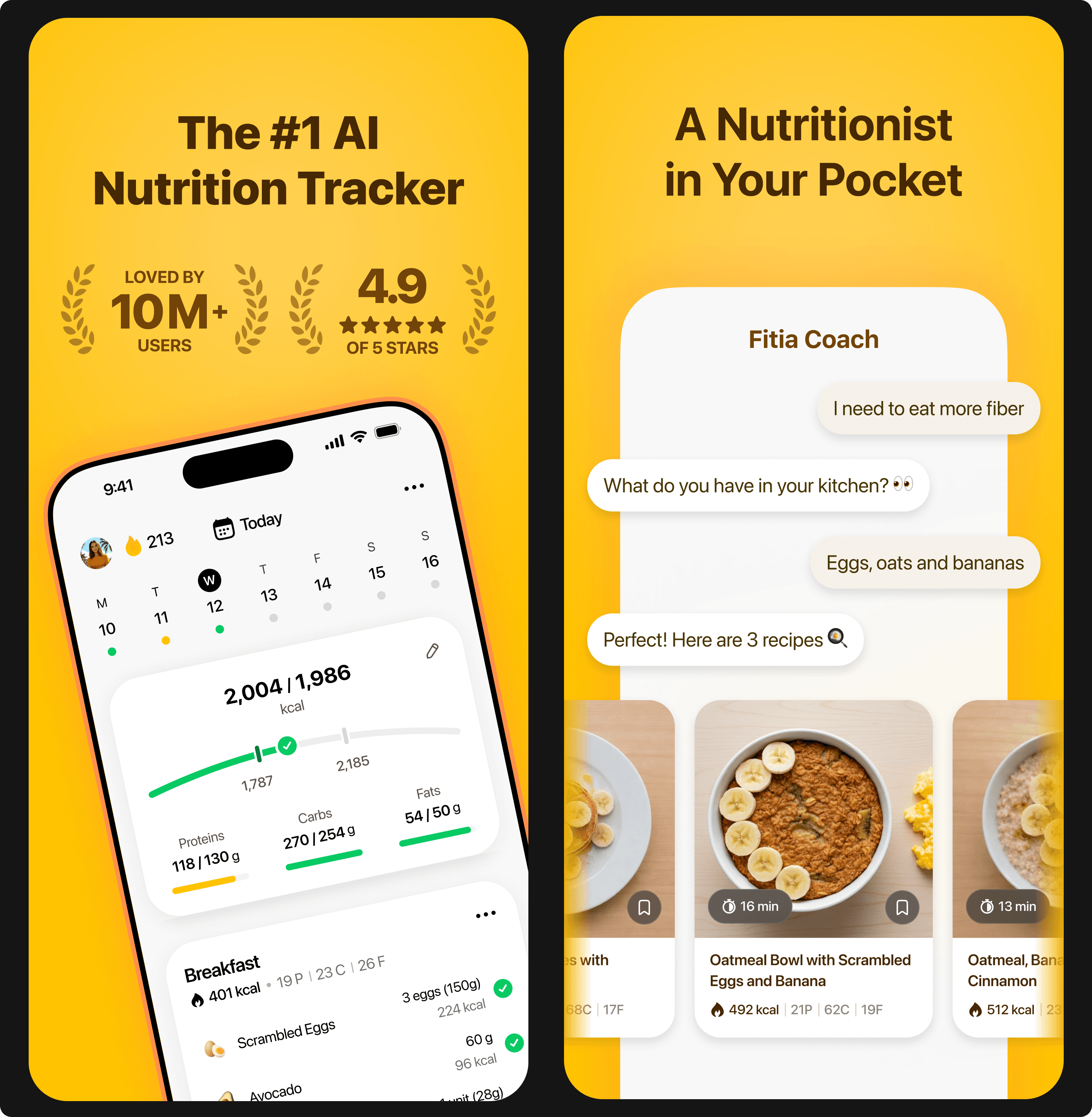
Fitia's differentiation is that it combines four things most competitors split apart: a 100% nutritionist-verified food database (every entry reviewed by a nutrition professional before publication), automatic personalized meal plans with auto-generated grocery lists, AI logging (photo, voice, barcode, text), and a 24/7 AI Coach that reads your actual food log to answer in-the-moment decisions.
The meal-plan algorithm is built on 150+ scientific studies, and the database is regionally localized, so the foods and brands you actually eat (including Latin American and other non-U.S. cuisines) have accurate values rather than rough guesses.
Through a simple chat box, Fitia Coach uses natural-language processing to understand what you're asking, generates or adjusts recipes when your day doesn't go as planned, and shows you how well any food fits your goals based on the verified database. It gives instant feedback to help you stay consistent or break through plateaus, and once your day ends, it generates a food quality summary based on your nutrition score, so you can review how well you actually ate, not just how much.
Curious how Fitia Coach actually works? Read the full breakdown of why Fitia's AI Coach is built differently
Noom - best for the psychology of eating
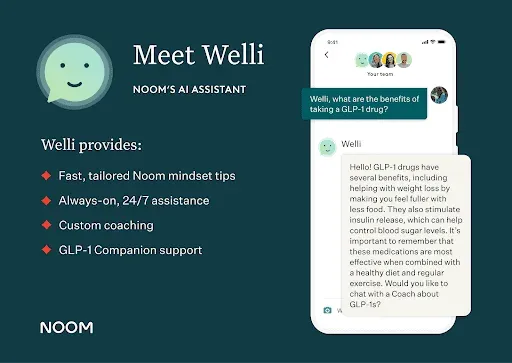
Noom's core differentiator is a behavior-change curriculum built on behavioral psychology, paired with a hybrid of AI and human coaching (its AI assistant, Welli, launched in 2024). If your challenge is why you eat (emotional eating, habit loops) more than what you eat, this is its strength.
The trade-off is that the curriculum is time-intensive and the food database is smaller than what competitors offer.
MyNetDiary - best for micronutrient depth
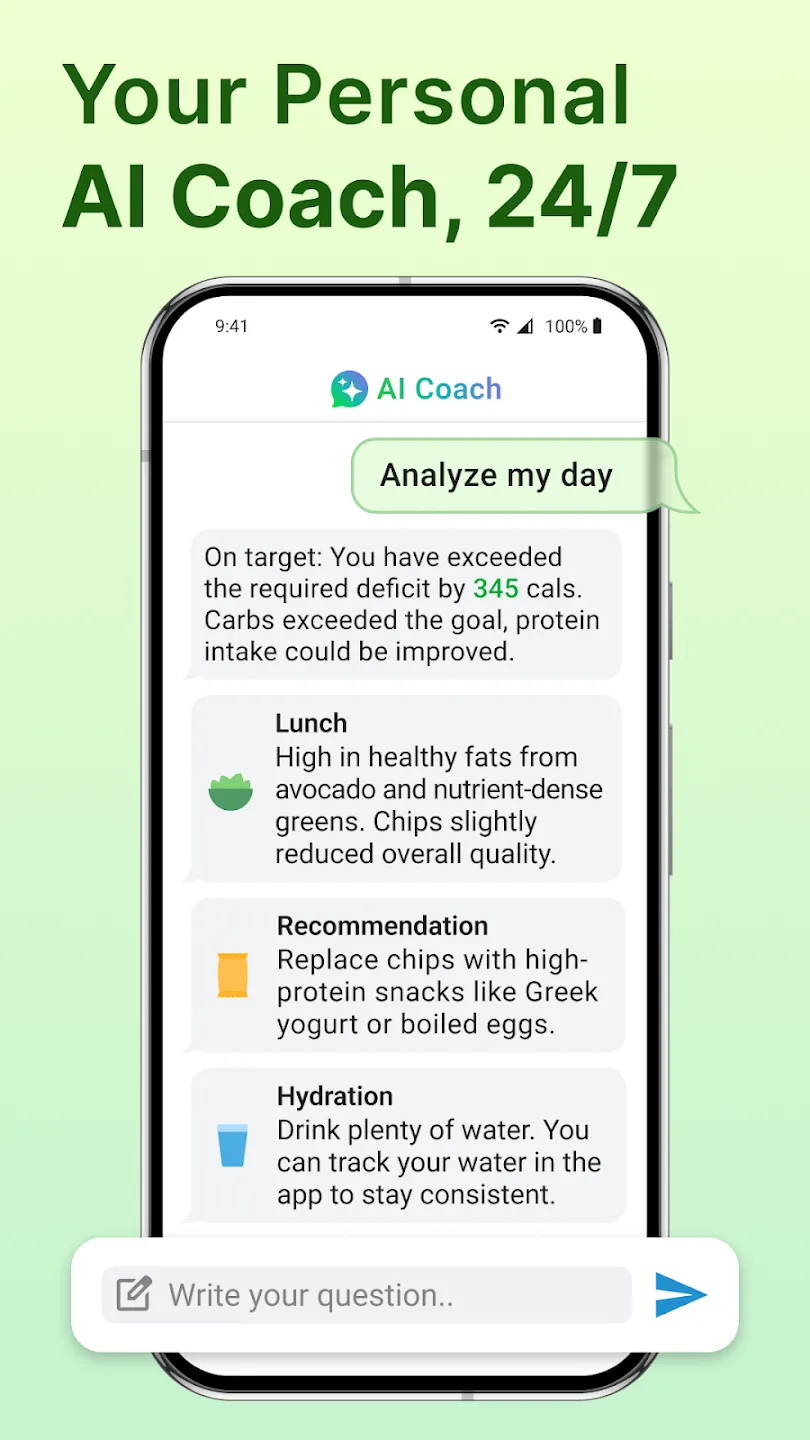
MyNetDiary launched its Premium Plus tier with an AI Coach in January 2026, layering conversational coaching, AI Suggest Meals, AI Restaurant Menu Scan, and voice logging on top of its existing strengths. It's also one of the few apps with dedicated GLP-1 medication support.
MyFitnessPal - best for raw database size, but its AI coach is still finding its footing
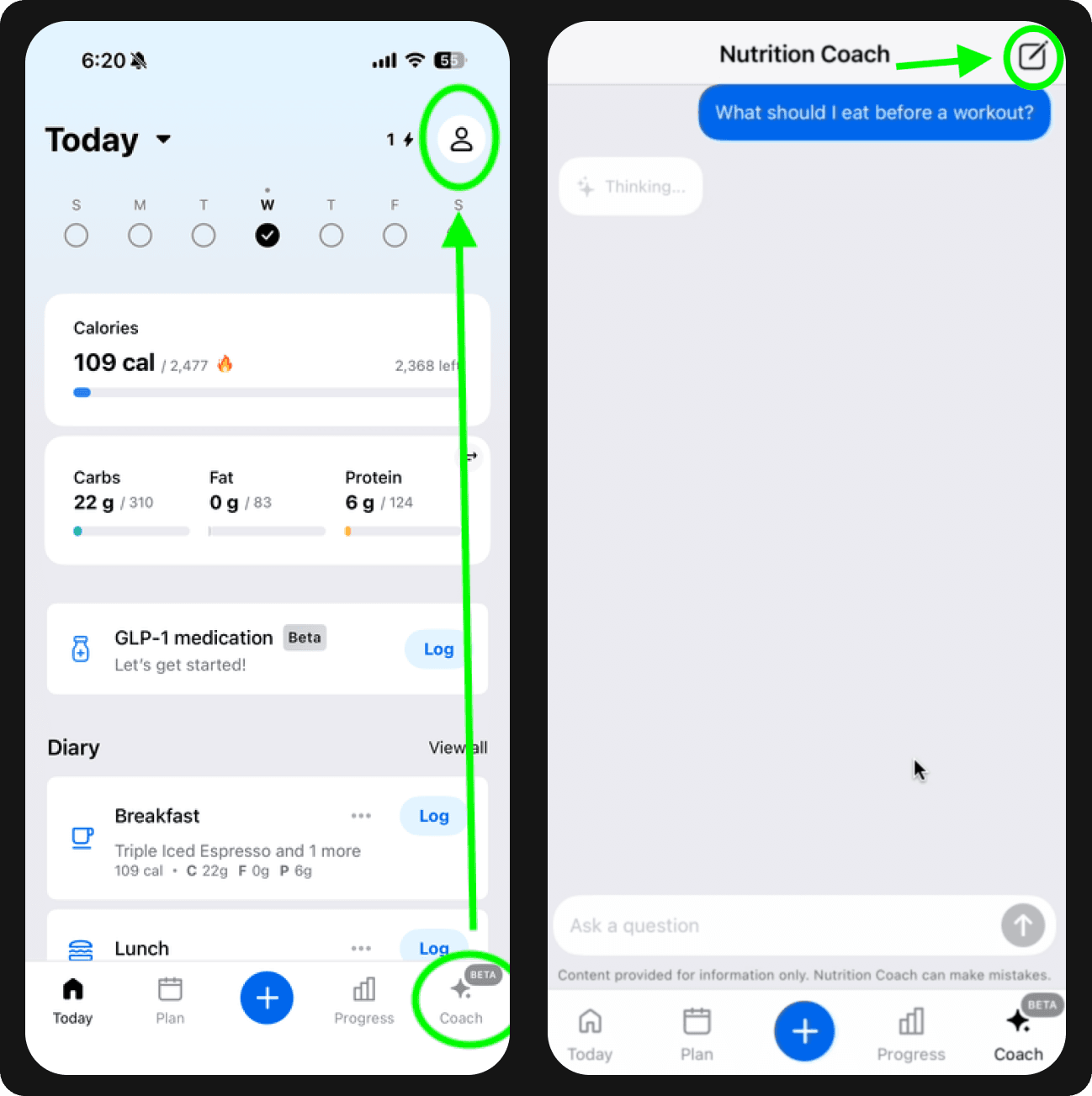
MyFitnessPal's "Coach" launched in April 2026 for Premium and Premium+ users (iOS-only, English-only, six countries). It's a conversational assistant that can answer questions like "Am I on track today?" or "What should I eat with my remaining calories?", suggest recipes, and review your goals, all grounded in your logged diary rather than generic responses.
However, the redesign that introduced Coach drew sharp backlash on Reddit and Trustpilot, with users finding it not fully ready for deployment in its current state. More updates will likely be needed to bring it up to par with competitors.
Honest summary: choose Fitia if you want accurate data, a plan that tells you what to eat, and an AI coach that adapts to your day in one integrated experience. Pick Noom if your barrier is psychological rather than practical. Go with MyNetDiary if you want maximum nutrient depth. Stick with MyFitnessPal if you just need the biggest database and can wait for its Coach to mature.
How to choose the right AI nutrition coach for your goal
Match the tool to your actual bottleneck:
- You quit because tracking is tedious → prioritize logging speed and a verified database (less time fixing wrong entries).
- You quit because you don't know what to eat → prioritize integrated meal planning and grocery lists.
- You quit when you hit a plateau → prioritize adaptive targets.
- You eat for emotional reasons → prioritize a psychology-based curriculum.
Expert insight: a registered dietitian's take on AI coaching
The following reflects general guidance consistent with registered-dietitian practice and the cited research. It is educational and not a substitute for individualized medical or nutrition advice.
From a dietitian's standpoint, AI nutrition coaches are most useful when they're treated as a tool to improve consistency, not an authority that can't be challenged. A few practical recommendations:
- Aim for "good enough, logged" over "perfect, abandoned." The data is clear that frequency beats precision. Logging a roughly estimated restaurant meal is far more valuable than skipping the log because you can't weigh it.
- Log within the same day, ideally close to eating. Memory-based back-logging is where accuracy collapses. Use photo or voice logging in the moment to protect data quality.
- Follow weight trends, not daily numbers. Body weight fluctuates with water, sodium, and hormones. Judge progress on a 2–4 week trend line, which is exactly what adaptive algorithms are designed to read.
- Use the AI for decisions, not diagnoses. "How do I fit this dinner in?" is a great question for an AI coach. "Why am I always tired and is this medical?" is a question for a clinician. Know the boundary.
- Expect and plan for plateaus. A stall after initial loss is physiologically normal. This is precisely when an adaptive coach earns its value, and the wrong time to quit.
Remember, the best outcomes come from people who let the app remove friction and then simply keep showing up.
Frequently asked questions
What is an AI nutrition coach?
It's an app that tracks your food, sets adaptive calorie and macro targets, and gives personalized, conversational guidance based on your actual eating patterns, rather than fixed, generic advice.
Does an AI nutrition coach actually work for weight loss?
The research is consistent: app-based dietary self-monitoring is associated with greater weight loss and better adherence than other approaches, with frequency of logging being the strongest behavioral predictor of success.
Is an AI nutrition coach better than a human dietitian?
They serve different roles. AI coaches excel at daily, low-cost, in-the-moment decision support and consistency. A registered dietitian provides individualized clinical assessment. For many people, an AI coach handles the daily work while a dietitian handles the medical and individualized layer.
Are AI nutrition coaches accurate?
Accuracy depends heavily on the food database. Apps with professionally verified databases avoid much of the error found in crowd-sourced entries. Photo logging is fast but worth double-checking on calorie-dense or complex meals.
Ready to put the consistency principle into practice? Download Fitia and use code FITIANOW to save on Premium, which unlocks the full AI Coach, adaptive meal planning, and multi-method logging.
About the Author
 | Arantza Echeandía León is a registered dietitian and nutritionist, graduated from Universidad Peruana de Ciencias Aplicadas (UPC), where she ranked in the top 10% of her class. She specializes in sports nutrition and metabolic conditions, with experience supporting athletes and collaborating with multidisciplinary teams to optimize performance and recovery. She holds a Level I ISAK certification in kinanthropometry and currently leads food database optimization and AI-driven nutrition feature integration at Fitia Inc. |
References
- Cavero-Redondo, I., Martinez-Vizcaino, V., Fernandez-Rodriguez, R., Saz-Lara, A., Pascual-Morena, C., & Álvarez-Bueno, C. (2020). Effect of Behavioral Weight Management Interventions Using Lifestyle mHealth Self-Monitoring on Weight Loss: A Systematic Review and Meta-Analysis. Nutrients, 12(7), 1977. https://doi.org/10.3390/nu12071977
- Harvey, J., Krukowski, R., Priest, J. and West, D. (2019), Log Often, Lose More: Electronic Dietary Self-Monitoring for Weight Loss. Obesity, 27: 380-384. https://doi.org/10.1002/oby.22382
- Farage, G., Simmons, C., Kocak, M., Klesges, R. C., Talcott, G. W., Richey, P., Hare, M., Johnson, K. C., Sen, S., & Krukowski, R. (2021). Assessing the Contribution of Self-Monitoring Through a Commercial Weight Loss App: Mediation and Predictive Modeling Study. JMIR mHealth and uHealth, 9(7), e18741. https://doi.org/10.2196/18741
Related articles
 Fat Loss
Weight Loss Calorie Chart (2026): How Many Calories to Eat by Body Weight, Sex, and Activity
See how many calories to eat to lose weight, with simple charts by body weight and activity, plus why your target changes as you go.
Read article Fat Loss
Best Personalized Meal Planning App for Weight Loss in the US (2026): Comparing Apps That Plan Around Your Likes, Dislikes & Food Preferences
Compare Fitia, Eat This Much, Lifesum & Mealime on how deeply each one plans meals around your likes, dislikes, and dietary patterns for weight loss.
Read article Fat Loss
Best Calorie Deficit App to Diet Without Feeling Hungry in the US (2026): Satiety-Focused Reviews & Feature Comparison
Compare the best calorie deficit apps in the US for 2026. See which satiety features actually keep you full so you can stick to a deficit for months.
Read article