5 Common Mistakes to Avoid When Starting at the Gym
Discover the 5 most common mistakes when starting at the gym and learn how to fix them to progress safely and effectively on your fitness journey.
- Published
- Updated
- 10 min read
- 10 min read

Your first day at the gym can be exciting, but it can also feel a bit overwhelming. After all, you're taking your first steps into a completely new world.
You probably already have some preconceived ideas about what it means to live a fitness lifestyle. Depending on how seriously you're taking the gym, those ideas might even be a little extreme.
Do you think you need to get super strong or gain muscle as quickly as possible?
Are you considering spending a fortune on supplements to "maximize" your results?
Or maybe you're planning to train six days a week and completely cut carbs from your diet?
If any of this sounds familiar, be careful. You might be on the verge of making—or may have already made—some of the most common mistakes when starting at the gym.
But don’t worry. In this article, we’ll explain what these mistakes are and, most importantly, how to avoid or correct them so you can make steady progress on your fitness journey.
1. Prioritizing Weight Over Proper Form

It’s happened to many of us: we step into the gym for the first time and see others lifting much heavier weights. This can trigger our competitive side, pushing us to match or surpass them as quickly as possible.
The problem with this mindset is that it often leads to prioritizing weight over proper form, which increases the risk of injury and slows down long-term progress.
How Can You Avoid Prioritizing Weight Over Proper Form?
Focusing on developing efficient technique before increasing the load will help you progress safely and prevent compensatory movements that can overstrain your muscles and joints.
Remember, the learning curve varies depending on the exercise. For example, it’s easier to master a bicep curl or a horizontal leg press than an Olympic bar deadlift or a free-weight squat.
If you’re unsure, rely on the resources available:
- There are numerous guides and tutorials online to help you learn the proper form for the most common movements.
- Don’t hesitate to ask the gym trainer for corrections and specific tips.
Likewise, don’t obsess over perfection. It’s important to understand that not everyone will perform each exercise the exact same way, nor do you need “perfect” technique to make progress.
For many movements, it’s enough to focus on a few key basics, such as maintaining good posture, controlling your breathing, and mastering the tempo and range of motion (1).
Currently, to address this particular area of improvement, you can use AI tools like Gymscore.
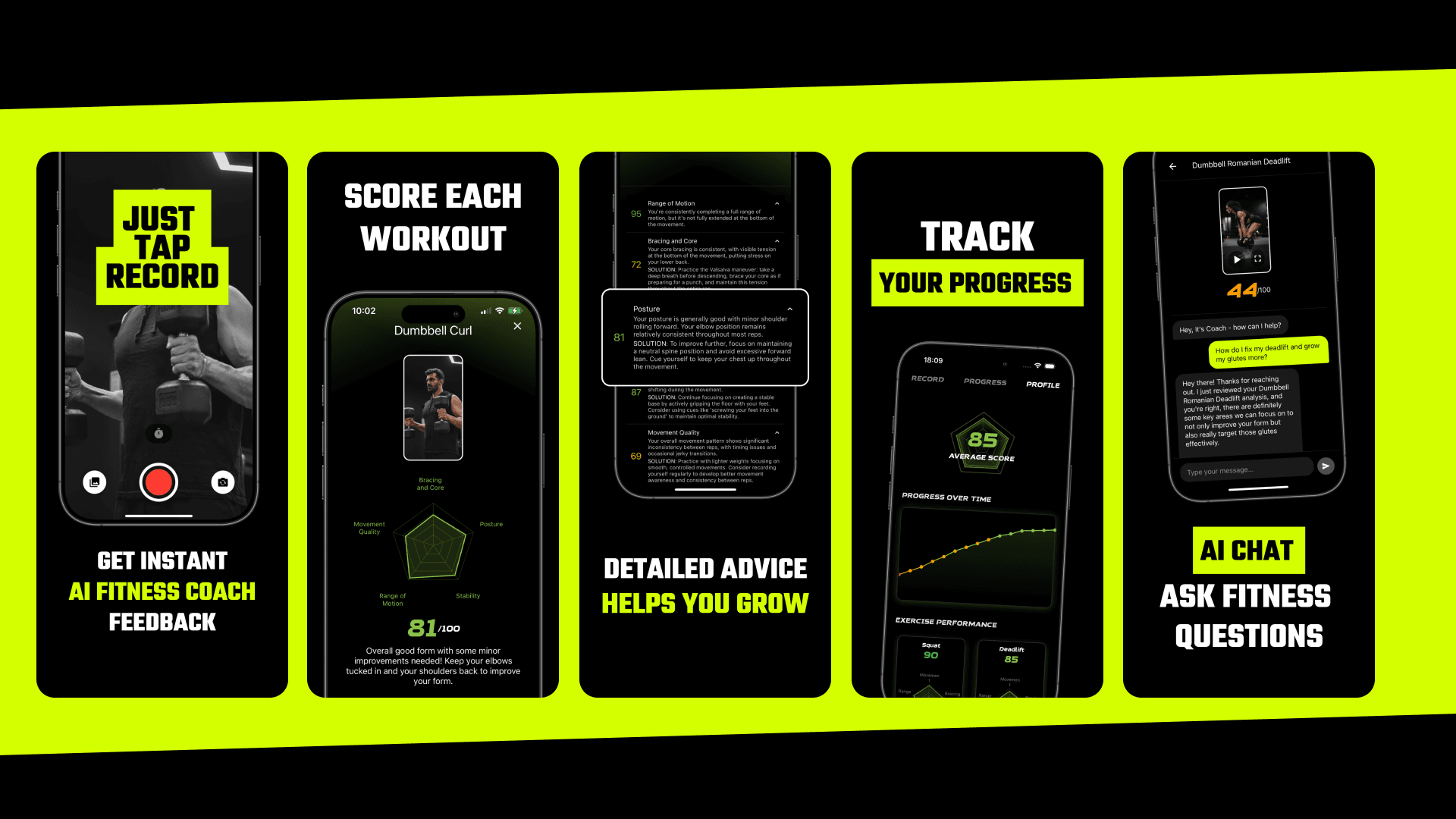
Apps like Gymscore help you build muscle by improving your form and providing detailed feedback on each lift. Proper form is key to unlocking muscle growth, and Gymscore excels at helping you perfect it.
The app acts as your AI fitness coach, designed to elevate your workouts through advanced form analysis. Whether you're a beginner or a seasoned athlete, Gymscore provides instant, professional-grade feedback by analyzing your exercise technique across five key areas: bracing and core strength, posture and spinal alignment, foot placement and balance, range of motion optimization, and overall movement efficiency.
You can upload existing videos, and the AI will handle the detailed analysis of your form. The app delivers comprehensive insights, assigns scores (0–100) to objectively track progress, and offers personalized recommendations to help you train safely while maximizing results.
To wrap up this first section: just practice, practice, practice. In fact, some research indicates that the speed of motor learning is linked to the number of mistakes made (2,3), as long as you’re aware of them and actively work to correct them.
2. Spending Money on Unnecessary Supplements

When starting at the gym, it’s easy to fall into the idea that you need supplements to see results. They’re marketed as the ultimate solution to improve muscle recovery, performance, and, ultimately, your gains.
However, the truth is that most supplements aren’t essential, and in many cases, their use is more circumstantial or practical than necessary. After all, the sports supplement industry excels at one thing: marketing.
How Can You Avoid Spending Money on Unnecessary Supplements?
The most important thing is to focus on the basics: a balanced diet, getting 6 to 8 hours of sleep each night (4), and following a consistent training program. This not only means performing exercises correctly but also choosing the right movements and doing the necessary training volume—something we’ll discuss later.
These three fundamentals will have a much greater impact on your recovery and performance than any supplement. As Dr. Eric Helms, creator of the popular Muscle and Strength Training Pyramid, aptly says (5):
"Supplements are the least important part of the pyramid and are not necessary for success, unless you have a nutritional deficiency or a specific condition that requires them." – Dr. Eric Helms
If you’re still interested in exploring the world of sports supplementation, the best approach is to consult a healthcare professional to determine whether you genuinely need any specific supplement.
Lastly, it’s important to note that only a small group of supplements have sufficient scientific evidence to support their benefits and may be useful in specific scenarios. Examples include creatine monohydrate and protein powder (6).
If you want to learn more about supplements that can actually boost your performance, don’t miss our article 👉 The 5 Fitness Supplements That Are Actually Worth Your Money
3. Overdoing Training Frequency and Volume

Another common mistake when starting at the gym is trying to go from 0 to 100 in just one week, often leading to training 6 or even 7 days a week without any rest.
Even those who train a more reasonable number of days, like 4 or 5, can still make another mistake: performing too many sets per muscle group or overdoing repetitions, often exceeding 20 per exercise.
The result? Excessive fatigue and unnecessary muscle damage that, instead of helping you progress, can actually hinder your development. This physical exhaustion can also affect your motivation, making you lose interest in continuing your training (7,8).
How Can You Avoid Overdoing Training Frequency and Volume?
Contrary to popular belief, science has shown that training volume (the total number of sets per muscle group) is more important than frequency (how often you work a muscle in different sessions) (9,10).
If you’re just starting out, you can achieve excellent results by training 3 to 5 days per week, with a frequency of two sessions per muscle group and a moderate volume.
In practice, this means working each muscle twice a week, accumulating an average volume of 8 total sets with a range of 5 to 10 repetitions per set, always pushing close to maximum effort (11,12,13).
For example, if you train 4 days a week (Monday, Tuesday, Thursday, and Friday), you could perform two exercises of 2 sets x 5–10 repetitions for your back on Monday and repeat the same structure on Thursday using different exercises.
Over time, your training volume can increase, but this will depend on your individual response and recovery capacity. It’s always better to start with less and gradually progress to avoid injuries and ensure sustainable progress.
If you’re struggling to create an effective training plan or find a reliable one online, don’t hesitate to seek help from a personal trainer. Just make sure they are well-qualified and capable of tailoring the plan to your specific needs.
4. Switching Routines Too Often

If your routine is poorly designed or doesn’t fit well with your lifestyle, you’re likely not giving it enough time to produce consistent muscle adaptations and may end up changing it before seeing results.
Impatience from not seeing quick progress can also push you to switch programs week after week, creating an unproductive cycle.
The problem is that without consistency, your body doesn’t have the time to achieve the specific goals of the routine, and you end up stalling your progress.
How Can You Avoid Changing Your Routine Too Often?
There’s no exact timeline for changing your routine, but this primarily depends on two factors:
- How long it takes your body to adapt to the program’s stimuli
As you progress, you’ll notice diminishing returns in improvements: fewer gains in technical efficiency, reps before muscle failure, or the weight lifted. This happens due to the principle of adaptation (14). - Signs of accumulated fatigue
These include persistent muscle or joint pain, lack of motivation to train, irritability, and decreased sleep quality (15). These signs indicate your body needs time to recover properly.
With experience, you’ll learn to recognize when it’s time to switch routines or incorporate a deload period to avoid burnout.
In general, most programs work well for 8 to 12 weeks and follow some form of periodization to maximize results.
5. Overcomplicating Your Diet

This mistake is, without a doubt, the most common of all and one of the main reasons why many beginners give up on their fitness journey before seeing lasting results.
There’s a common misconception that starting at the gym must come with an extremely restrictive diet—like cutting carbs almost entirely, following absurd liquid diets, avoiding favorite foods, or, on the opposite extreme, consuming an exaggerated amount of calories just because “that’s what the pros do.”
The problem? These restrictions are usually unsustainable, leading many people to abandon their diets and, eventually, the gym as well.
Additionally, an unbalanced diet can hinder your progress, whether your goal is to gain strength, build muscle mass, or lose fat (16).
How Can You Avoid Overcomplicating Your Diet?
If you’re unsure where to start, the best option is to consult a nutritionist who can help you set realistic goals and create a meal plan tailored to your needs.
Another practical option is to use apps like Fitia, which allow you to track calories and provide personalized meal plans based on your goals and the foods you have available.
Whichever route you choose, keep these key points in mind:
- Consume the right amount of protein: Aim for 1.6 to 2.2 grams per kg of body weight. Protein is essential for building muscle mass and optimizing recovery after training (17).
- Carbs are not your enemy: During exercise, your body uses glycogen stores as an energy source, and these are replenished through carbohydrate consumption (18).
- Don’t neglect micronutrients: Make sure to include proper portions of fruits and vegetables in your diet, about one serving of each per 1000 kcal consumed daily (19).
Forget about extreme diets and aim for a balanced approach to eating that aligns with your lifestyle and goals. The key is to maintain a nutritional balance that allows you to make progress without giving up the foods you enjoy.
Looking for a simple meal plan tailored to your fitness goals? Download Fitia for free and start seeing real results today.
In Summary...
Starting at the gym can be challenging, but avoiding the most common mistakes will make a big difference in your progress. In this article, we covered how:
- Prioritizing form over weight helps you train safely and effectively.
- Focusing on the basics—diet, rest, and training—without relying on unnecessary supplements is the key to seeing results.
- Training with the right volume prevents excessive fatigue and allows you to progress without frustration.
- Giving your routine time is essential for your body to adapt and avoid hitting plateaus.
- Simplifying your diet and choosing a balanced approach helps you move forward without falling into extreme restrictions.
Avoid these mistakes, stay consistent, and focus on building sustainable habits. With time and a smart approach, you’ll progress effectively and enjoy the journey even more.
References
- Androulakis Korakakis, P., Wolf, M., Coleman, M., Burke, R., Piñero, A., Nippard, J., & Schoenfeld, B. J. (2024). Optimizing Resistance Training Technique to Maximize Muscle Hypertrophy: A Narrative Review. Journal of Functional Morphology and Kinesiology, 9(1), 9. https://doi.org/10.3390/jfmk9010009
- Thoroughman KA, Shadmehr R. Learning of action through adaptive combination of motor primitives. Nature. 2000 Oct 12;407(6805):742-7. doi: 10.1038/35037588. PMID: 11048720; PMCID: PMC2556237.
- Scheidt RA, Dingwell JB, Mussa-Ivaldi FA. Learning to move amid uncertainty. J Neurophysiol. 2001 Aug;86(2):971-85. doi: 10.1152/jn.2001.86.2.971. PMID: 11495965.
- Hirshkowitz M, Whiton K, Albert SM, Alessi C, Bruni O, DonCarlos L, Hazen N, Herman J, Adams Hillard PJ, Katz ES, Kheirandish-Gozal L, Neubauer DN, O'Donnell AE, Ohayon M, Peever J, Rawding R, Sachdeva RC, Setters B, Vitiello MV, Ware JC. National Sleep Foundation's updated sleep duration recommendations: final report. Sleep Health. 2015 Dec;1(4):233-243. doi: 10.1016/j.sleh.2015.10.004. Epub 2015 Oct 31. PMID: 29073398.
- Helms, E. R., Aragon, A. A., & Morgan, A. (2018). The muscle and strength pyramid: Nutrition. Muscle and Strength Press.
- Vilar Neto, J. D. O., da Silva, C. A., Lima, A. B., Rosa de Souza, F. J., Pinto, D. V., et al. (2018). Effects of low-dose creatine monohydrate on muscle strength and endurance. Asian Journal of Sports Medicine, 9(3), e62739. https://doi.org/10.5812/asjsm.62739
- Carroll TJ, Taylor JL, Gandevia SC. Recovery of central and peripheral neuromuscular fatigue after exercise. J Appl Physiol (1985). 2017 May 1;122(5):1068-1076. doi: 10.1152/japplphysiol.00775.2016. Epub 2016 Dec 8. PMID: 27932676.
- Hubal MJ, Rubinstein SR, Clarkson PM. Mechanisms of variability in strength loss after muscle-lengthening actions. Med Sci Sports Exerc. 2007 Mar;39(3):461-8. doi: 10.1249/01.mss.0000247007.19127.da. PMID: 17473772.
- Yue FL, Karsten B, Larumbe-Zabala E, Seijo M, Naclerio F. Comparison of 2 weekly-equalized volume resistance-training routines using different frequencies on body composition and performance in trained males. Appl Physiol Nutr Metab. 2018 May;43(5):475-481. doi: 10.1139/apnm-2017-0575. Epub 2017 Dec 7. PMID: 29216446.
- Schoenfeld BJ, Ogborn D, Krieger JW. Effects of Resistance Training Frequency on Measures of Muscle Hypertrophy: A Systematic Review and Meta-Analysis. Sports Med. 2016 Nov;46(11):1689-1697. doi: 10.1007/s40279-016-0543-8. PMID: 27102172.
- Beardsley, C. (16 de octubre de 2018). What determines training frequency? Medium. https://sandcresearch.medium.com/what-determines-training-frequency-62ec783f908f
- Peterson MD, Rhea MR, Alvar BA. Maximizing strength development in athletes: a meta-analysis to determine the dose-response relationship. J Strength Cond Res. 2004 May;18(2):377-82. doi: 10.1519/R-12842.1. PMID: 15142003.
- Schoenfeld BJ, Contreras B, Vigotsky AD, Peterson M. Differential Effects of Heavy Versus Moderate Loads on Measures of Strength and Hypertrophy in Resistance-Trained Men. J Sports Sci Med. 2016 Dec 1;15(4):715-722. PMID: 27928218; PMCID: PMC5131226.
- International Association of Strength and Conditioning. (n.d.). Training principles. IASC Fitness. Recuperado de https://iascfitness.org/training-principles/
- Chiu, Loren Z.F. MS, CSCS; Barnes, Jacque L.. The Fitness-Fatigue Model Revisited: Implications for Planning Short- and Long-Term Training. Strength and Conditioning Journal 25(6):p 42-51, December 2003.
- Smith CF, Williamson DA, Bray GA, Ryan DH. Flexible vs. Rigid dieting strategies: relationship with adverse behavioral outcomes. Appetite. 1999 Jun;32(3):295-305. doi: 10.1006/appe.1998.0204. PMID: 10336790.
- Churchward-Venne TA, Burd NA, Phillips SM. Nutritional regulation of muscle protein synthesis with resistance exercise: strategies to enhance anabolism. Nutr Metab (Lond). 2012 May 17;9(1):40. doi: 10.1186/1743-7075-9-40. PMID: 22594765; PMCID: PMC3464665.
- Howell S, Kones R. "Calories in, calories out" and macronutrient intake: the hope, hype, and science of calories. Am J Physiol Endocrinol Metab. 2017 Nov 1;313(5):E608-E612. doi: 10.1152/ajpendo.00156.2017. Epub 2017 Aug 1. PMID: 28765272.
- Helms, E. (2017). Structuring Flexible Dieting (Video). 1(1). https://massresearchreview.com/
Related articles
 Training
Top 5 Fitness Apps to Start 2026 in Your Best Shape
Kick off 2026 with top fitness apps for nutrition, training, sleep and wellness. Build a routine that fits your day and helps you stay consistent.
Read article Training
Best Post-Run Foods to Boost Recovery and Rebuild Muscle
Learn the best post-run foods to refuel, rebuild muscle, and recover faster. Real meals, smart timing, and science-backed nutrition for runners.
Read article Training
How to Distribute Macros Throughout the Day for Better Post-Gym Recovery
Learn how to time protein, carbs, and fats for better post-gym recovery. Get practical tips and see how Fitia helps you hit your goals with ease.
Read article