Weight Loss Calorie Chart (2026): How Many Calories to Eat by Body Weight, Sex, and Activity
See how many calories to eat to lose weight, with simple charts by body weight and activity, plus why your target changes as you go.
- Published
- 8 min read
- 8 min read

TL;DR: To lose weight, eat about 500 calories below your maintenance level, which works out to roughly 1 pound per week for most people at the start. A moderately active 150-pound woman lands near 1,625 calories a day, and a 200-pound man near 2,375. Use the charts below to find your starting number by body weight and activity. Just treat it as a starting point: as you lose weight your needs fall, so the number has to be adjusted.
Table of contents
- The short answer: how many calories to lose weight
- Calorie charts: how many calories to eat by body weight
- How to find your exact number
- Why your calorie target keeps changing
- How low is too low: safe floors and a safe pace
- How Fitia sets and updates your number for you
- FAQ
The short answer: how many calories to lose weight
Losing weight comes down to a calorie deficit: eating fewer calories than your body burns in a day. That daily burn is your total daily energy expenditure (TDEE), usually called your maintenance calories. Eat below it and you lose weight, eat at it and you hold steady.
A practical starting deficit is about 500 calories per day, which lines up with losing roughly 1 pound per week early on. Larger bodies burn more and can usually handle a slightly bigger deficit, while smaller bodies need a gentler one. A safe pace for almost everyone is about 0.5 to 1 percent of body weight per week (see how fast you should lose weight). Faster than that tends to cost muscle and get hard to sustain.
Calorie charts: how many calories to eat by body weight
Here is the part most people actually want, the numbers. These charts estimate your maintenance calories and a target for losing about 1 pound per week, organized by body weight and how active you are. They assume an average height (women 5'5", men 5'10") and an age of 35, so read them as a close starting point rather than a personal prescription.
Quick guide to activity levels: lightly active means exercise 1 to 3 days a week, moderately active means 3 to 5 days a week.
Women (calories per day)
| Body weight | Maintenance (lightly active) | Maintenance (moderately active) | Target to lose ~1 lb/week |
|---|---|---|---|
| 130 lb | 1,775 | 2,000 | 1,500 |
| 150 lb | 1,900 | 2,125 | 1,625 |
| 170 lb | 2,025 | 2,275 | 1,775 |
| 190 lb | 2,150 | 2,425 | 1,925 |
| 210 lb | 2,275 | 2,550 | 2,050 |
Men (calories per day)
| Body weight | Maintenance (lightly active) | Maintenance (moderately active) | Target to lose ~1 lb/week |
|---|---|---|---|
| 160 lb | 2,300 | 2,575 | 2,075 |
| 180 lb | 2,425 | 2,725 | 2,225 |
| 200 lb | 2,550 | 2,875 | 2,375 |
| 220 lb | 2,675 | 3,000 | 2,500 |
| 240 lb | 2,800 | 3,150 | 2,650 |
The target column takes moderately active maintenance and subtracts 500, without dropping below the common floors of 1,200 calories for women and 1,500 for men. If you are lightly active, subtract about 500 from the lightly active column instead.
Remember: your target is your own maintenance minus roughly 500, and your maintenance depends heavily on how much you move.
How to find your exact number
A chart uses average height and age, so your real number can sit a few hundred calories higher or lower. To get closer, calculate your resting metabolic rate with the Mifflin–St Jeor equation, which validates as one of the most accurate predictive equations for general adults (Frankenfield et al., 2005):
- Women: (10 × weight in kg) + (6.25 × height in cm) − (5 × age) − 161
- Men: (10 × weight in kg) + (6.25 × height in cm) − (5 × age) + 5
Then multiply that result by an activity factor (1.2 for sedentary up to 1.9 for very active) to reach your TDEE, and subtract your deficit. The most common mistake is overestimating activity, so when you are unsure, pick the lower setting and let your results correct it. For a full walkthrough, see our guide on how many calories you should eat to lose weight.
Why your calorie target keeps changing
This is the part static charts and calculators leave out, and it is the reason people stall. Your target is a snapshot, and the thing it measures keeps moving.
Two forces pull your number down as you lose weight. First, a smaller body simply burns fewer calories, so your maintenance falls on its own. Second, your resting metabolism adapts beyond that, staying lower than your new body size alone would predict. In the best-known long-term study on this, participants' resting metabolism remained hundreds of calories per day below baseline even years after losing weight (Fothergill et al., 2016).
Put those together and a fixed deficit does not keep producing the same loss. Researchers describe a more realistic rule: hold a constant daily deficit and weight loss slows toward a plateau. A steady 500 calorie per day cut points toward roughly 9 pounds before it levels off, not the endless drop simple multiplication promises (Hall & Schoeller, 2018). That is normal physiology, and the fix is to recalculate against your current weight every two to three weeks rather than cut harder. If your loss has flattened while you keep logging carefully, our breakdown of why weight loss plateaus covers what to change first.
How low is too low: safe floors and a safe pace
Lower is not better. Very low intakes raise the risk of nutrient gaps and muscle loss, and they are hard to keep up. As a general guide, most people should not drop below about 1,200 calories a day for women or 1,500 for men without professional supervision.
If your calculated target lands under those floors, do not eat less. Either choose a gentler pace or raise your activity so the deficit comes partly from movement. Hunger is the usual reason a deficit fails, and there are better levers for it than going lower (see how to run a calorie deficit without hunger). If you have a medical condition or any history of disordered eating, talk to a qualified professional before cutting calories.
How Fitia sets and updates your number for you
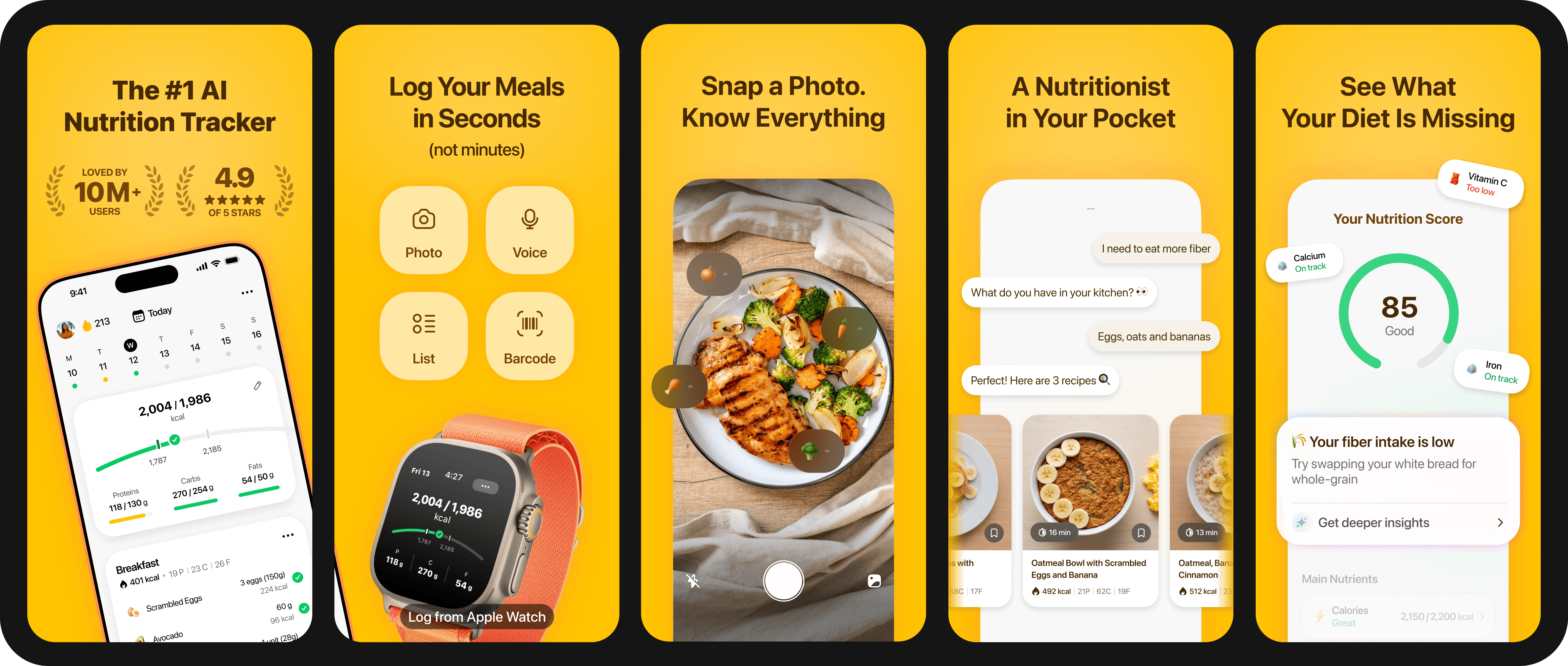
A chart hands you one number on one day. Hitting your goal means recalculating it as you lose, reading your weight trend correctly, and turning the target into actual meals every day, which is the part most people quit.
This is what Fitia handles for you. It calculates a calorie and macro target from your body and goal, then adjusts that target automatically as your weight and habits change, so you are never eating an outdated number. From there it builds personalized meal plans around your target using a nutritionist-verified food database, and lets you log food by photo, voice, or text. The daily task becomes eating the plan rather than redoing the arithmetic.
Start Fitia's free trial to get a target personalized to your body, updated as you go, with a meal plan built to match.
FAQ
How many calories should I eat to lose 1 pound a week?
About 500 calories below your maintenance level. For example, a moderately active 150-pound woman is near 1,625 calories a day and a 200-pound man near 2,375. Expect that number to fall as you lose, so recalculate rather than ride the same target to your goal.
How many calories should a woman eat to lose weight?
Most women land somewhere between 1,500 and 2,000 calories a day depending on body weight and activity, as shown in the chart above. Going below roughly 1,200 calories a day is not recommended without professional guidance.
What is the best app to calculate and track my weight-loss calories?
A chart gives you a static estimate, while an app keeps it current and turns it into meals. Fitia calculates your target, updates it automatically as your weight changes, and plans food around it with logging by photo, voice, or text, which makes it a strong fit for anyone who wants the number handled rather than recomputed by hand.
Is 1,200 calories a day too low?
For many women it is the floor, not a goal, and for men the comparable floor is around 1,500. Eating below your floor raises the risk of muscle loss and nutrient gaps, so if your target lands there, slow the pace or move more instead of eating less.
Why am I not losing weight on a calorie deficit?
Usually because the same calories stopped being a deficit. As you lose weight your maintenance falls and your metabolism adapts downward (Fothergill et al., 2016), so a target that worked in week one can sit at maintenance later on. Recalculate against your current weight and double-check your logging accuracy.
About the Author
 | Fiorella Ricardi is a licensed nutritionist from Universidad Científica del Sur, where she graduated in the top fifth of her class. She brings hands-on experience across clinical, public health, and food service nutrition. For the past two years, she has worked at Fitia as Operations Lead, focused on improving the accuracy of internal food entry data and ensuring users see correct, reliable nutritional insights inside the app. |
References
- Fothergill, E., et al. (2016). Persistent metabolic adaptation 6 years after "The Biggest Loser" competition. Obesity, 24(8), 1612-1619. https://doi.org/10.1002/oby.21538
- Frankenfield, D., Roth-Yousey, L., & Compher, C. (2005). Comparison of predictive equations for resting metabolic rate in healthy nonobese and obese adults: a systematic review. Journal of the American Dietetic Association, 105(5), 775-789. https://doi.org/10.1016/j.jada.2005.02.005
- Hall, K. D., Schoeller, D. A., & Brown, A. W. (2018). Reducing calories to lose weight. JAMA, 319(22), 2336. https://doi.org/10.1001/jama.2018.4257
- Hector, A. J., & Phillips, S. M. (2018). Protein recommendations for weight loss in elite athletes: a focus on body composition and performance. International Journal of Sport Nutrition and Exercise Metabolism, 28(2), 170-177. https://doi.org/10.1123/ijsnem.2017-0273
Related articles
 Fat Loss
Best Personalized Meal Planning App for Weight Loss in the US (2026): Comparing Apps That Plan Around Your Likes, Dislikes & Food Preferences
Compare Fitia, Eat This Much, Lifesum & Mealime on how deeply each one plans meals around your likes, dislikes, and dietary patterns for weight loss.
Read article Fat Loss
Best Calorie Deficit App to Diet Without Feeling Hungry in the US (2026): Satiety-Focused Reviews & Feature Comparison
Compare the best calorie deficit apps in the US for 2026. See which satiety features actually keep you full so you can stick to a deficit for months.
Read article Fat Loss
The 7-Day Meal Plan for Weight Loss: A Realistic First Week Toward Losing 10 Pounds
You can't lose 10 pounds in 7 days, but here's a realistic 7-day meal plan to start the process right, with the math behind a 10-week timeline.
Read article