The 7-Day Meal Plan for Weight Loss: A Realistic First Week Toward Losing 10 Pounds
You can't lose 10 pounds in 7 days, but here's a realistic 7-day meal plan to start the process right, with the math behind a 10-week timeline.
- Published
- 12 min read
- 12 min read

Table of Contents
- Can You Actually Lose 10 Pounds in 7 Days? (The Honest Answer)
- How a Healthy Calorie Deficit Works
- The 7-Day Meal Plan
- Foods to Prioritize and Foods to Limit
- How Fitia Helps You Make This Plan Stick Beyond Week 1
- FAQ
Can You Actually Lose 10 Pounds in 7 Days? (The Honest Answer)
The short answer: no, not as fat. But here's what actually happens.
One pound of body fat contains roughly 3,500 calories of stored energy. Losing 10 pounds of fat in 7 days would require a calorie deficit of 35,000 calories per week, or 5,000 calories per day.
For most adults, total daily energy expenditure is in the 1,800 to 2,500 calorie range, meaning a 5,000-calorie daily deficit is physiologically impossible without starvation-level intervention that would be neither safe nor sustainable.
What you can do in your first week is lose roughly 3 pounds on the scale, but that number is misleading because most of it isn't fat. Here's the breakdown of what actually leaves your body in Week 1 on a calorie deficit:
- Water weight: When you reduce carbohydrate intake, your body burns through stored glycogen, and each gram of glycogen holds about 3 grams of water. Reduced sodium intake from cutting processed foods also drops retained water.
- Glycogen itself: The stored carbohydrate in your muscles and liver.
- Body fat: This is the only kind of weight loss that's permanent and the only kind that matters for the 10-pound goal.
This is why almost everyone sees a dramatic Week 1 weight drop on a new diet, followed by what looks like a "plateau" in Week 2. You're not plateauing. You're just running out of water and glycogen to lose. Real fat loss continues underneath at roughly 1 to 2 pounds per week.
The realistic timeline to lose 10 pounds of actual fat on a healthy calorie deficit is 10 to 15 weeks, not 1 week.
So now that we're on the same page, here's what you'll find: a guide with a 7-day meal plan to start the process the right way, aiming for a 10-pound loss over roughly 10 weeks. But before we jump into the plan, let's start with how a calorie deficit actually works, since that's the engine behind the whole thing.
How a Healthy Calorie Deficit Works
A calorie deficit means consuming fewer calories than your body burns. The 2013 AHA/ACC/TOS Guideline for the Management of Overweight and Obesity in Adults, one of the most authoritative clinical references in the field, recommends prescribing an energy deficit of 500 to 750 calories per day for sustainable weight loss (Jensen et al., 2014). At this range, expected weekly fat loss is roughly 1 to 1.5 pounds, which is consistent with longer-term weight loss success.
How to calculate your calorie target
- Estimate your maintenance calories using the Mifflin-St. Jeor equation. A systematic review by the Academy of Nutrition and Dietetics found this equation predicts resting metabolic rate within 10% of measured values more reliably than other common equations for healthy adults (Frankenfield et al., 2005):
For women: BMR = (10 × weight kg) + (6.25 × height cm) - (5 × age) - 161
For men: BMR = (10 × weight kg) + (6.25 × height cm) - (5 × age) + 5
Then multiply BMR by your activity factor:
- Sedentary (desk job, little exercise): × 1.2
- Lightly active (light exercise 1 to 3 days/week): × 1.375
- Moderately active (exercise 3 to 5 days/week): × 1.55
- Very active (intense exercise 6 to 7 days/week): × 1.725
- Subtract 500 to 750 calories from your maintenance number. This is your target calorie intake for sustainable fat loss.
- Set a minimum floor. Clinical guidelines recommend prescribing no fewer than 1,200 to 1,500 calories per day for women and 1,500 to 1,800 calories per day for men, adjusted for body weight, to ensure adequate micronutrient intake (Jensen et al., 2014).
You may be interested in our deeper guide on how a caloric deficit actually works.
Why deeper deficits backfire
Going below the 500 to 750 calorie deficit range, often called "crash dieting," is associated with:
- Greater lean muscle loss. Faster rates of weight loss from larger deficits produce greater loss of lean body mass, and higher protein intake only partially offsets this as the deficit deepens (Hector & Phillips, 2018).
- A larger drop in resting metabolic rate. Aggressive weight loss suppresses resting metabolic rate beyond what body-composition changes alone would predict, an effect known as metabolic adaptation. In the most-cited example, participants who lost large amounts of weight rapidly showed a resting metabolic rate roughly 500 calories per day below what their body size predicted, and this adaptation persisted for years (Fothergill et al., 2016).
- Worse adherence in the first 4 to 8 weeks, which is the strongest predictor of long-term success (Höchsmann et al., 2023).
The meal plan below targets a deficit in the sustainable range, with adequate protein (which helps preserve lean muscle during a deficit) and adequate fiber (which improves satiety and reduces drop-off).
The 7-Day Meal Plan
This meal plan is designed for an average adult targeting a 1,500-calorie daily intake (suitable for most women) with adaptable portion adjustments for men or higher-activity readers (add a 200 to 300 calorie option per day, typically through larger protein portions or an extra serving of complex carbs). The plan averages:
- 130 to 150 g protein per day (preserves lean muscle)
- 25 to 30 g fiber per day (improves satiety)
- 35 to 45 g total fat per day (about a third from unsaturated sources)
- 150 to 180 g carbohydrates per day (moderate-carb, not low-carb)
Day 1
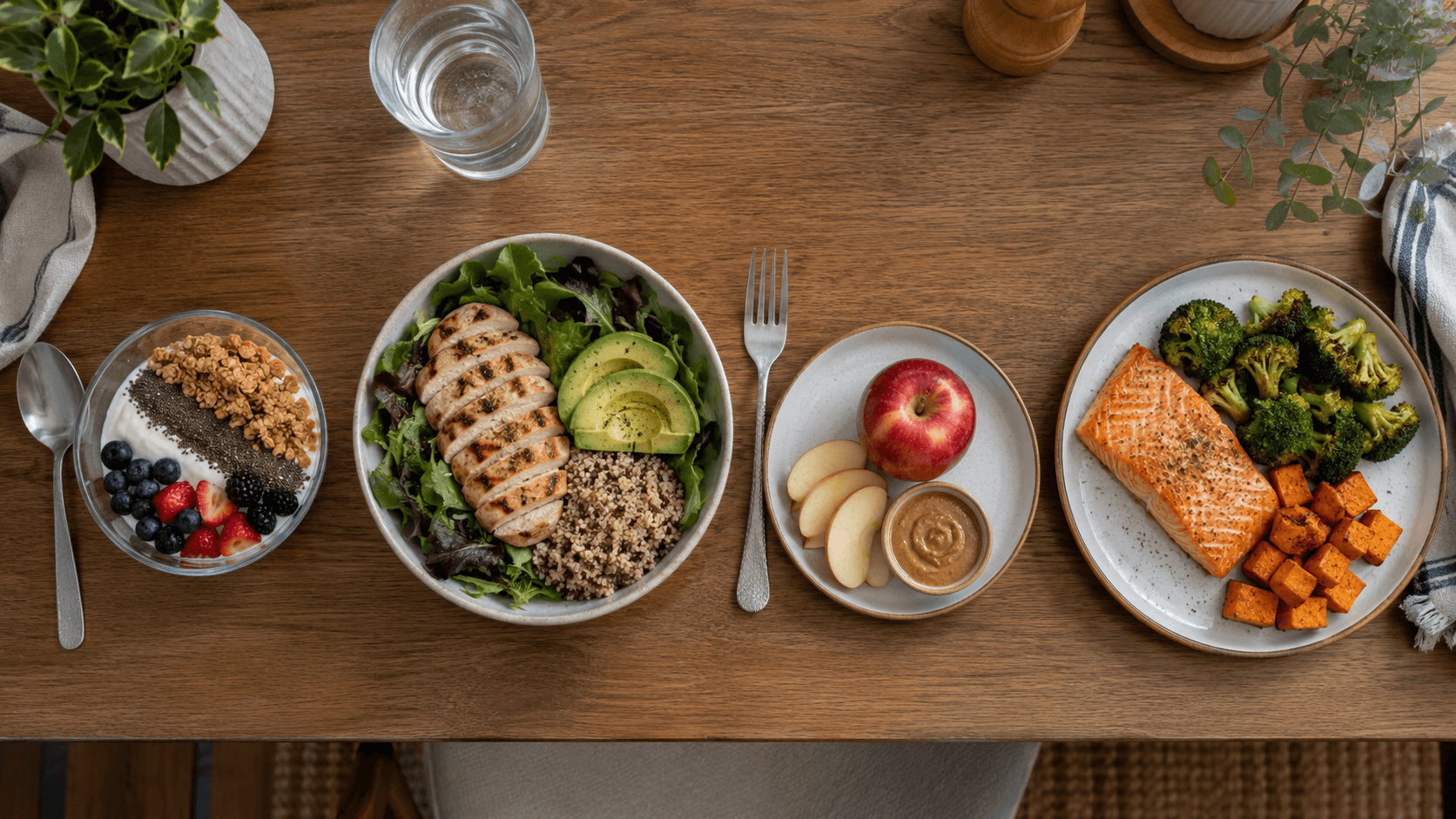
| Meal | What to eat | Calories |
|---|---|---|
| Breakfast | Greek yogurt parfait: 1 cup nonfat Greek yogurt, ½ cup mixed berries, 1 tbsp chia seeds, ¼ cup granola | 350 |
| Lunch | Grilled chicken salad bowl: 4 oz grilled chicken breast, 2 cups mixed greens, ½ avocado, ¼ cup cooked quinoa, 1 tbsp olive oil and lemon dressing | 450 |
| Snack | 1 medium apple + 1 tbsp almond butter | 200 |
| Dinner | 5 oz baked salmon, 1 cup roasted broccoli, ½ cup baked sweet potato | 500 |
| Total | ~1,500 |
Day 2
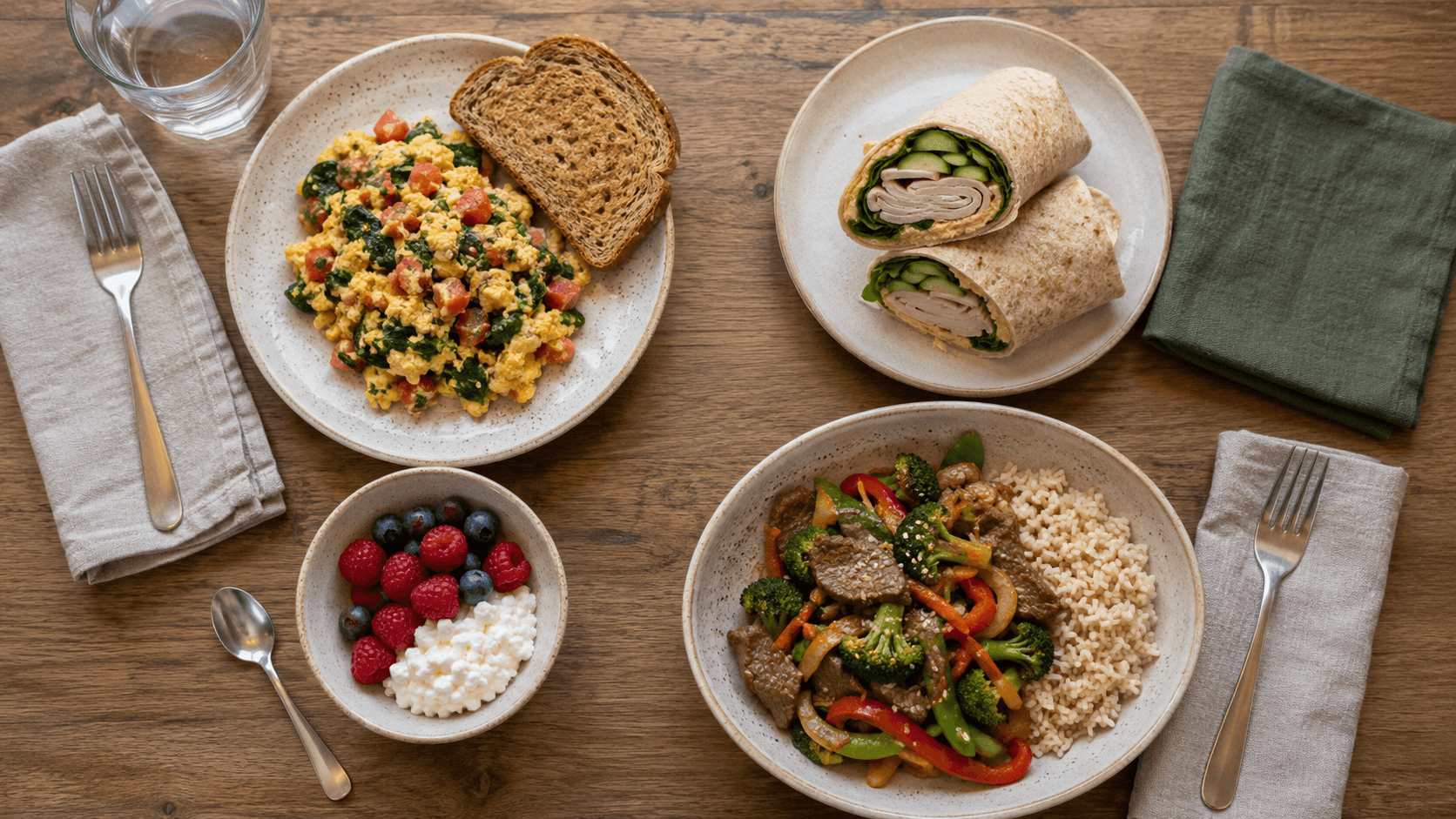
| Meal | What to eat | Calories |
|---|---|---|
| Breakfast | Veggie scramble: 3 eggs, ½ cup spinach, ¼ cup tomato, 1 slice whole-grain toast | 380 |
| Lunch | Turkey hummus wrap: whole-wheat tortilla, 3 oz turkey breast, 2 tbsp hummus, mixed greens, cucumber | 400 |
| Snack | ½ cup low-fat cottage cheese + ½ cup berries | 180 |
| Dinner | Lean beef stir-fry: 4 oz lean sirloin, 1½ cups mixed stir-fry vegetables, ½ cup brown rice, 1 tsp sesame oil | 540 |
| Total | ~1,500 |
Day 3
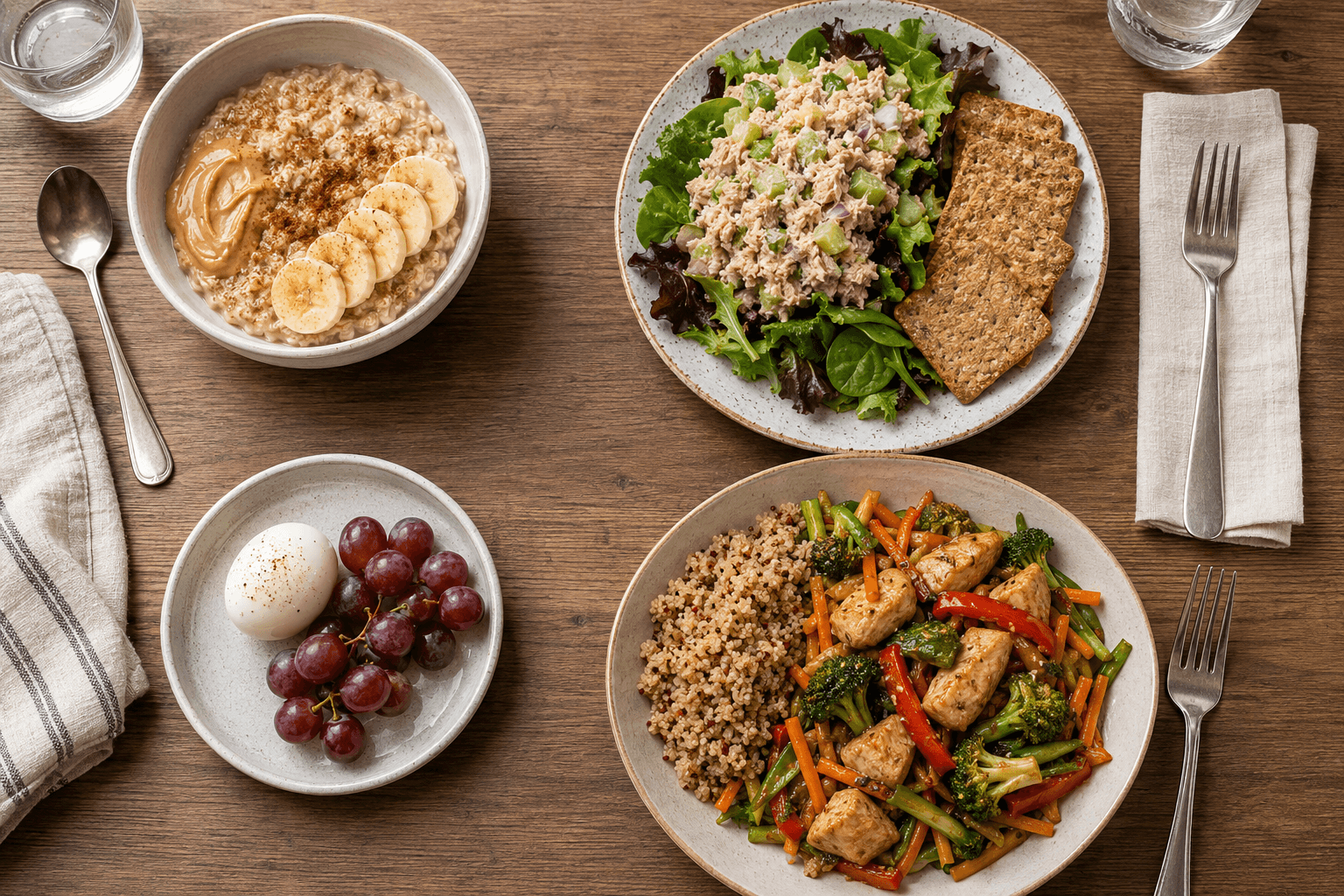
| Meal | What to eat | Calories |
|---|---|---|
| Breakfast | Oatmeal bowl: ½ cup steel-cut oats cooked, 1 tbsp peanut butter, ½ banana, cinnamon | 380 |
| Lunch | Tuna salad lunch: 1 can light tuna in water, 2 tbsp Greek yogurt (instead of mayo), ½ cup chopped celery, on 2 cups mixed greens, 6 whole-grain crackers | 380 |
| Snack | 1 hard-boiled egg + 1 cup grapes | 190 |
| Dinner | Chicken stir-fry: 4 oz chicken breast, 1½ cups mixed vegetables, ½ cup quinoa, 1 tsp sesame oil | 550 |
| Total | ~1,500 |
Day 4
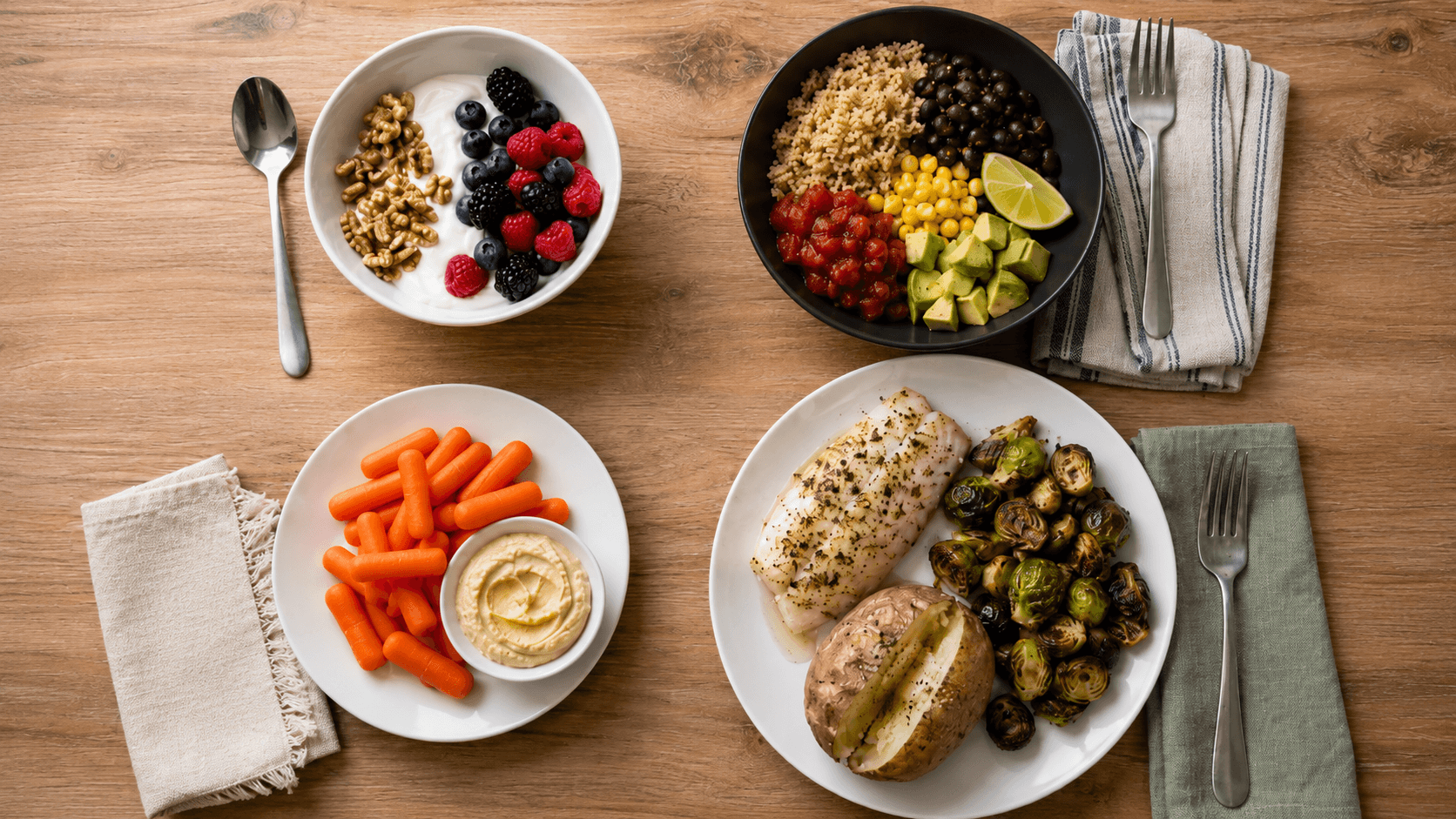
| Meal | What to eat | Calories |
|---|---|---|
| Breakfast | Greek yogurt + nuts: 1 cup nonfat Greek yogurt, ¼ cup walnuts, ½ cup berries | 380 |
| Lunch | Black bean and quinoa bowl: ½ cup quinoa, ½ cup black beans, ¼ cup corn, ¼ cup salsa, ¼ avocado, lime | 480 |
| Snack | 1 cup baby carrots + 2 tbsp hummus | 130 |
| Dinner | Baked cod (5 oz), 1 cup roasted Brussels sprouts, 1 small baked potato (4 oz), 1 tsp olive oil | 510 |
| Total | ~1,500 |
Like this meal plan? Download Fitia to get a full personalized plan in seconds, with as much or as little variety as you want, and start your free trial today.
Day 5
| Meal | What to eat | Calories |
|---|---|---|
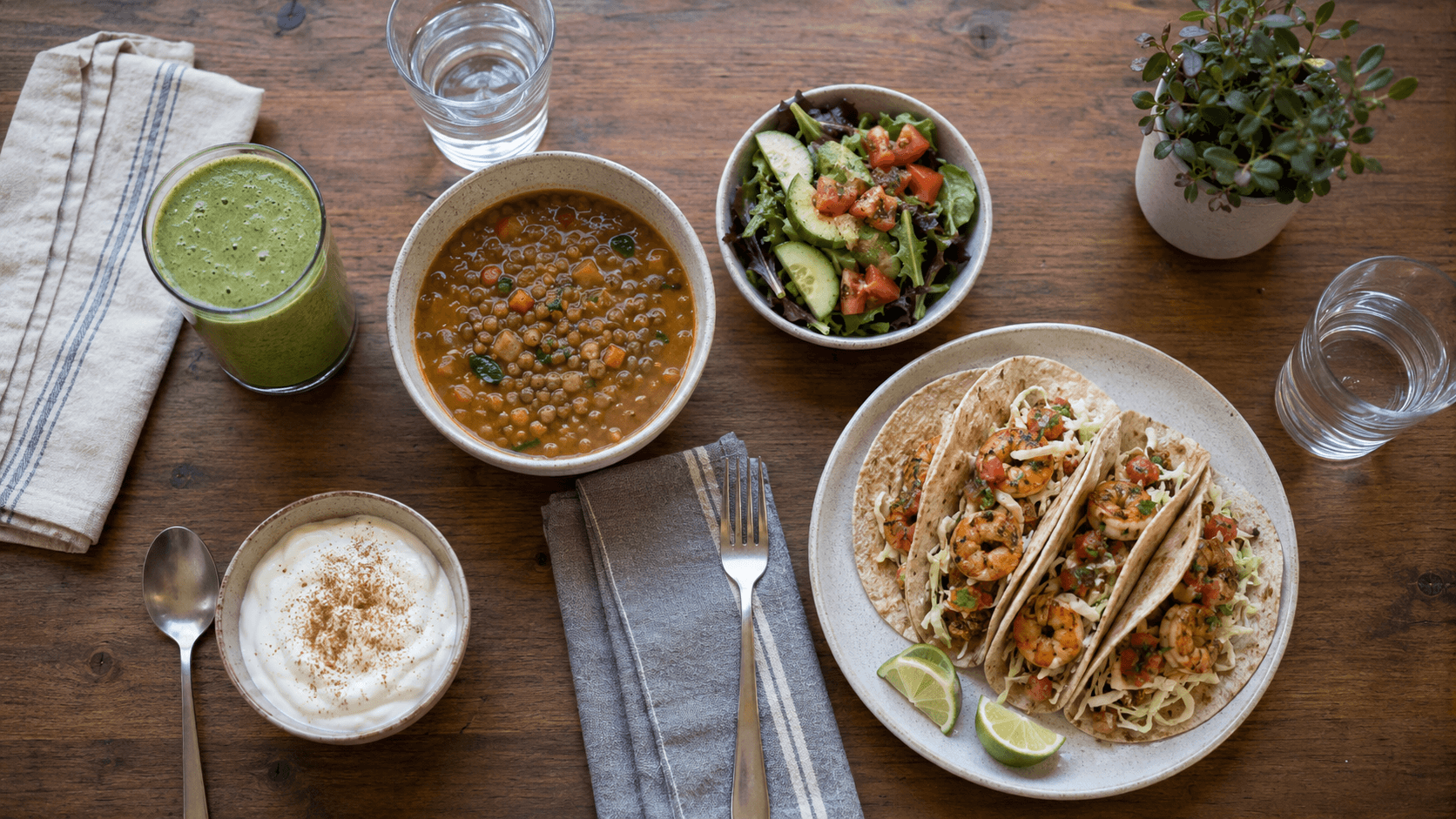
| Breakfast | Protein smoothie: 1 scoop whey or plant protein, 1 cup unsweetened almond milk, ½ banana, 1 cup spinach, 1 tbsp almond butter | 380 |
| Lunch | Lentil soup (1½ cups) + side salad (mixed greens, cucumber, tomato, 1 tsp olive oil) | 450 |
| Snack | 1 cup nonfat Greek yogurt with cinnamon | 150 |
| Dinner | Shrimp tacos: 3 small whole-wheat tortillas, 4 oz grilled shrimp, 1 cup cabbage slaw, ¼ cup pico de gallo, lime | 520 |
| Total | ~1,500 |
Day 6
| Meal | What to eat | Calories |
|---|---|---|
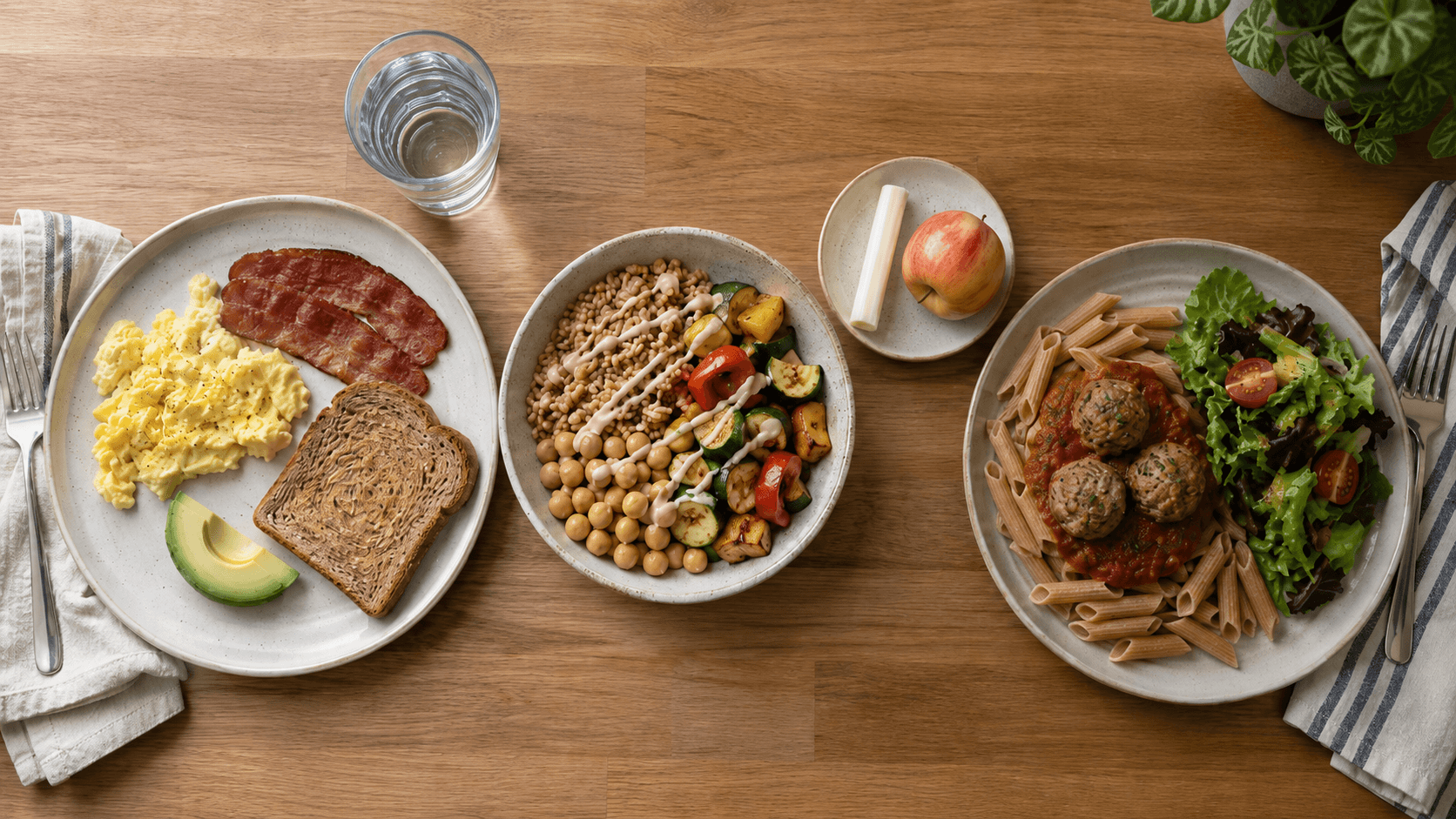
| Breakfast | 2 scrambled eggs + 2 slices turkey bacon + ¼ avocado + 1 slice whole-grain toast | 400 |
| Lunch | Grain bowl: ½ cup farro, 1 cup roasted vegetables (zucchini, bell pepper), ½ cup chickpeas, 1 tbsp tahini sauce | 480 |
| Snack | 1 string cheese + 1 small apple | 170 |
| Dinner | Whole-wheat pasta (¾ cup cooked), 3 turkey meatballs (3 oz), ½ cup marinara, side salad with 1 tsp olive oil | 470 |
| Total | ~1,500 |
Day 7
| Meal | What to eat | Calories |
|---|---|---|
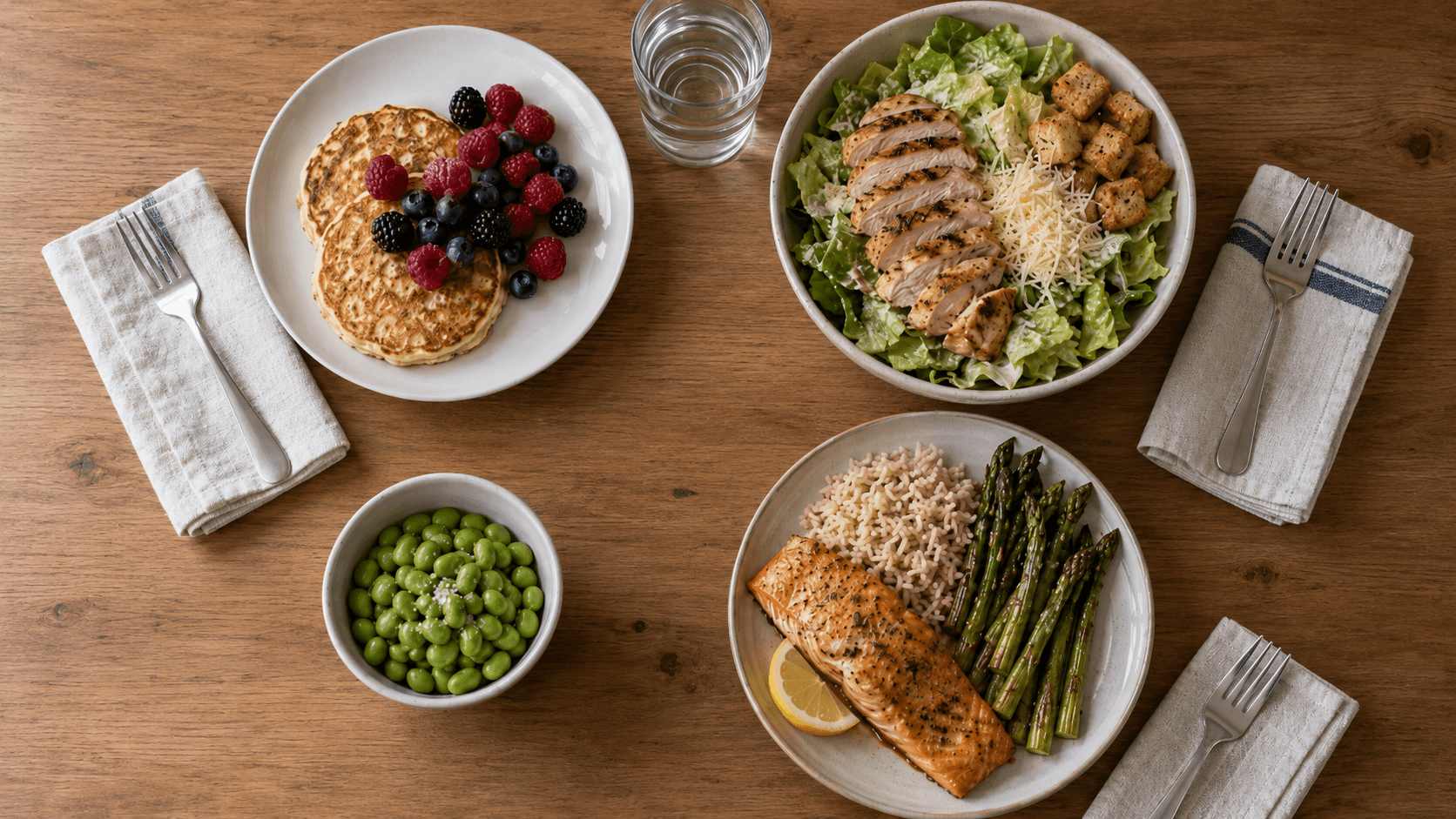
| Breakfast | Cottage cheese pancakes: 2 pancakes made with ½ cup cottage cheese + 2 eggs + ¼ cup oats batter, topped with ½ cup berries | 380 |
| Lunch | Chicken Caesar bowl: 4 oz grilled chicken, 2 cups romaine, 2 tbsp light Caesar dressing, ¼ cup parmesan, ½ cup whole-grain croutons | 420 |
| Snack | 1 cup shelled edamame with sea salt | 180 |
| Dinner | Baked salmon (5 oz), 1 cup roasted asparagus, ½ cup brown rice, lemon | 540 |
| Total | ~1,520 |
Drinks for all 7 days
- Water (aim for 64 to 96 oz per day)
- Unsweetened coffee or tea
- Sparkling water
- No sugar-sweetened beverages, no fruit juice, and limited or no alcohol (alcohol is a particularly high-leverage cut for fat loss, since it carries 7 calories per gram with no nutritional value and is independently associated with central adiposity)
Foods to Prioritize and Foods to Limit
The meal plan above is built around the food categories most consistently linked to weight loss in peer-reviewed research.
Prioritize
- Lean protein: chicken, turkey, fish, eggs, Greek yogurt, cottage cheese, tofu, lentils, beans
- High-fiber carbohydrates: oats, quinoa, brown rice, sweet potato, beans, lentils
- Non-starchy vegetables: leafy greens, broccoli, cauliflower, peppers, asparagus, Brussels sprouts
- Unsaturated fats: olive oil, avocado, nuts, seeds, fatty fish
- Whole fruits: berries, apples, pears, citrus
You may be interested in our deeper guide on the best foods for weight loss.
Limit
- Sugar-sweetened beverages: soda, sweetened iced tea, sports drinks, sweetened coffee drinks, fruit juice
- Added sugars: the American Heart Association recommends no more than 25 g added sugar/day for women and 36 g for men
- Refined carbohydrates: white bread, white pasta, white rice, pastries
- Trans fats and excess saturated fats: processed meats, fried foods, packaged baked goods
- Alcohol: 7 cal/gram with no nutritional value, and a 2026 Oxford Biobank study of 5,761 DXA-measured participants found alcohol is dose-dependently associated with greater visceral fat mass, even after adjusting for total fat mass (Chesters et al., 2026)
How Fitia Helps You Make This Plan Stick Beyond Week 1
The 7-day meal plan above gets you started. The 10-pound goal takes 10 to 15 weeks of consistent execution, which means the real question isn't "what should I eat this week?" but "how do I keep eating this way for 3 months?"
Three things separate people who hit the 10-pound mark from people who quit early:
1. Adaptive calorie targets. As you lose weight, your maintenance calorie level drops too. The 1,500-calorie target that produced a deficit in Week 1 may only produce maintenance by Week 8. People who quit usually do so because the diet "stopped working." It didn't stop working; their calorie target needed to come down by 100 to 200 calories. Static calculators don't recalibrate. The Fitia algorithm does this automatically, adjusting your calorie and macro target based on your actual weight trend so the deficit holds.
2. Logging support for when meals don't match the plan. Real life includes restaurant meals, social events, work travel, and weekends. Apps that let you log unplanned meals through photo, voice, or barcode (Fitia supports all three, plus text, manual search, and meal-plan check-off) keep you in the deficit even when you can't follow the plan exactly.
3. A verified database, not crowd-sourced. Even a consistent calorie undercount of 20 to 30% adds up over 10 weeks, and can be the difference between steady fat loss and stalling out. Verified-database apps like Fitia give you the accuracy that user-generated databases like MyFitnessPal and Lose It! consistently underdeliver in peer-reviewed validation (Morello et al., 2025; Banal et al., 2024; Fallaize et al., 2019).
Start your free Fitia trial to get a personalized meal plan calibrated to your specific calorie and macro target, with adaptive recalibration as you progress.
FAQ
How long does it really take to lose 10 pounds?
For most adults on a sustainable 500 to 750 calorie daily deficit, losing 10 pounds of actual body fat takes 10 to 15 weeks. The scale can drop about 3 pounds in the first week from water weight and glycogen, but that isn't sustained fat loss. Aiming for 1 to 2 pounds of fat loss per week is the timeline associated with long-term success in peer-reviewed research.
Is 1,500 calories a day enough?
For most adult women aiming for moderate weight loss, 1,500 calories per day produces a deficit in the recommended 500 to 750 calorie range. For most men, the equivalent target is typically 1,800 to 2,000 calories. The Academy of Nutrition and Dietetics recommends not eating below 1,200 calories (women) or 1,500 calories (men) without medical supervision, to ensure adequate micronutrient intake.
What if I don't lose weight in Week 1?
A few possibilities: you may be in a smaller deficit than expected (calorie estimates are often off by 20 to 30%), you may have started the week retaining water (high salt, intense exercise, menstrual cycle), or scale weight may have fluctuated up on weigh-in day. Check three things: (1) are you tracking accurately against a verified database; (2) are you actually under your maintenance calorie level; (3) is this a weigh-in day issue, not a weekly trend? Most people who don't lose in Week 1 do lose in Week 2.
Can I drink alcohol on a calorie deficit meal plan?
You can, but alcohol is a particularly high-leverage cut for fat loss. It carries 7 calories per gram with no nutritional value and is independently associated with greater visceral fat accumulation, even after adjusting for total fat mass (Chesters et al., 2026). If reducing belly fat is part of the 10-pound goal, eliminating or significantly reducing alcohol intake during the deficit phase produces faster results.
Do I need to exercise to lose 10 pounds?
Diet alone can reduce body fat. However, the combination of dietary changes plus resistance training is more effective at preserving lean muscle mass during the deficit, which protects your resting metabolic rate and supports more sustainable results (Hector & Phillips, 2018). For most people, the combination of a calorie-deficit meal plan plus 2 to 3 resistance training sessions and 150 minutes of moderate cardio per week is the most efficient combination.
References
- Jensen, M. D., Ryan, D. H., Apovian, C. M., et al. (2014). 2013 AHA/ACC/TOS Guideline for the Management of Overweight and Obesity in Adults. Circulation, 129(25 Suppl 2), S102–S138. https://doi.org/10.1161/01.cir.0000437739.71477.ee
- Frankenfield, D., Roth-Yousey, L., & Compher, C. (2005). Comparison of predictive equations for resting metabolic rate in healthy nonobese and obese adults: a systematic review. Journal of the American Dietetic Association, 105(5), 775–789. https://doi.org/10.1016/j.jada.2005.02.005
- Hector, A. J., & Phillips, S. M. (2018). Protein recommendations for weight loss in elite athletes: a focus on body composition and performance. International Journal of Sport Nutrition and Exercise Metabolism, 28(2), 170–177. https://doi.org/10.1123/ijsnem.2017-0273
- Fothergill, E., Guo, J., Howard, L., et al. (2016). Persistent metabolic adaptation 6 years after "The Biggest Loser" competition. Obesity, 24(8), 1612–1619. https://doi.org/10.1002/oby.21538
- Höchsmann, C., Dorling, J. L., Apolzan, J. W., et al. (2023). Initial weight loss and early intervention adherence predict long-term weight loss during the Promoting Successful Weight Loss in Primary Care in Louisiana lifestyle intervention. Obesity, 31(7), 1735–1745. https://doi.org/10.1002/oby.23854
- American Heart Association. (2024). How Much Sugar Is Too Much? heart.org. https://www.heart.org/en/healthy-living/healthy-eating/eat-smart/sugar/how-much-sugar-is-too-much
- Chesters, J., Neville, M. J., & Karpe, F. (2026). Greater visceral fat mass accumulation with high alcohol consumption. International Journal of Obesity. https://doi.org/10.1038/s41366-026-02030-5
- Morello, A. L., Ouellette, M. M., Hyder, M., et al. (2025). Comparing the nutrient analyses of MyFitnessPal and Cronometer with a research-standard reference method for dietary assessment. Journal of Human Nutrition and Dietetics. https://doi.org/10.1111/jhn.70148
- Banal, R. P., Maramba, J. J., Vendiola, A. F., et al. (2024). Comparison of MyFitnessPal app calorie and macronutrient estimates with a research-grade method among Filipino adults. BMJ Nutrition, Prevention & Health. https://doi.org/10.1136/bmjnph-2023-000770
- Fallaize, R., Forster, H., Macready, A. L., et al. (2019). Online dietary intake estimation: reproducibility and validity of the Food4Me food frequency questionnaire against a 4-day weighed food record. JMIR mHealth and uHealth, 7(2), e9838. https://doi.org/10.2196/mhealth.9838
Related articles
 Fat Loss
Weight Loss Calorie Chart (2026): How Many Calories to Eat by Body Weight, Sex, and Activity
See how many calories to eat to lose weight, with simple charts by body weight and activity, plus why your target changes as you go.
Read article Fat Loss
Best Personalized Meal Planning App for Weight Loss in the US (2026): Comparing Apps That Plan Around Your Likes, Dislikes & Food Preferences
Compare Fitia, Eat This Much, Lifesum & Mealime on how deeply each one plans meals around your likes, dislikes, and dietary patterns for weight loss.
Read article Fat Loss
Best Calorie Deficit App to Diet Without Feeling Hungry in the US (2026): Satiety-Focused Reviews & Feature Comparison
Compare the best calorie deficit apps in the US for 2026. See which satiety features actually keep you full so you can stick to a deficit for months.
Read article