
Oct 11, 2024
Caloric Surplus: What It Is and How to Achieve It
If you're aiming to build muscle, you've probably been told to significantly increase your food intake, especially focusing on protein and carbs.
While there's some truth to this advice, it's an oversimplified approach to achieving what’s known as a caloric surplus. This can also lead to misunderstandings that might result in outcomes that fall short of your expectations.
That’s why in this article, we’ll dive deeper into what a caloric surplus really means and how to implement it correctly, based on the latest scientific evidence. This way, you’ll be able to reach your muscle-building goals within a reasonable timeframe.
Ready to turn theory into practice? Get a personalized nutrition plan to achieve a proper caloric surplus with Fitia app. Download it for free here.
👉 You might be interested in: 10 Foods to Gain Weight
What Is a Caloric Surplus?
Every day, our body carries out a wide range of essential internal processes that are key to our survival and overall well-being. These include everything from regulating our respiratory and cardiovascular systems to activating our muscles for tasks like doing curls in the squat rack.
All of these processes require a significant amount of energy, which is produced from the macronutrients we consume—proteins, carbohydrates, and fats—or drawn from our glycogen and fat stores.
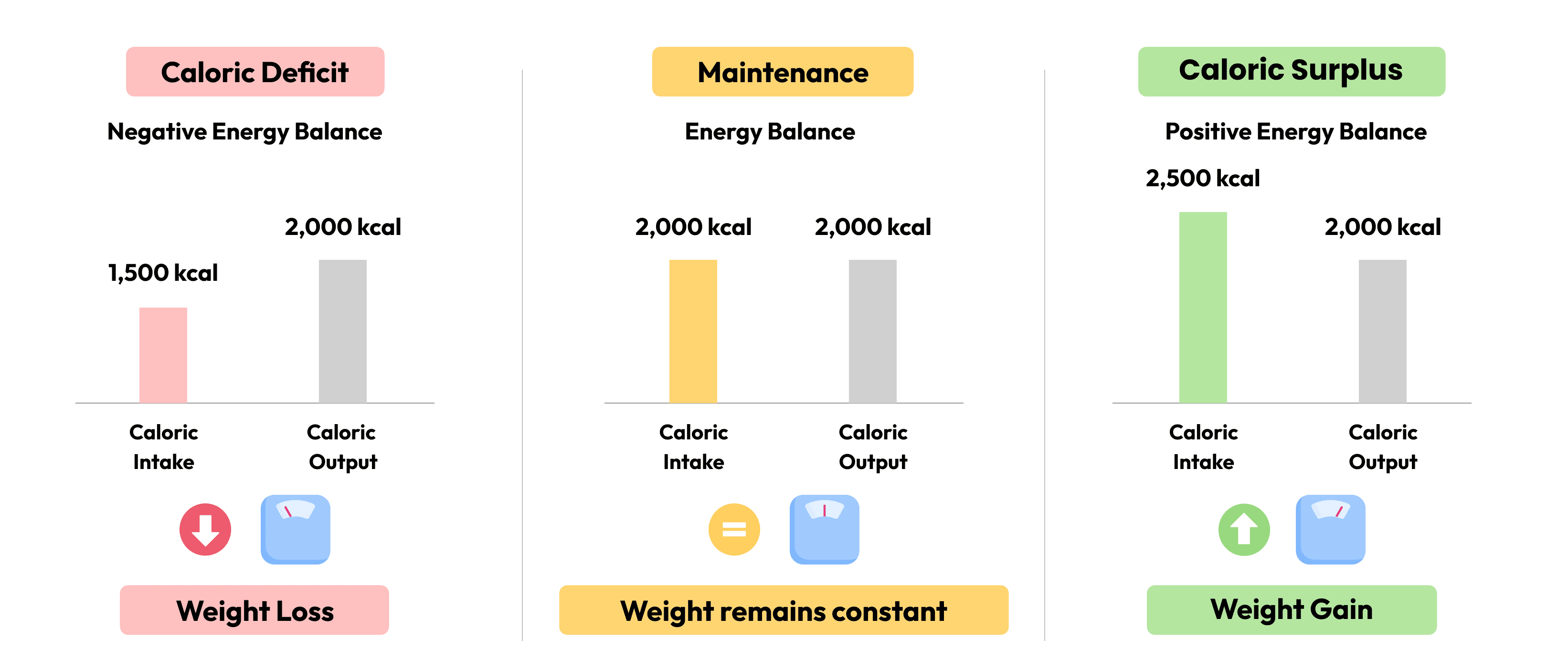
This constant flow of calorie consumption and expenditure (which we usually measure in kilocalories or kcal) determines our energy balance. It will be negative if we consume fewer kilocalories than our body burns, neutral if we consume about the same amount as we burn, and positive if we consume more kilocalories than our body needs to carry out all its required functions.
When this energy balance is negative, we are in a caloric deficit. Conversely, when it’s positive, we are in a caloric surplus.
What Is a Caloric Surplus For?
Now that you know what a caloric surplus is, it's important to understand its specific purpose.
When you consume more calories than you burn, the excess energy will be used by your body in different ways depending on these factors:
- Without strength training: If you're not stimulating your muscles, meaning you're not doing strength training, the extra calories will be stored as fat.
- With strength training: In the context of training and muscle building, a controlled caloric surplus helps you gain muscle mass. It provides the energy and nutrients needed for muscle recovery and growth.
But here’s a key question: Is a caloric surplus the only way to gain muscle? It's not the only way, but in some cases, it may be the most effective. Let’s explain this in more detail below.
Is a Caloric Surplus Necessary to Gain Muscle?
The suitability of being in a caloric surplus mainly depends on two factors: an individual’s training level and body fat percentage.
Scientific literature has shown that individuals who are overweight or obese, and have less training experience, can build muscle even in a caloric deficit. Similarly, in more experienced lifters, body recomposition—simultaneously losing fat and gaining muscle—has been observed, even when consuming maintenance calories or in a caloric deficit.
However, as the magnitude of a caloric deficit increases or its duration extends, building muscle becomes more challenging. In fact, it's well known that a significant caloric deficit reduces our ability to synthesize new muscle proteins (which are essential for muscle growth). For individuals with lower body fat, it’s also likely that protein breakdown in the body will intensify, tipping the hypertrophy balance to the negative side of the equation.
Therefore, if you’re a beginner with a higher amount of body fat than ideal, it wouldn’t be necessary to aim for a caloric surplus.
In this case, it’s preferable to prioritize a consistent strength training program (one that allows you to progressively increase weights or repetitions week by week without causing excessive fatigue) and ensure an adequate protein intake (there’s a recommended range we’ll cover later).
Additionally, you can adjust your calorie intake based on your levels of satiety. Use the following image as a reference. Your goal should be to stay within the blue range of the scale, with occasional touches on the yellow edges (numbers 8 and 3).
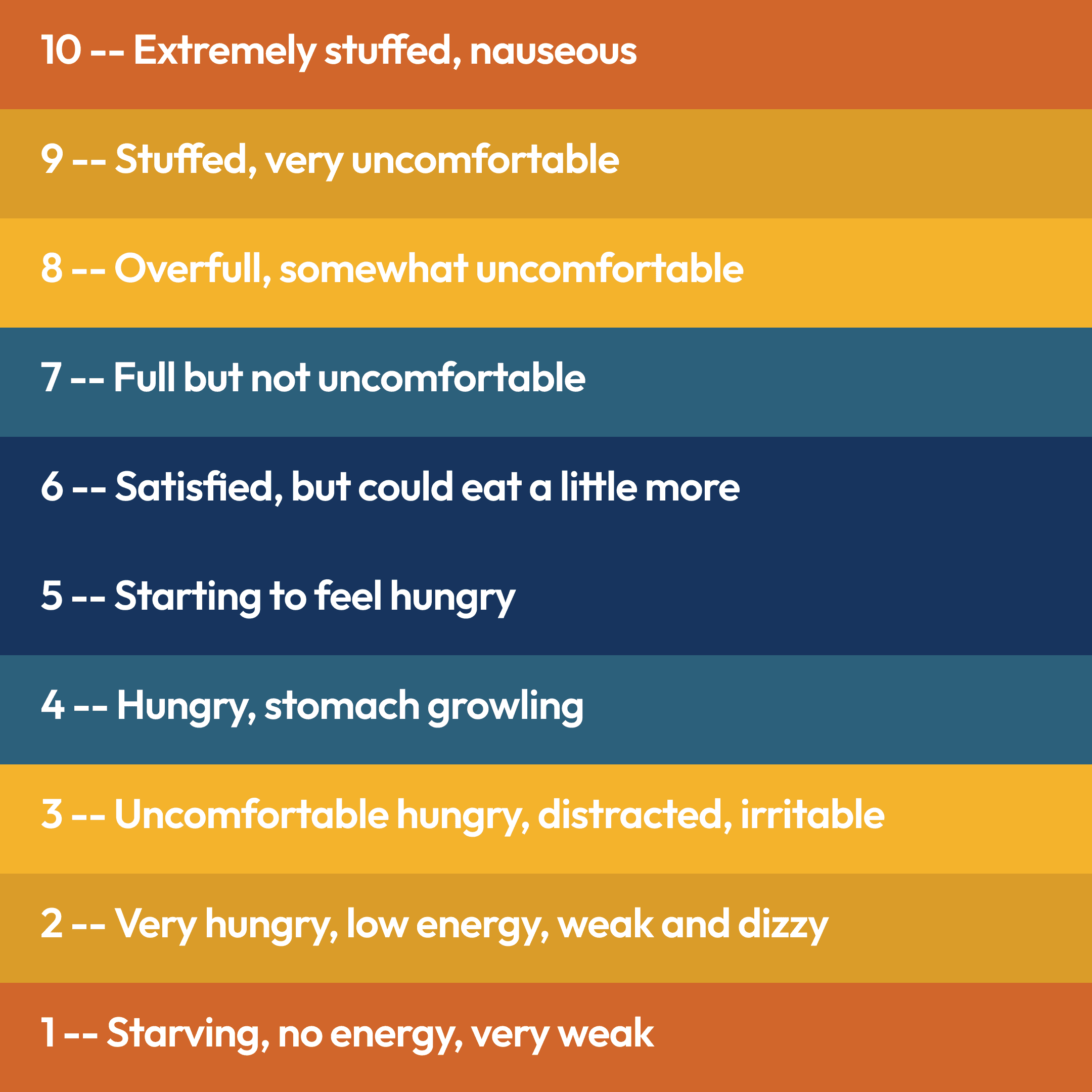
Adapted from: Berkeley University Health Services. The Hunger-Satiety Scale. https://uhs.berkeley.edu/sites/default/files/wellness-hungersatietyscale.pdf
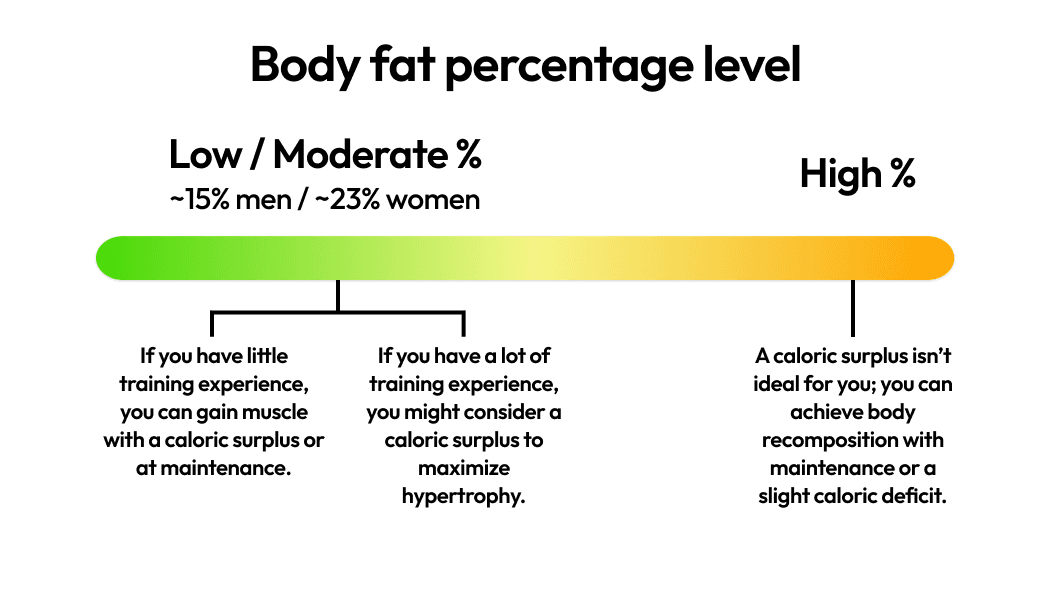
On the other hand, if you have experience in the gym and a low to moderate body fat percentage (around 15% for men and 23% for women), the best approach would be to maintain a neutral energy balance or aim for a caloric surplus to maximize the hypertrophic stimulus from your training.
Lastly, beginner lifters with a low body fat percentage can also choose to follow a caloric surplus or remain at maintenance. However, for advanced lifters with higher body fat percentages, the decision to pursue a caloric surplus will depend on the demands of their sport and personal goals. For example, it’s not uncommon for professional strongmen, strongwomen, and powerlifters to prioritize weight gain, even with body fat percentages higher than those mentioned here.
How to Calculate a Caloric Surplus?
Starting Point: TDEE (Total Daily Energy Expenditure)
As we mentioned earlier, when you consume roughly the same number of calories as your body uses, your energy balance is neutral. This state is called "maintenance", meaning you’re consuming enough calories to meet your Total Daily Energy Expenditure (TDEE).
At maintenance, your weight will remain stable over time, with slight fluctuations due to natural physiological changes.
The first step in calculating your caloric needs for a surplus is to get an initial estimate of your TDEE. Here are three options to help you calculate it:
- Online TDEE Calculator: This tool uses your weight, age, height, and activity level to estimate your TDEE. You can also input your body fat percentage for a more accurate result.
- Manual Calculation: We have a detailed article that walks you through calculating your TDEE manually 👉 Caloric Deficit: What Is It and How to Achieve It.
- Multiply 33 kcal by your body weight in kg: This is the simplest option, but also the least accurate. It works better for individuals under 70 kg, but the calculation becomes less precise as body weight approaches 90 kg or more.
Don’t have time to calculate your energy requirements? Let the Fitia app handle the complex calculations so you can focus on enjoying your nutrition. Start here.
How Many Additional Calories to Consume Above TDEE and How Fast to Progress in a Caloric Surplus?
Science shows that the size of the recommended caloric surplus and the rate of weight gain depend on how close a person is to their genetic potential. In other words, beginners and intermediate lifters can build muscle faster and tolerate a larger caloric surplus without gaining excessive body fat.
On the other hand, advanced lifters who are closer to their genetic potential should follow a moderate caloric surplus and aim for a slower rate of progress. While they can still build muscle, they are at a higher risk of gaining excess body fat with an aggressive caloric surplus.
With that in mind, follow these recommendations based on your training experience:
If you're a beginner or intermediate:
- Consume an additional +10-20% of your maintenance calories or TDEE.
- Aim to progress at a rate of 0.25% to 0.5% of your body weight per week.
- Example: A beginner or intermediate weighing 85 kg with an estimated TDEE of 2,817 kcal can consume an extra 280 to 560 kcal to achieve an appropriate caloric surplus. They should also aim to gain 0.2 to 0.4 kg of body weight per week.
If you're advanced:
- Consume an additional +5-10% of your maintenance calories or TDEE.
- Aim to progress at a rate of 0.25% of your body weight per week.
- Example: An advanced lifter weighing 85 kg with an estimated TDEE of 3,135 kcal can consume an extra 155 to 315 kcal to achieve an appropriate caloric surplus. They should aim to gain around 0.2 kg of body weight per week.
How to Distribute Macronutrients in a Caloric Surplus?
By macronutrients, we mean proteins, fats, and carbohydrates. Every food we consume provides a specific distribution of these nutrients, generating the energy our body needs.
- Each gram of protein provides 4 kcal.
- Each gram of carbohydrate also provides 4 kcal.
- Each gram of fat provides 9 kcal.
When it comes to macronutrient distribution in a caloric surplus, the recommendations are the same for both beginners and advanced lifters. Using the following ranges, you can calculate the daily amount of each macronutrient needed to meet your energy goals and adjust the values according to your needs:
- Proteins: 1.6 g to 2.2 g per kg of body weight
- Fats: 0.5 g to 1.5 g per kg of body weight
- Carbohydrates: Fill in the remaining calories (usually, this will be between 3 g to 5 g per kg of body weight, or slightly more)
Example: If a 85 kg weightlifter needs to consume 3,350 kcal to be in a caloric surplus, they can distribute their macronutrients as follows:
- Proteins:
- The lifter chooses the upper end of the range, consuming 2.2 g of protein per kg of body weight.
- Total: 85 kg × 2.2 g = 187 g of protein per day.
- Calories from protein: 187 g × 4 kcal = 748 kcal.
- Fats:
- The lifter opts for the middle of the recommended range, consuming 1 g of fat per kg of body weight.
- Total: 85 kg × 1 g = 85 g of fat per day.
- Calories from fat: 85 g × 9 kcal = 765 kcal.
- Carbohydrates:
- After adding the calories from protein and fat (748 kcal + 765 kcal = 1,513 kcal), the lifter has 1,837 kcal left to meet the daily goal.
- Divide the remaining calories by 4 kcal per gram to determine the carbohydrate intake:
1,837 kcal ÷ 4 kcal = 459 g of carbohydrates.
It’s important to note the following points:
- These values are initial estimates and should be adjusted over the first few weeks to stay within the recommended rate of weight gain.
- As your body weight increases weekly, the macronutrient values will need to be adjusted accordingly to ensure continued progress.
Summary Table
In the table below, you'll find a summary of all the recommendations from this section:
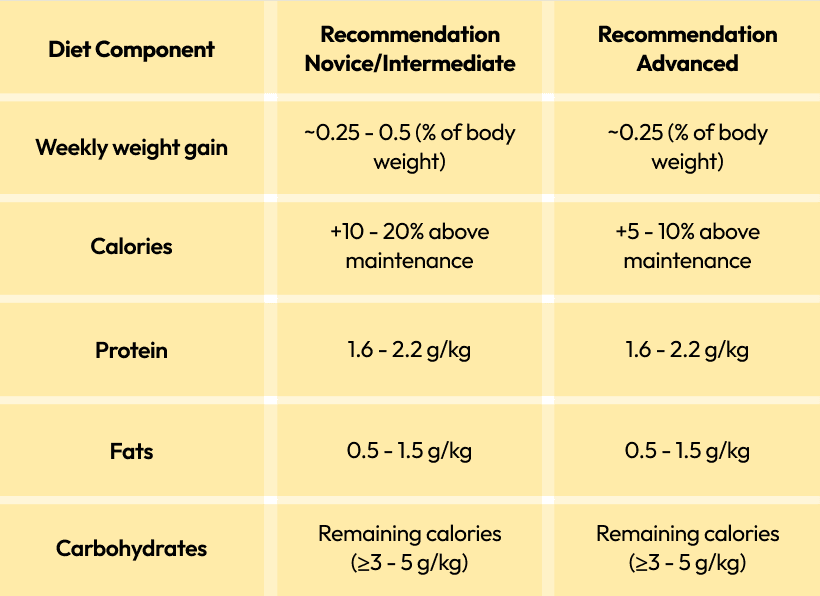
Adapted from Iraki et al. PMID: 31247944
Some Tips for Maintaining a Caloric Surplus
- Weighing and Monitoring: Remember, the calorie and macronutrient values provided in this article are just an initial estimate and will likely need weekly adjustments based on fluctuations in your body mass. Therefore, it's crucial to monitor your weight consistently (daily or every other day) to validate those adjustments.We recommend taking these measurements at the same time each day, ideally in the morning after waking up, using the bathroom, and before eating. Since weight can fluctuate daily, it's best to calculate your weekly average to accurately identify your weight trend.
Did you know that Fitia allows you to log your weight and measurements routinely? The app automatically adjusts your daily requirements based on your progress. Download it here.
- Meal Frequency: The recommended range for daily meals to support hypertrophy and maintain muscle mass is 3 to 6 meals, distributed proportionally. Scientific evidence suggests there is no significant difference between the minimum or maximum of this range, so the exact frequency depends on personal preference. However, it’s important to ensure you consume at least 0.24g/kg of protein at three different times throughout the day.
- Struggling to Gain Weight? If you're having trouble with a lack of appetite and can't consistently gain weight, try these strategies:
- Drink liquid calories.
- Include snacks between main meals.
- Choose higher-calorie-dense foods.
- Occasionally eat hyper-palatable meals.
- Prioritize softer-textured foods.
- Add condiments to your meals.
References
References
- Helms ER, Spence AJ, Sousa C, Kreiger J, Taylor S, Oranchuk DJ, Dieter BP, Watkins CM. Effect of Small and Large Energy Surpluses on Strength, Muscle, and Skinfold Thickness in Resistance-Trained Individuals: A Parallel Groups Design. Sports Med Open. 2023 Nov 2;9(1):102. doi: 10.1186/s40798-023-00651-y. PMID: 37914977; PMCID: PMC10620361.
- Slater GJ, Dieter BP, Marsh DJ, Helms ER, Shaw G, Iraki J. Is an Energy Surplus Required to Maximize Skeletal Muscle Hypertrophy Associated With Resistance Training. Front Nutr. 2019 Aug 20;6:131. doi: 10.3389/fnut.2019.00131. PMID: 31482093; PMCID: PMC6710320.
- Barakat, Christopher MS, ATC, CISSN1; Pearson, Jeremy MS1; Escalante, Guillermo DSc, MBA, ATC, CSCS, CISSN2; Campbell, Bill PhD, CSCS, FISSN3; De Souza, Eduardo O. PhD1. Body Recomposition: Can Trained Individuals Build Muscle and Lose Fat at the Same Time?. Strength and Conditioning Journal 42(5):p 7-21, October 2020. | DOI: 10.1519/SSC.0000000000000584
- Murphy C, Koehler K. Energy deficiency impairs resistance training gains in lean mass but not strength: A meta-analysis and meta-regression. Scand J Med Sci Sports. 2022 Jan;32(1):125-137. doi: 10.1111/sms.14075. Epub 2021 Oct 13. PMID: 34623696.
- Murphy C, Koehler K. Energy deficiency impairs resistance training gains in lean mass but not strength: A meta-analysis and meta-regression. Scand J Med Sci Sports. 2022 Jan;32(1):125-137. doi: 10.1111/sms.14075. Epub 2021 Oct 13. PMID: 34623696.
- Carbone JW, Pasiakos SM, Vislocky LM, Anderson JM, Rodriguez NR. Effects of short-term energy deficit on muscle protein breakdown and intramuscular proteolysis in normal-weight young adults. Appl Physiol Nutr Metab. 2014 Aug;39(8):960-8. doi: 10.1139/apnm-2013-0433. Epub 2014 Jun 19. PMID: 24945715.
- Berkeley University Health Services. The Hunger-Satiety Scale. 2024 https://uhs.berkeley.edu/sites/default/files/wellness-hungersatietyscale.pdf
- TDEE Calculator. Learn How Many Calories You Burn Every Day. 2024. https://tdeecalculator.net/
- Iraki J, Fitschen P, Espinar S, Helms E. Nutrition Recommendations for Bodybuilders in the Off-Season: A Narrative Review. Sports (Basel). 2019 Jun 26;7(7):154. doi: 10.3390/sports7070154. PMID: 31247944; PMCID: PMC6680710.
- Appleby B, Newton RU, Cormie P. Changes in strength over a 2-year period in professional rugby union players. J Strength Cond Res. 2012 Sep;26(9):2538-46. doi: 10.1519/JSC.0b013e31823f8b86. PMID: 22076095.
- Taguchi M, Hara A, Murata H, Torii S, Sako T. Increasing Meal Frequency in Isoenergetic Conditions Does Not Affect Body Composition Change and Appetite During Weight Gain in Japanese Athletes. Int J Sport Nutr Exerc Metab. 2021 Mar 1;31(2):109-114. doi: 10.1123/ijsnem.2020-0139. Epub 2020 Dec 25. PMID: 33361498.
Fitia: Meal Plans & Calorie Counter
We use cookies to enhance your browsing experience, analyze site traffic, and personalize content. By clicking 'Accept', you consent to the use of these technologies in accordance with our Privacy Policy.